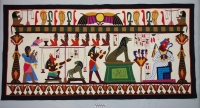
Beyond The Chador Regional Dress From Iran
7. Woven textiles
A variety of woven textiles have been produced in Central Asia, ranging from simple tabby weaves made on ground looms, to sophisticated brocades and velvets produced on variations of drawstring looms. In addition, carpet weaving and tablet weaving are practiced in some parts of Central Asia.
Tabby and twill weaves
Afghanistan, for example, is known for the production of tabby weave textiles in a variety of forms, including even weave, (warp-) faced weaves, and twill weaves (associated with men’s blankets). These are used for both undecorated and decorated textiles, with stripes being especially popular. Green and purple striped cloth, for example, has been traditionally woven in the north of Afghanistan for the production of the long-sleeved coats known as chapans, which were made famous by the former president of Afghanistan, Hamid Karzai. Other regions also produced these sort of textiles, including Uzbekistan and Tajikistan.
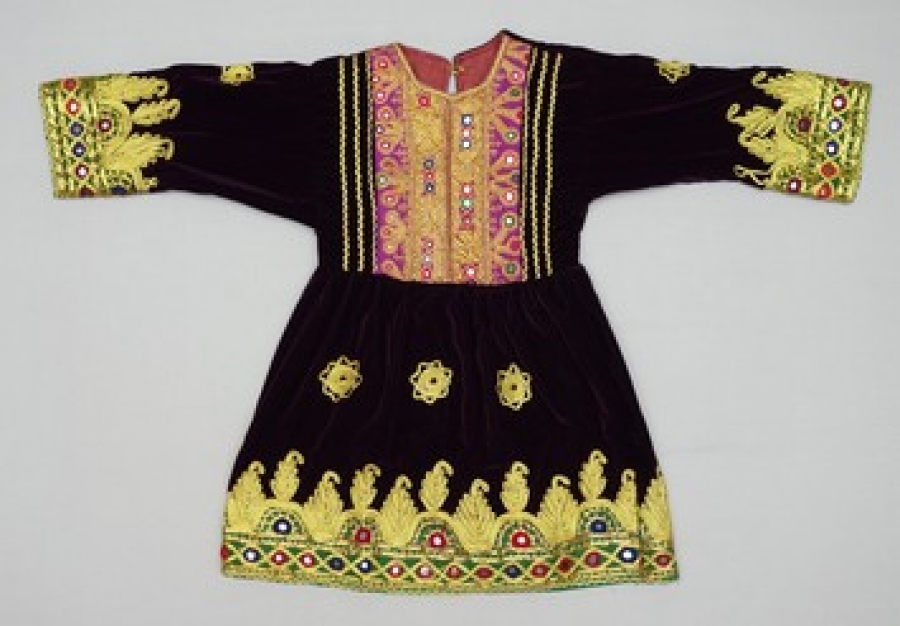
 Uzbek woman's brocaded dress in orange silk. TRC 2011.0470. For further information, click on the illustration.Brocade weaves
Uzbekistan, especially the cities of Bokhara and Samarkand, were until comparatively recently major producers of a wide range of brocade textiles, especially in silk, which were used for garments such as men and women’s coats, robes and dresses, as well as for soft furnishings of various types.
Velvet weaves
Uzbekistan has also long been famous for the production of silk velvet textiles that were used for the garments worn by elite men and women, as well as for cushions, covers, and wall-hangings for decorating palaces, homes and tents. Sometimes silk velvets were decorated using an ikat technique, creating a very rich and decorative textile that was very expensive.
Tablet weaving
Card or tablet weaving also occurs in some parts of Central Asia, most notably in Uzbekistan, where narrow bands are sewn onto the edges of some caps, as well as being used for the straps of bags, etc.
 Bicycle or motor bike saddle covering made from a freshly woven carpet, decorated with fringes. Kabul, Afghanistan, late 20th century. TRC 2016.1864. For more information click on the illustration.Pile carpets
Central Asia is also known for the production of pile carpets of many different types, colours and designs. Some of these carpets now sell for hundreds of thousands of euros. But there is also another form of carpet that is popular, especially in Afghanistan, namely bike carpets. These are small, woven to shape covers for bicycle and motorbike saddles. They come in a variety of sizes, but are generally made from wool with beaded tassels, and have similarly woven designs to their larger ‘cousins’.

9. Painted and printed textiles
A range of painted and printed textiles have been used in Central Asia for centuries. These include hand painted hunting scenes as well as block printed and roller printed textiles produced locally or imported from neighbouring countries.
Painted
An ancient method of decorating textiles was to paint a design on them, either with fingers, sticks or brushes. By the 20th century, few textiles were being decorated in this manner, but one of the most intriguing are the hunting cloths associated with northern Afghanistan. These cloths (locally called chireh) come in various forms, but the most characteristic are the painted hoods that represent an animal (often a leopard) and squares of material with the representations of the various creatures that used to be hunted in the region. These include birds (often partridges) and animals. These painted textiles were designed to make the hunter one with his pray and the surrounding environment.
 Woman's head covering from Uzbekistan, with printed and resist-dyed decoration. Late 20th century. TRC 2016.1836. For more information, click on the illustration.Printed
Until the 19th century, many of the printed textiles used in Central Asia were either locally produced or imported from India or Iran. In all cases these were made using wooden blocks. In the 19th century, the situation changed considerably as more and more imported textiles from Europe appeared on the market and these were made by block printing, screen printing and later by roller printing machines.
By the early 20th century, the dominant exporter of printed textiles to Central Asia was Russia and this country continued to satisfy the need for printed textiles until the beginning of the 21st century. Russian textiles have a characteristic red background (although there are some exceptions) with large stylised floral motifs or geometric designs. Sometimes Soviet period propaganda, such as the hammer and sickle or red stars, also appear on the printed textiles.

6. Ikat textiles
Ikat is a dyeing technique that creates a patterned textile by tightly binding individual yarns (warp, weft or both) or bundles of yarns. The threads are then dyed (as a generalization the red comes from saffron, blacks from pomegranate skins, red from cochineal insects, while blues come from indigo). Where there is a binding the dye is ‘resisted’ and keeps the underlying or original colour.
The process of binding and unbinding may be repeated several times to create multiple colours along a thread or bundle of threads, in a specific order. The threads are then woven in such a way that the different colours create a pattern and motifs. Three or more colours, for example, are often used to create intricate patterns that often range from white to a dark blue or purple colour.
In the past, the more luxurious ikat cloths were made of silk. As a generalisation, during the 19th and early 20th centuries women in Central Asia were responsible for looking after the silk moths and caterpillars, as well as the reeling of silk thread, while men did the binding, dyeing and weaving of the cloth.
Uzbekistan and in particular the cities of Bokhara and Samarkand, as well as the Ferghana Valley, were famous for the production of ikats, localled called abr-bandi (‘cloud tying’) and depictions of men wearing what appear to be ikat garments date back to at least the 18th century. It would appear that the 19th century was a peak period for the production of complicated and colourful silk ikats, and there would appear to be a decline since then. During the Soviet period the production of ikats was encouraged, but this was done in factory situations where the designs, production, materials (often synthetics), and so forth could be tightly controlled.
 Woman with Uzbek ikat coat, standing outside of a yurt, early 20th century. Digitally enhanced photograph. Library of Congress.Use of ikats
The most common use for ikats in Central Asia was for the clothing of both men and women. The wearing of silk ikat was regarded as a status symbol, so people would wear multiple layers of robes (up to ten garments in some cases) in order to indicate the wearer’s position and wealth. Ikats were also used at weddings (especially as dowry gifts) and for wrapping new born babies, as well as for soft furnishings such as prayer rugs and wall hangings.
With respect to trade, Central Asia played an important role in the so-called Silk Road and ikats were prestigious items that were traded in both directions. In addition, ikat robes were an important part of the honour system called khilat, whereby a high ranking man or woman would give a lesser person an item of clothing as a gift.

10. Knitted textiles
During the 1960’s and 70’s, some young people in the West were known for wearing Afghan coats made from a fleece decorated with embroidery, together with knitted socks. Most of the socks were knitted in Afghanistan, in particular by the Hazaras, and were worn by men in the wintertime. The history of knitting in Central Asia and Afghanistan is still not clear, but there is a long tradition of knitting in neighbouring Iran. What is apparent is that the various techniques were quickly adopted and adapted to local tastes in patterns and colours.
Felted caps
In addition to the knitted socks mentioned above there are also a few examples of knitted and felted textiles in Central Asia. One such example is the knitted and felted cap worn by some Turkmen men in northern Iran and southern Turkmenistan. These are made from a brown woollen yarn that is loosely knitted (stocking stitch) into the desired shape and then felted with a comb. The felting provides extra warmth with little extra weight.
Western fashions have also had an influence on the range of knitted items worn in Central Asia. Jumpers, cardigans, waistcoats, shawls and so forth are locally knitted and used.

5. Fleece and felt textiles
Two products that derive from sheep that have played an essential role in many people’s lives in Central Asia are fleece and felt. Fleece is the skin of a sheep that still has the wool in place (unlike leather where it has been deliberately removed). Felt is made from the wool that is sheared from a (living) animal and then rolled, rubbed and processed until a thick, matted sheet is created.
Fleece
Fleece skin clothing and goods have played an important role in Central Asia for a very long time, notably in the form of headgear and coats. The iconic, embroidered fleece skin coats of the 1960’s and 1970’s that were popular throughout the West, for example, were based on Afghan originals, although many were hastily produced in Turkey to satisfy the needs of Western fashion. Among Afghan and Turkmen men, various forms of headgear made of sheep skin have long been popular. Central Asians, and especially wealthy men, sometimes wear long narrow caps made out of astrakhan, which is the fleece of an unborn or just born lamb. As such, true astrakhan is very expensive and there are many copies. The former president of Afghanistan, Hamid Karzai, wore such a cap. A much cheaper form of headgear, but no less memorable, is the telpek of the Turkmen, which is a large deep cap made of a flat top and a wide band of fleece. The white versions are regarded as belonging to the more elite men (as it gets dirty much more quickly and needs to be cleaned and replaced on a more regular basis).
 Felt panel for a yurt, Kazakhstan, 1970s. TRC 2017.3044. For further information, click on the illustration.Felt
Felt has played an important role in the daily lives of many people in Central Asia for thousands of years. It is made using locally produced wool from hardy sheep (that sometimes look like goats). Yurts (the characteristic round tent-like structures) were and are important in Kazakhstan, Kyrgyzstan, Turkmenistan as well as Uzbekistan. They remain an important form of shelter and the outside and inside of such tents are normally covered with thick sheets of felt. The sheets are often decorated either during the felting process, or afterwards with embroidery and/or large, cotton appliqués that are sewn onto the felt itself. A related form are the smaller, rectangular felt wall and floor coverings that are decorated in a similar manner to the large tent pieces, namely with coloured felt, embroidery or applied cloth decoration.
In southern Afghanistan, among the nomadic Pashtuns, felt was used for a specific type of coat worn by men called a kosai, which has long sleeves. These coats were associated with shepherds and they formed a thick and warm tent in which the wearer could sleep at night while tending his flocks. These coats were often embroidered. Felt socks are worn in some parts of Central Asia during the winter months. These are made from a single piece of felt that is moulded by hand into shape. They are normally worn inside leather boots. In both Kazakhstan and Kyrgyzstan there has long been a tradition of men wearing tall felt hats that are decorated with embroidery. The examples worn at the beginning of the 21st century still have some embroidery, but they represent a considerably simpler form than those worn in the late 19th century.

8. Decorative needlework
A wide range of decorative needlework styles, techniques, patterns and end uses exist in Central Asia. These range from very small beaded watch pockets to large, embroidered wall hangings called suzanis. Some of these pieces are used to decorate the body, while others are used in palaces, houses and tents.
Embroidery
One of the most popular forms of decorative needlework in Central Asia is embroidery. There are many different forms, including counted thread and free-style work. The counted thread forms include

the famous white work of Kandahar (Afghanistan), known as khamak, which uses satin stitch and pulled thread work, and also the cross stitch embroideries of the Uzbeks. These are used to decorate everything, from bags, caps to V-shaped bands used to hold folded up bedding in place in a tent (yurt) or household cupboard. Other forms of embroidery include the gold and silver thread work that is associated with urban centres in Uzbekistan, especially Bokhara and Samarkand. This form includes the use of a metal strip (plate), or working a thread over a card template, as well as a mixture of embroidery and applied metal forms (bracteates).
Gold work is especially popular for men and women’s headgear. It shows the wealth, patience and creativity of the wearer. Sometimes they are worked with silk (rayon) threads in various colours to help bring out the designs.
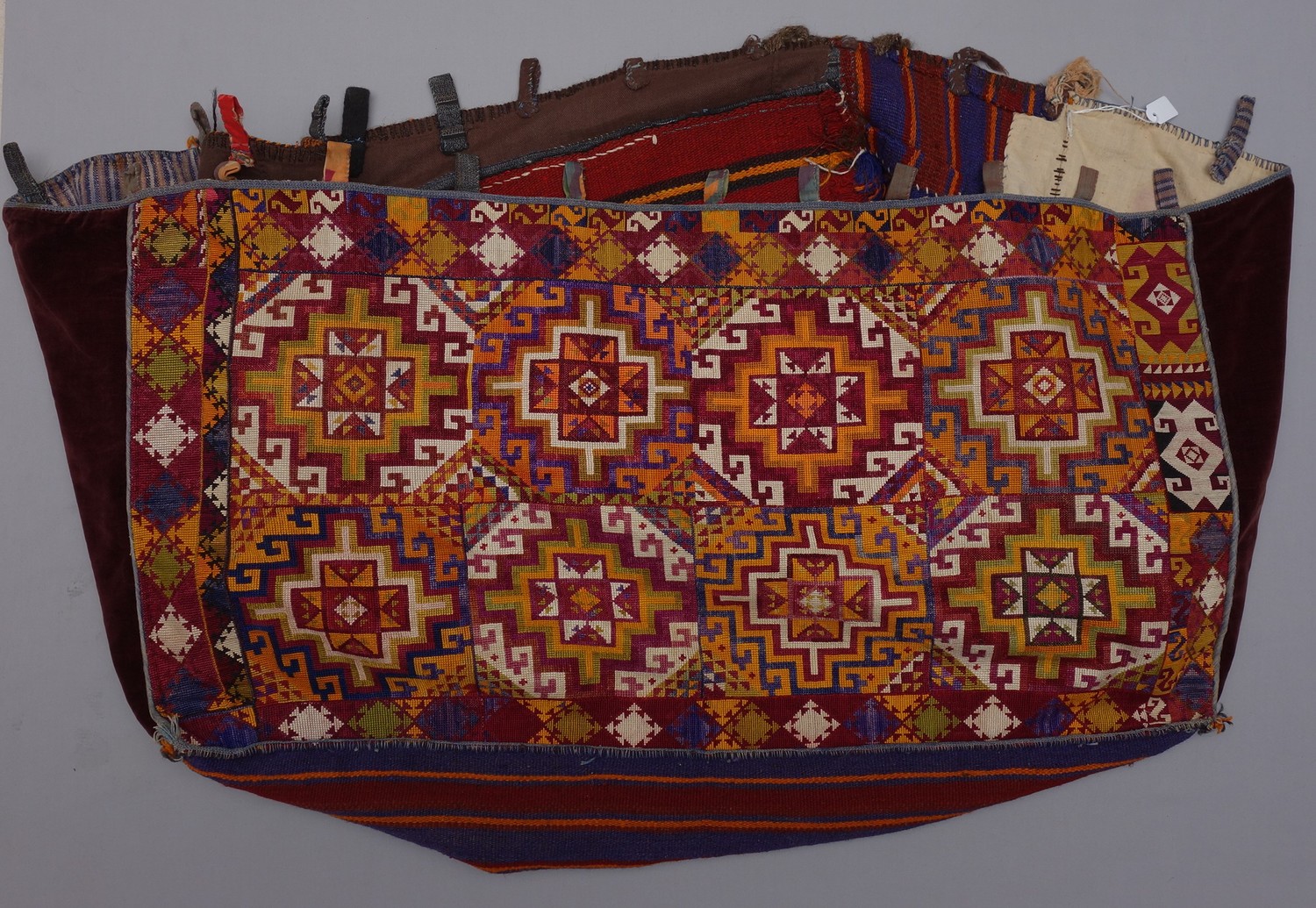 Embroidered bag for inside an Uzbek yurt. Mid-20th century. TRC 2016.1821. For more information, click on the illustration.A wide range of designs are used for embroidery in Central Asia. Often the same or a comparable design may be used by two different groups, such as a stylised goat that is found in both Turkmen and Uzbek designs. Many embroidery patterns have symbolic meanings, such as the stylised goats, or more in particular the ram’s horns, that represent good luck and fertility. Sometimes a design seems the same at first glance, but in the case of the Uzbek embroidered caps, for example, the design of a cockerel looks very similar to the buteh or paisley motif.
Beading
Beading is used mainly in Afghanistan and Turkmenistan for the decoration of garments and household objects. White glass beads are especially popular, as these are seen as having amuletic properties. The beads were originally locally made, but by the 19th century more and more Italian (especially Venetian) beads were being used. By the mid-20th century, however, cheaper Indian beads were introduced, and by the end of the 20th century Czech and Chinese glass beads, which are more even in size, were widespread. Various beading techniques are associated with Central Asia, including weaving bands on a small loom, hand sewing them onto canvas, or creating a trellis work in the hand by threading beads together.

4. Raw fibres
Central Asia is home to a range of raw materials that are used for the production of textiles for personal, domestic and public use. Traditionally the main fibre types are cotton, as well as various animal fibres, such as camel hair, silk, sheep’s wool and goat hair.
Cotton
The cotton plant is a member of the Gossypium genus (mallow family). Cotton consists of the soft, fluffy fibres that grow in a protective case (called a boll) surrounding the seeds of the cotton plant. There are four main types of cotton, of which Gossypium arboretum is native to Central Asia. Cotton has been grown in this part of the world, and in India and Pakistan, for thousands of years. By the medieval period the production of cotton was widespread. But it was in the twentieth century that the mega-industrial scale of cotton production in former Soviet Cental Asia and neighbouring Afghanistan took place and with it the devastating environmental damage due to the intensive use of water. The huge Aral Sea, for example, has just about vanished due to intensive cotton farming of cotton in the region and the drying up of the Amu Darya river.
Camel hair
Both the one-humped (dromedary) and the two-humped camel were used for their hair, that was applied to make various forms of cloth for garments, especially coats, and soft furnishing. The dromedary is more common in the Middle East and Iran, while the two-humped variety was more prevalent in the colder and more mountainous lands of Central Asia. The Bactrian camel (Camelus bactrianus) is in fact named after the ancient province of Bactria in what is now northern Afghanistan. The ruins of its ancient capital, now known as Balkh, still rise from the plains west of the Afghan city of Mazar-i Sharif. For thousands of years the Bactrian camel has been an important pack animal, especially along the so-called Silk Road that used to connect China with the Persian world and onto Europe.
 Uzbek woman's ikat dress made of silk, early twentieth century. TRC 2007.1125. For further information, click on the illustration.Silk and rayon
For hundreds of years, silk has been produced, spun, dyed and woven in Central Asia, and in particular in what is now Uzbekistan. The most widespread form of silk moth used is from the Bombyx sp., which lives on mulberry bushes. Until comparatively recently it was the most prestigious of the textile fibres. Then in the late 1890’s rayon or artificial silk (based on cellulose) was invented in France. By the mid-20th century rayon was widely used in many parts of the world. Rayon and more recently synthetic yarns (usually based on oil) have come onto the open market and have taken the place of ‘real’ silk. By the beginning of the 21st century most of the ikat textiles produced in Central Asia were of rayon or a synthetic fibre.
Wool and goat hair
Many different types of sheep and goat are kept in Central Asia, some of which are used for meat production, while others are more important for their wool and hair. These products are used for a wide range of goods, including clothing (notably coats and shoulder cloths and blankets), soft furnishings, tents (including the typical, circular yurts), tent furnishings, animal trappings, as well as specific items such as carpets (pile and flat-weave forms).
3. The peoples of Central Asia
The lands of Central Asia are nowadays inhabited by a wide array of groups, many of whom with their own particular history, language and dress. Roughly speaking, the Central Asians can be divided, mainly on the basis of their language, into those with a more Iranian background, and those with a more pronounced Turkic or Turkic/Mongolian origin.
Those with an Iranian-speaking background had lived in Central Asia for millennia when from the first millennium Turkic group arrived. They came from much further north and east. Some of the Turkic peoples migrated towards the west, towards a land subsequently was called after them, namely Turkey. Others settled in what is now Iran and the lands east of the Caspian Sea. Their descendants are the Turkmen, who now mainly are found in modern Turkmenistan and settled there in the early second millennium. Relative newcomers in large parts of Central Asia are the equally Turkic Uzbeks, who in the late 15th and early 16th centuries moved south from what is Kazakhstan and occupied large parts of what is now Uzbekistan. They also moved further south into northern Afghanistan. Other immigrants are the Turkic Kyrgyz, who centuries ago came to live in the mountainous Central Asian borderlands with what is now China.
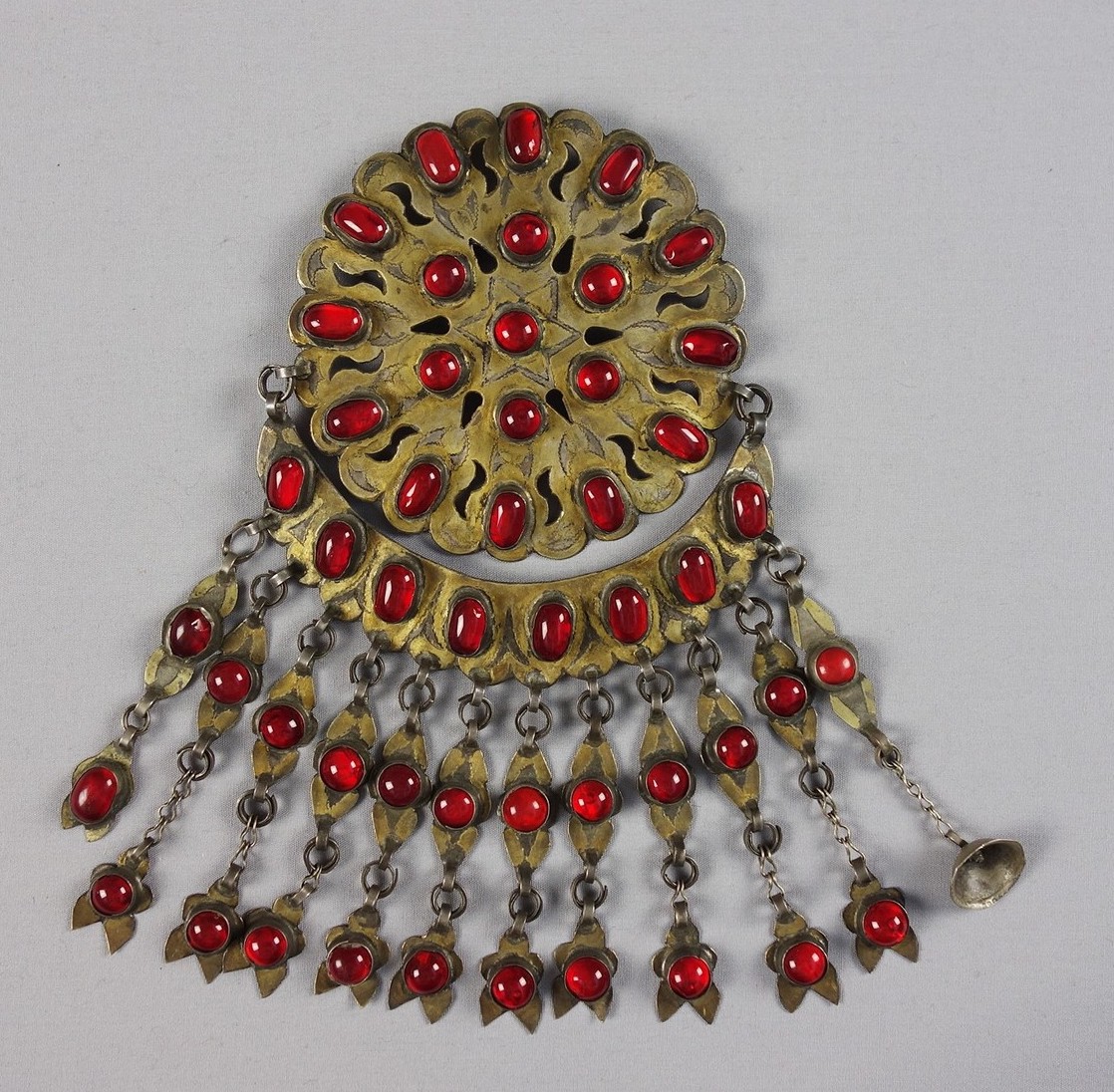 Turkmen woman's broach, mid-nineteenth century. Silver with garnet coloured glass insets. TRC 1999.0316. For further information, clock on the illustration.The original, Iranian speaking population of Central Asia are traditionally called Tajiks, and they were allocated their own country by the Soviet rulers in the 1920s, but they can also be found in neighbouring lands. In Afghanistan, the Tajiks represent a large part of the population, mainly in the north of the country, but also in the urban centres in the south. Their language is called Dari, which is basically a form of Persian, which is one of the many Iranian languages. Dari is, next to Pashto, the main language of Afghanistan. Pashto is another Iranian language, which is spoken by the Pashtuns, who form the larger, and dominant part of the population of the country, and who traditionally are named Afghans, hence the name of the country.
Iranian and Turkic groups constitute the dominant ethnicities in Central Asia, but there are also other groups, such as the Hazaras in Afghanistan. They claim descent from the armies of the Mongolian conqueror, Genghiz Khan, in the early 13th century. Their language, which is now Dari or Persian, still contains many Mongolian words.

2. The 'Stans' of Central Asia
The term ‘Stans’ is a modern appellation that is often used, perhaps somewhat derogatory, for Central Asia. It covers most of the mountains and deserts between the Caspian Sea to the west and the borders with China to the east. They include five modern states that were (re)created in the late 20th century after the fall of the Soviet Union in 1991. These are Kazakhstan, Kyrgyzstan, Tajikistan, Turkmenistan and Uzbekistan. It also includes the modern Islamic republic of Afghanistan. All six of these lands are named after their dominant ethic population, with the suffix ‘stan’, which means ‘land’. Afghan-i-stan thus means ‘land of the Afghans’.
 Group of people at the Registan of Samarkand, between 1905 and 1915. Digitally enhanced photograph, Library of Congress.The former Soviet states were occupied by the Tsarist Russian Empire in the 18th and particularly in the 19th century. Before that time, they had been divided into independent realms, such as that of Khiva, Bokhara and Khojend. These lands were incorporated into the Soviet Empire following the Russian Revolution of 1917. New borders were being drawn, massive changes were being imposed, large groups of other ethnicities were imported (notably from Korea), and local culture, including religion and dress codes, were transformed. With the demise of the Soviet Union in 1991, the former Soviet states of Central Asia declared their independence, although often under the same leaders that had controlled the states while still under the Soviet umbrella.
 The Stans of Central Asia.Afghanistan has always been different. It was never incorporated into the Russian Empire. It was in fact never colonised at all. It was founded as an independent kingdom in the mid-18th century. In the 19th century it was transformed into a buffer state between the Tsarist Central Asian lands to the north, and British India to the southeast. In this way, Afghanistan has always retained its independence, although it has been affected by civil war and foreign intervention especially since 1978, when it was brought into the influence of the Soviet Union, and after 1989 when it became the scene of a bitter civil war that continues to the present day.

1. Introduction
Appliqué is a textile technique whereby one or more textiles are sewn onto a ground material, usually of cloth, in a decorative manner. The earliest surviving examples of Egyptian appliqués can be dated to over three thousand years ago and come from the tomb of the famous Egyptian pharaoh, Tutankhamun (died c. 1322 BC). Given the quality of the work found in the tomb, it is likely that this technique is much older, but alas, nothing has survived.
Traditionally, this technique in Egypt is mainly used for the production of large decorative items such as awnings, flags, tents (suradeq) and tent panels, paired curtains for doorways, as well as wall hangings. Similarly, very large wall hangings were made in the Maghreb, especially Morocco, as wall hangings (called hiti), as well as in Palestine.
During the twentieth century the uses for Egyptian appliqués included wall hangings, cushion covers, table runners, and so forth. By the early 21st century these items are popular with the national and international tourist markets. The latter not only includes Westerners, but also buyers from other parts of the Arab world, as well as tourists from Asia, notably China, India, Japan and Korea.