• F3
  • F1
  • F4
  • F2

By Dr. Willem Vogelsang, Lt Col. (ret) and former Cultural Advisor to the Dutch armed forces in Afghanistan. 10 July 2024

A few days ago, Gillian and I returned from a short trip to France, where we went to see the Bayeux Tapestry (we had seen it before, but it remains a spectacular piece of early cartoon work and well worth another visit), Chambord Castle along the Loire (where we admired the chintz wall coverings), and the fascinating fortress of Carcassonne in the south of the country.

And before seeing Joanne and Luc Aujame in Lyon (whose parents used to work in Afghanistan), we went to visit our dear friends, Rolando and May Schinasi, in Nice, the main reason for our trip (and they remember Luc Aujame as a young boy in Kabul). Over the years they have donated many textiles and other items from Afghanistan to the TRC, including a marvellous collection of Turkmen and other jewellery.
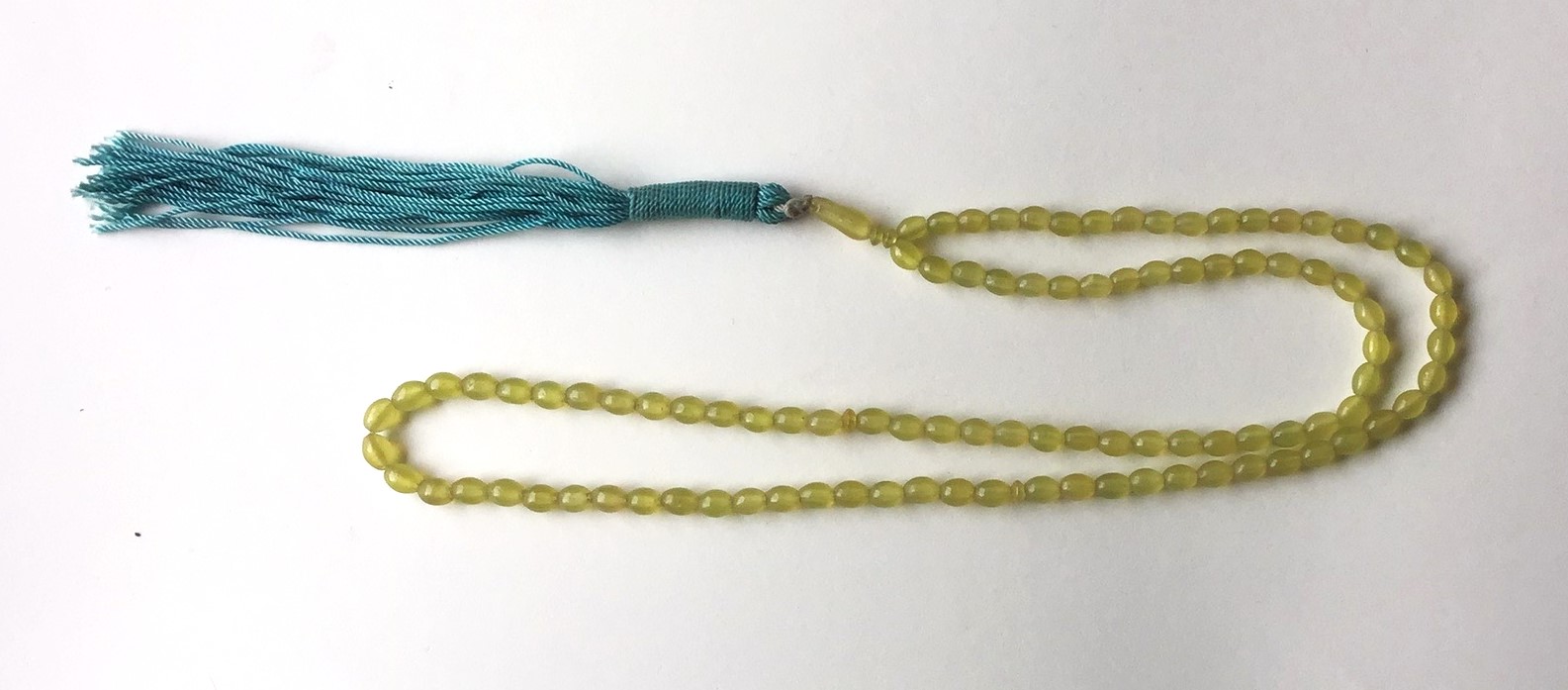
Set of prayer beads made from Shah Maqsud chrysolite stone, from southern Afghanistan, pre-1965 (TRC 2024.1940).Set of prayer beads made from Shah Maqsud chrysolite stone, from southern Afghanistan, pre-1965 (TRC 2024.1940).
by Dr Gillian Vogelsang-Eastwood, Director TRC, 18 June 2024

We are currently working on another of the many (and often intriguing) boxes of items from the former Naaldkunst Museum, Winschoten, which were donated to the TRC in October 2023.  In this particular box there were a number of school samples in the form of semi-formal work pieces, rather than the more formal samplers with alphabets, numbers, names, dates, etc.

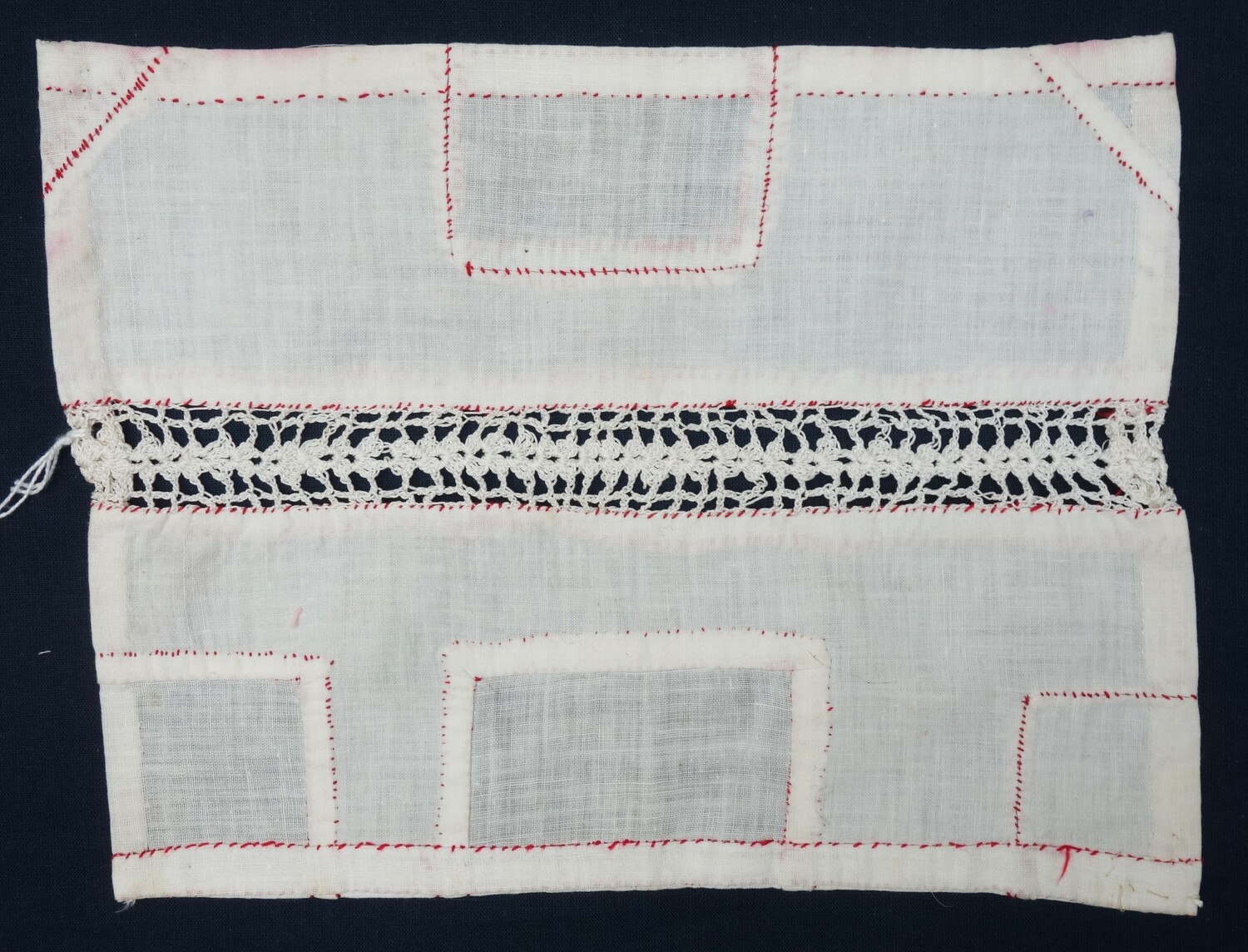
Fig. 1: School sample, worked by a young girl, with six types of patching, stitched with red yarn, and with a crochet inset (insertion) down the middle of the cloth. The Netherlands, early 20th century (TRC 2024.1633).Fig. 1: School sample, worked by a young girl, with six types of patching, stitched with red yarn, and with a crochet inset (insertion) down the middle of the cloth. The Netherlands, early 20th century (TRC 2024.1633).

All of the school samples date to the first quarter of the 20th century and show a diversity of skill levels. They were made by young girls between the age of 6 and about 12, who were learning about textiles and needlework and how to sew cloth for later domestic and professional use. The techniques include the making of basic seams, hems, buttonholes and eyelets, as well as the sewing on of items such as buttons, hooks and eyes, loops and ties.

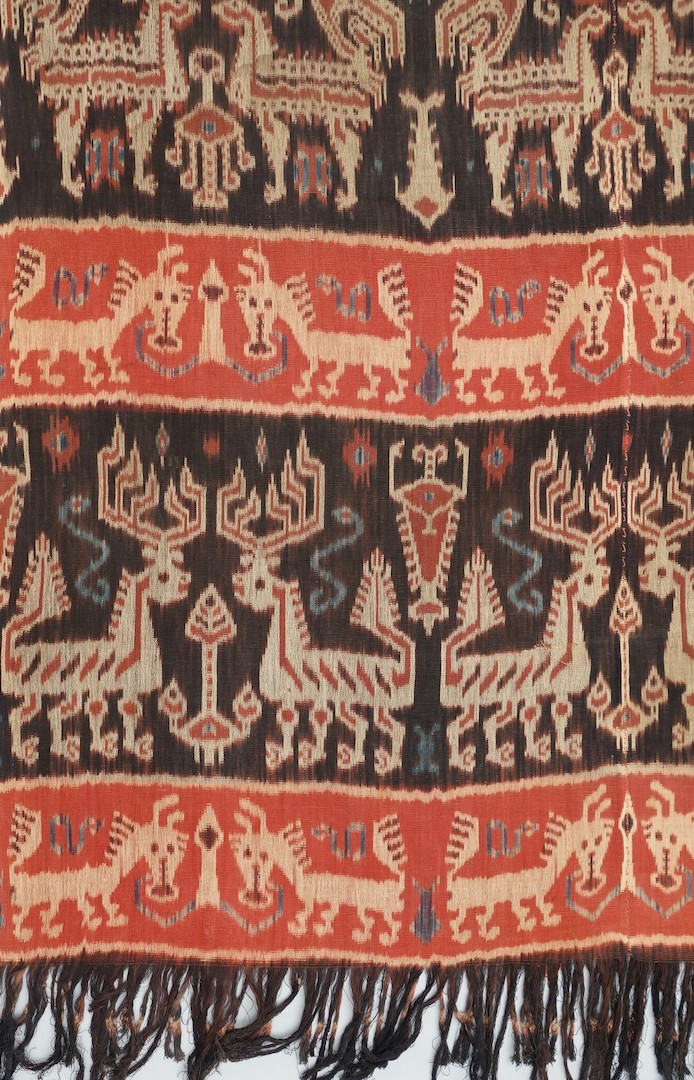
Hand woven ikat cloth from East Sumba, Indonesia, early 20th century (TRC 2000.0085).Hand woven ikat cloth from East Sumba, Indonesia, early 20th century (TRC 2000.0085).by Dr Gillian Vogelsang-Eastwood, Director TRC, 11 June 2024

Part and parcel of the TRC are the absorption and dissemination of knowledge about textiles and dress, and especially about items that are already in the TRC’s large and diverse collection.

This is done by studying specific aspects and publishing about them (such as via the Bloomsbury embroidery encyclopedia series), or by focussing on parts of the collection and expanding the information provided in the online catalogue (such as by TRC’s intern student Olivia Buchan’s study of the lace collection).

We also invite groups of people to come and talk in an informal setting about specific forms of textiles and dress. This is the series of meetings: Let's talk about ... , for which people with specific interests, from different communities or with various ethnic roots are invited to the TRC to see and talk about groups of objects from the collection. 

A significant aspect of these group visits is to make items from the TRC Collection available for discussion purposes. We want to learn, and record information for the future.

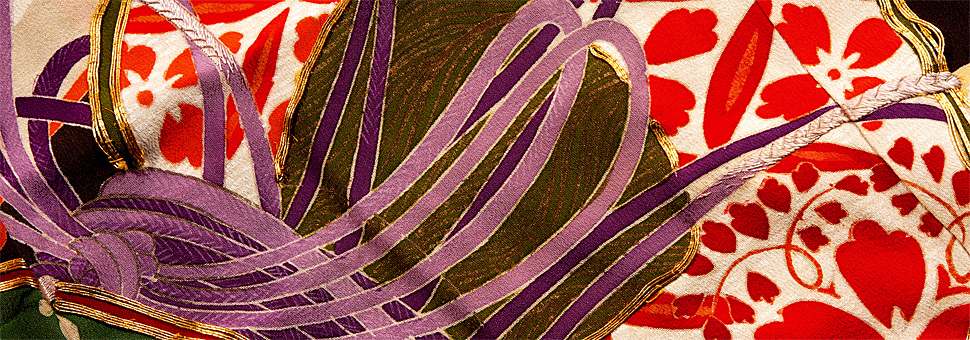
Japanese kimono from the 20th century, died with ikat technique (TRC 2022.0977).Japanese kimono from the 20th century, died with ikat technique (TRC 2022.0977).A tool, piece of cloth or a garment on the table can open up lines of discussion, as well as bring forth new information or perspectives on a particular technique, uses, symbolism or indeed, a whole culture.

Over the last year or so, there have been a Romanian embroidered blouses day, a Moroccan henna afternoon, a group visit of embroiderers from different countries organised by Museum De Lakenhal here in Leiden, not to mention the regular visits of a group of bobbin lace makers who help further identify and describe our collection of bobbin lace and equipment.

And just a few days ago, an ikat afternoon was held at the TRC with a group of ikat weavers and wearers, whose ancestors originate from various parts of the world, including Indonesia. 

By Shelley Anderson, TRC volunteer, 8 June 2024
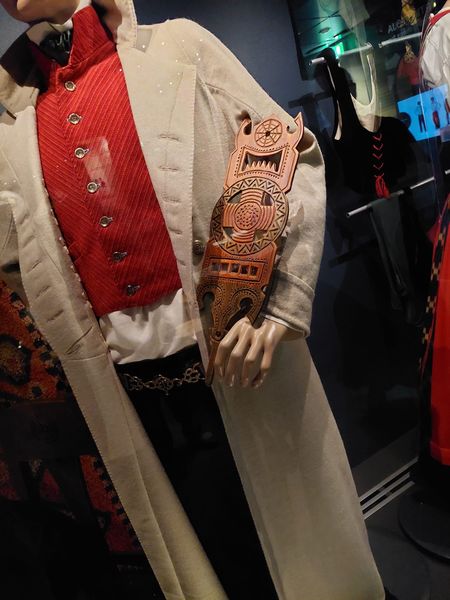
The recent five-day ErasmusPlus study tour to Finland by five TRC volunteers, supported by European Union funding, was a stimulating learning opportunity.

Mannequin in regional Finnish dress, holding a hand carved, decorated distaff, late 19th century. Such spindles were given to women as part of courtship for marriage. From the National Crafts Museum, Jyvaskyla. Photograph by Hanke van ProoijeMannequin in regional Finnish dress, holding a hand carved, decorated distaff, late 19th century. Such spindles were given to women as part of courtship for marriage. From the National Crafts Museum, Jyvaskyla. Photograph by Hanke van ProoijeWe were introduced to the work of Taito (Finnish for 'craft'), the national Finnish umbrella organization for the promotion of crafts. Taito's activities to preserve traditional skills, including weaving, knitting, rug making and basketry, are truly impfessive. We also visited the KSL Study Centre (run by the KSL Civic Association for Adult Learning), which uses crafts such as sewing and quilting to promote community participation and social dialogue.

We visited KSL’s stall at the World Village Festival, an annual Helsinki weekend event that each year attracts thousands of people. We assisted in distributing a small kit with felt, a needle and different coloured thread, with a flyer about craftivism, for free.

With this kit, people are encouraged to start embroidering something of their liking and thereby help to build a world where nature, animals and humans are all respected. “We want to inspire people, especially people who might not identify with traditional means of activism (e.g., marching or gathering signatures for a petition), to take part in social debates,” said KSL coordinator, Riina Nasi.

KSL also helps pensioners in different senior citizen homes to embroider panels for a massive “memory” quilt, in order to share those memories with others. Another craftivism project involves bringing people together to stitch “My Promise to Finland”--an individual action each person promises to make towards building a better society.

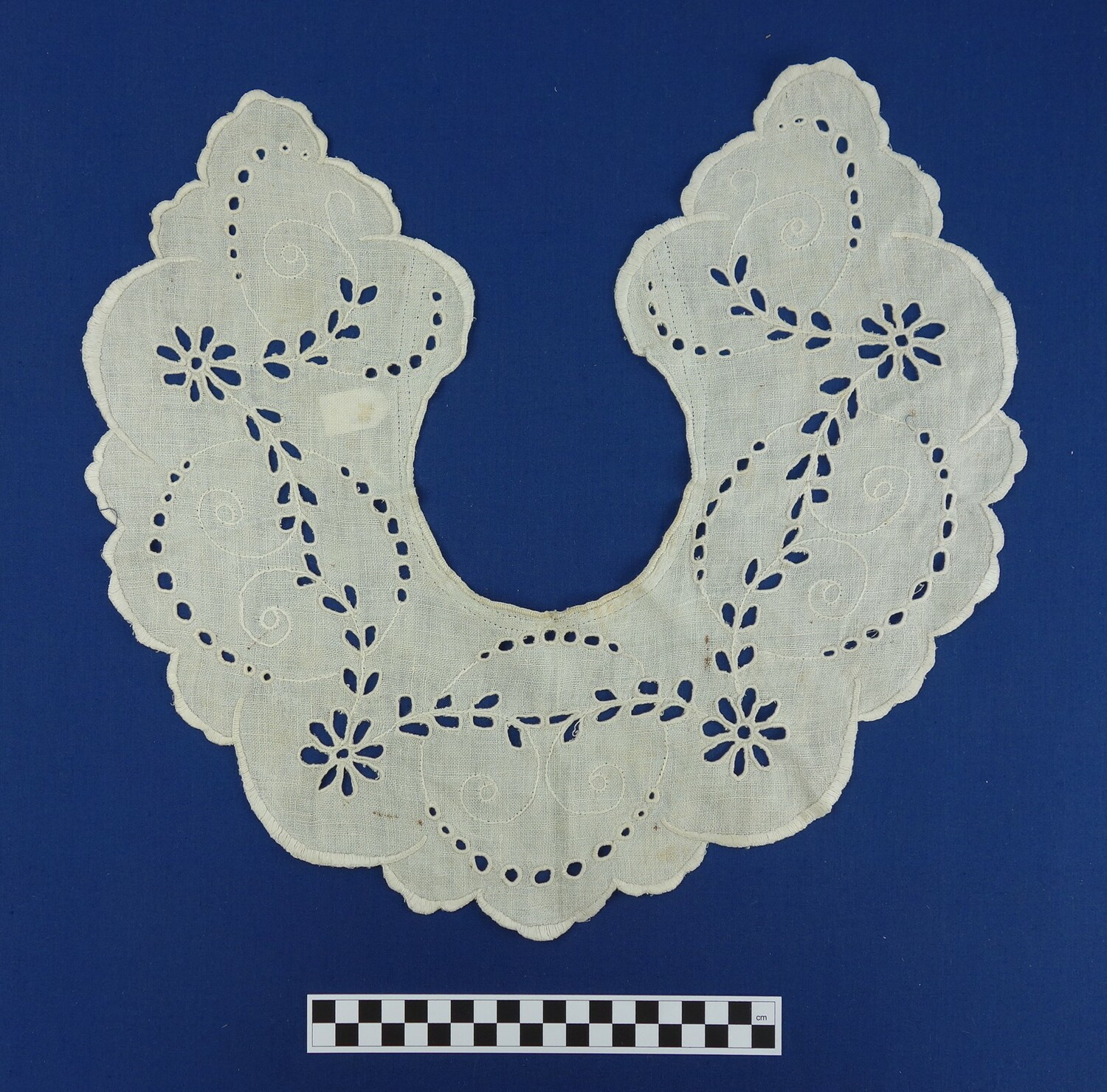
Collar decorated with floral broderie anglaise, handmade, c. 1900, the Netherlands (TRC 2007.0755).Collar decorated with floral broderie anglaise, handmade, c. 1900, the Netherlands (TRC 2007.0755).Gillian Vogelsang-Eastwood, 1 June 2024

While working on the various European volumes of the Bloomsbury World Encyclopedia of Embroidery, we often come across  broderie anglaise, otherwise also sometimes known as broderie de Calais, although there are minor differencesThere are various examples of this type of embroidery in the TRC collection.

In the US the term Madeira work is frequently used. As such it is named after the Portuguese island of Madeira, which lies in the Atlantic Ocean, west of Morocco. It was probably introduced on Madeira by Catholic nuns who taught in convent schools.

But what is broderie anglaise?

Basically it is a type of whitework, i.e., embroidery using white threads on a white ground, with the pattern mainly made from eyelets. These are small, round or oval holes deliberately cut into the ground material.

By Shelley Anderson, friend and long-time volunteer at the TRC (27 May 2024)

A recent visit to the Portuguese Synagogue in Amsterdam made me think about velvet, and especially the gorgeous velvet pieces in the TRC collection, and the TRC online exhibition: Velvet!. And please note, there are still some places left for the TRC study day on velvet, on Friday 31st of May. If you are interested, let us know asap.

Portuguese Synagogue, Amsterdam (1675). Photograph by Massimo Catarinella. This file is licensed under the Creative Commons Attribution-Share Alike 3.0 Unported license.Portuguese Synagogue, Amsterdam (1675). Photograph by Massimo Catarinella. This file is licensed under the Creative Commons Attribution-Share Alike 3.0 Unported license.

by Gillian Vogelsang-Eastwood, 23 May 2024

We have just had several groups visiting the TRC to see what the TRC is doing, to look at the current exhibition about Chinese garments and in particular to discuss the role of embroidery, past, present and future. And the reactions were positive, as more and more people are getting interested in embroidery and want to acquire the skills behind this ancient textile form. Not surprisingly, given the extensive nature of the TRC’s embroidery collection, everyone was intrigued, interested and surprised by what is in the archive and collection boxes! There were various request to have this box and that box opened.

Our visitors were also very impressed by the Bloomsbury World Encyclopedia of Embroidery – they had not realised that there are so many different forms of embroidery produced, sometimes for thousands of years, in almost every corner of the world. This is a craft that certainly deserves an eight-volume series.

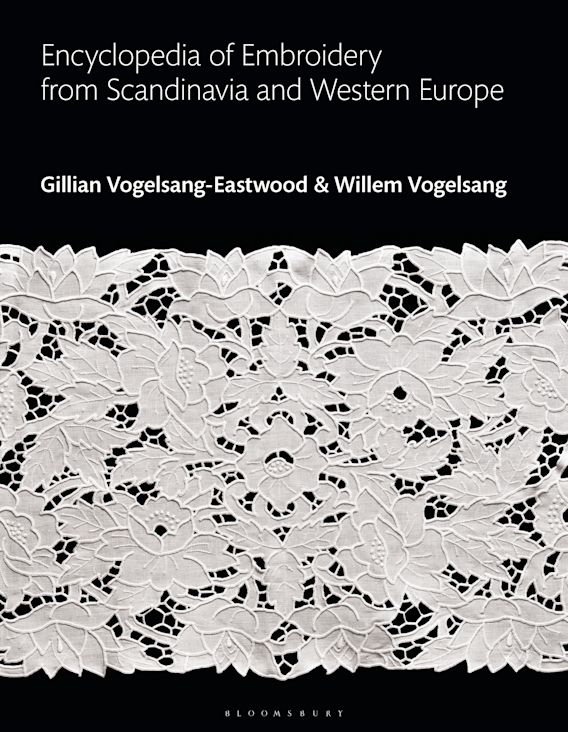
Given the various reactions we thought we would write an embroidery update. We just finished the final proofs of the fourth volume of the series, which is about embroidery from Scandinavia and Western Europe. It is c. 600 pages in length (the maximum we could have in one volume), with hundreds of colour pictures, black and white illustrations as well as diagrams. Again there are numerous maps and stitch illustrations, drawn by our colleague Dit e-mailadres wordt beveiligd tegen spambots. JavaScript dient ingeschakeld te zijn om het te bekijken.. The volume will be published on the 14th November 2024.

We are now working on the fifth volume, which is about embroidery from Eastern Eiurope and beyond, from the Baltic countries to Macedonia and Greece, not forgetting Russia, Turkey, Armenian, Azerbaijan and Georgia, to name just a few countries. We have had offers of help from various people and groups, including Armenian, Bulgarian, Hungarian, Polish, Romanian and Russian embroiderers and historians.

by Dr Gillian Vogelsang-Eastwood, Director TRC, 22 April 2024

Lace cap made from a very fine net (tulle) with applied embroidered and appliqué motifs of various types and sizes. The Netherlands, 19th century (TRC 2024.1174).Lace cap made from a very fine net (tulle) with applied embroidered and appliqué motifs of various types and sizes. The Netherlands, 19th century (TRC 2024.1174).It has been a funny old week at the TRC! Lots of things happening, even more to think about and some unexpected donations that have led to totally different thoughts!

We have had various meetings over the last few weeks about the future of the TRC, its role in Leiden, about textile studies in general, about the nature of the TRC Collection, how we can improve the TRC website, especially the database, not to mention the question whether we really need to regularly set up small exhibitions.

It has been a confusing, frustrating and at times enlightening time, with the promise of more discussions to come, but in the long run, the TRC will be the stronger for this period of ‘soul searching’.

I would like to thank everyone who has been helping, thinking with us and adding useful and constructive comments.

Zoek in TRC website

Contact

Boerhaavelaan 6
2334 EN Leiden.
Tel. +31 (0)71 5134144 (kantooruren)  
office@trcleiden.org

Het TRC is elke dag geopend tussen 10.00 en 15.00 uur.

facebook 2015 logo detail


instagram vernieuwt uiterlijk en logo


Bankrekening

NL39 INGB 0002 9823 59, t.a.v. Stichting Textile Research Centre.

Financiële giften

Het TRC is afhankelijk van project-financiering en privé-donaties. Al ons werk wordt verricht door vrijwilligers. Ter ondersteuning van de vele activiteiten van het TRC vragen wij U daarom om financiële steun:

Giften kunt U overmaken op bankrekeningnummer (IBAN) NL39 INGB 000 298 2359, t.n.v. Stichting Textile Research Centre. BIC code is: INGBNL2A

U kunt ook, heel simpel, indien u een iDEAL app heeft, de iDEAL-knop hieronder gebruiken en door een bepaald bedrag in te vullen: 


Omdat het TRC officieel is erkend als een Algemeen Nut Beogende Instelling (ANBI), en daarbij ook nog als een Culturele Instelling, zijn particuliere giften voor 125% aftrekbaar van de belasting, en voor bedrijven zelfs voor 150%. Voor meer informatie, klik hier