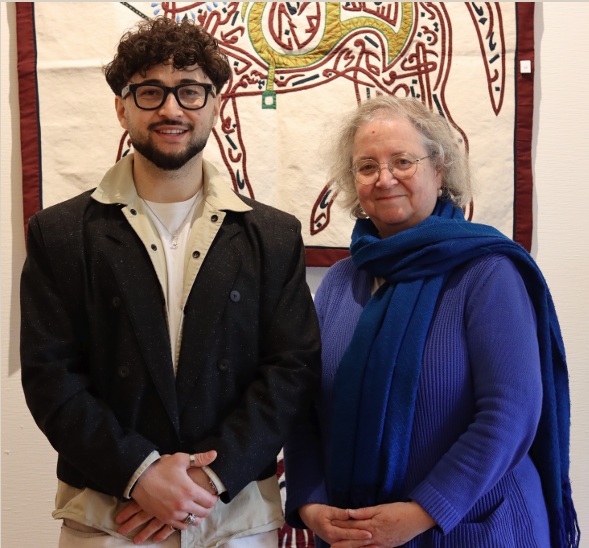
 Charly Sajjad Baumann and Dr. Gillian Vogelsang-Eastwood, 15 May 2026This year I am completing my Bachelor’s degree in Fashion Design at the University of Applied Sciences HTW Berlin. For my bachelor’s thesis, I am focusing on Afghan embroidery, with a special emphasis on traditional Hazara embroidery. As this topic is personally very important to me, I wanted to approach my work not only creatively but also in a well-founded academic way. Therefore, I began searching online for information, sources, and research institutions that deal with traditional textiles.
During my research, I discovered the Textile Research Centre (TRC), Leiden, in the Netherlands. This centre is dedicated to the study of traditional textiles, crafts, and embroidery from various cultures around the world. I found it particularly fascinating that it also holds information and textile collections from Afghanistan.
After a short time, I knew that I absolutely wanted to visit this place to learn more about Afghan embroidery and its cultural significance. So I traveled from Berlin to Leiden. The journey was very exciting for me because I knew it would be highly important for my bachelor’s thesis.
At the TRC, I was warmly welcomed by Dr. Gillian Vogelsang-Eastwood. She was incredibly friendly, open, and helpful. From our very first conversation, I immediately noticed how much knowledge and experience she has in the field of textiles and traditional embroidery.
The building of the TRC also impressed me greatly. The rooms were beautifully arranged, and there were textile objects and artworks to discover everywhere. The atmosphere was calm, creative, and inspiring – a perfect place for research and academic work. I stayed there from around 1 p.m. until approximately 3:30 p.m., and during this time I was able to gather many important insights for my thesis.
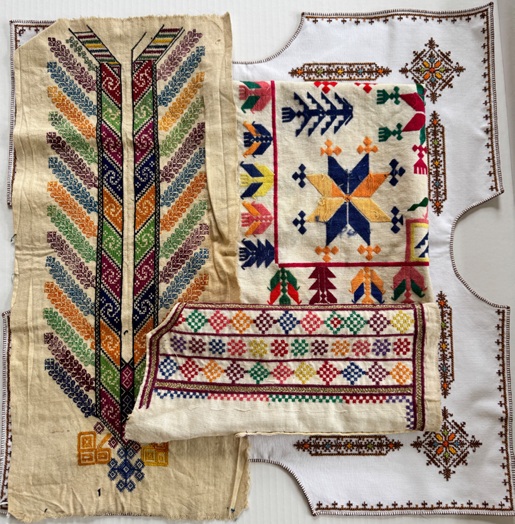 Embroidery collage by Charly Sajjad Baumann at the TRC, 15 May 2026.One of the highlights was that I had the opportunity to conduct a short interview with Dr. Gillian. I asked her various questions about traditional embroidery, textile craftsmanship, and the cultural meaning of clothing and ornamentation. Her answers were extremely valuable and will later be included in my bachelor’s thesis. A particularly special moment of my visit was when Dr. Gillian guided me into the archive room of the TRC. There, I was able to view the Afghan section, where various traditional embroideries are preserved. For me, this was an unforgettable experience, as I could see the pieces not only in photographs but directly in front of me. The fine details, colours, and patterns of the Hazara embroidery were especially inspiring.
It was fascinating to see how much history, culture, and identity is contained within these handcrafted works. In addition, the TRC has a small library with many books and academic sources on textiles from around the world. I spent a long time there browsing and found many interesting references that I will later cite in my bachelor’s thesis.
Overall, my trip to Leiden was a very enriching and successful experience. I was able to gather valuable information, gain new impressions, and bring a great deal of inspiration back to Berlin. This journey once again showed me how significant traditional embroidery is for culture, history, and identity, and how important it is to preserve this knowledge for future generations.
Charly Sajjad Baumann, 22 May 2026