

This three-day course introduces hand spinning as both a practical craft and a form of embodied knowledge. Participants work hands-on with fibres and spinning tools while also engaging with questions of labour, sustainability, and the role of handmade processes in contemporary life. Each day combines demonstration, guided practice, independent experimentation, and short reflective activities.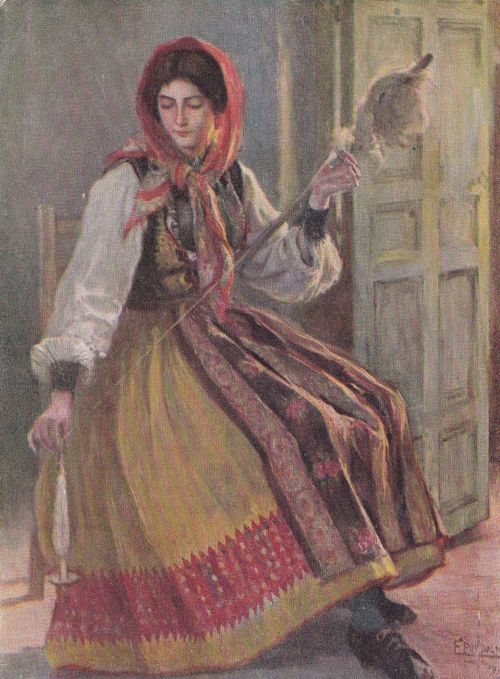 A postcard from early 19th century Spain, showing a woman handspinning with a distaff and a drop spindle,TRC.2020.4383
The course will be taught by Akash Kumar. Akash Kumar is an artist, researcher, and educator working at the intersection of material culture, with a focus on textiles, folklore, storytelling, and the transmission of knowledge. Rooted in hands-on making as both a method of inquiry and a medium for cultural exploration, his practice examines how and what skills, traditions, and wisdom are passed down across generations.
- 26th of August - Session 1 — Foundations of Hand Spinning
Focus: fibre basics, twist introduction, and spindle techniques- Short history of the spindle, charkha, great wheel, and treadle wheel, including
Gandhi’s use of spinning as non-violent resistance. - Introduction to local fibres (wool, linen, alpaca) and tools (takli, charkha, carders)
- Hands-on fibre prep: carding and pre-drafting
- Drafting by hand and inserting twist with a spindle or petite charkha
- Mini-lesson on twist structure (S-twist vs. Z-twist)
- Students spin small samples of each twist type
- End-of-day reflection: sensations of material, patience, skill, and surprise.
- Short history of the spindle, charkha, great wheel, and treadle wheel, including
- 9th of September - Session 2 — Technique, Tools & Yarn Metrics
Focus: tool comparison, fibre properties, measurement skills- Shared reflections from Day 1
- Rotations through the drop spindle, charkha, and treadle wheel
- Fibre comparison: cotton, wool, blends, staple length differences
- Practice plying: creating a balanced two-ply yarn
- Homework:
Spin, spin and spin. Write a short reflection on differences in tools and fibres
- Homework:
- 23rd of September - Session 3 — Creative Spinning & Custom Yarn
Focus: design, experimentation, and finishing techniques- Warm-up spinning
- Design session: creating custom blends with coloured cotton, wool, linen, alpaca,
- and optional textural additions (seeds, slubs, etc.)
- Spinning 50–150 m of custom yarn; optional plying
- Finishing: skeining and steam-setting twist
- Labelling yarn with fibre content, twist type, and measurements
- Final group discussion: skill growth, slow craft, labour, sustainability, and the
relevance of hand spinning today - Final reflection: connecting personal experience to ideas of craft and modern
technology
The course is given on three Wednesdays, the 26th of August, the 9th of September and the 23rd of September, from 10.00-13.00.
Please note that, in order to really learn the technique and obtain results, this course does involve some homework. The participants will be finishing techniques and projects, started during the meetings, at home. This will take about an hour, no more than three hours. Akash Kumar amongst spinning equipment
- Venue: TRC Leiden, Boerhaavelaan 6, 2334 EN, Leiden.
- Teacher: Akash Kumar
- Language: English
- Costs: 135 euros per three lessons. Coffee/tea/threads are provided. All necessary materials will be provided
- Maximum number of participants: 8. Minimum: 4. If the minimum number of participants is reached, confirmation and invoices shall be sent.
Please contact us to register: Dit e-mailadres wordt beveiligd tegen spambots. JavaScript dient ingeschakeld te zijn om het te bekijken.