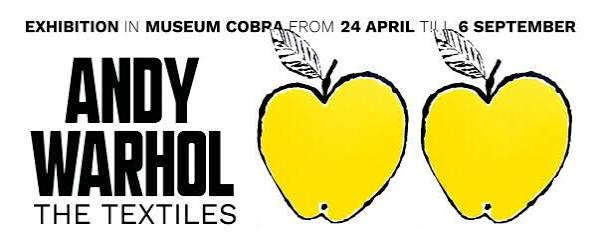
 Poster for the Andy Warhol exhibition, now extended until 8 November. Museum Cobra, Sandbergplein 1, Amstelveen.Until Sunday, 8 November 2026, Museum Cobra in Amstelveen in The Netherlands presents an exhibition with the title 'Andy Warhol, The Textiles'. TRC friend and volunteer, Loren Mealey, went to see the exhibition in Amstelveen and she wrote the following blog:
When we think of Andy Warhol, we think of Campbell’s Soup Cans, Coca-Cola bottles, Marilyn Monroe and the bright, bold world of Pop Art. Before all of that, though, Warhol was illustrating something quite different: textiles.
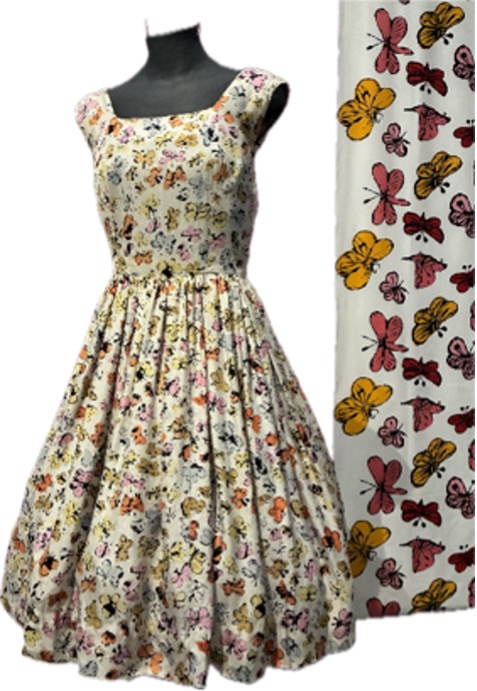 Left: “Happy Butterfly Day”. Printed silk, circa 1955-56. Manufacturer unknown; Right: “Large Butterflies”. Printed cotton, circa 1955-56. D. B. Fuller & Co., Inc.In the 1950s and early 1960s, long before he became one of the most recognisable artists of the twentieth century, Warhol was a successful commercial illustrator and graphic designer in New York City. He created playful textile patterns filled with ice-cream cones, candy apples, lemons, butterflies, flowers, pretzels, shoes, buttons and even circus clowns. They are cheerful, whimsical and unmistakably of their time. If observed closely, you can already see the beginnings of the Warhol we know today.
What is particularly appealing about these designs is their colourful combination of simplicity and repetition. Warhol took an ordinary object, reduced it to its essential shape, and then repeated it across the fabric. The same butterfly might appear again and again, but each one will show a tiny difference. A line shifts. A shape changes slightly. A colour lands differently.
Then there is the line. Warhol had developed his distinctive “blotted line” technique while still a student and refined it during his years as a commercial illustrator. The process was quite simple. He traced an image in ink on a non-absorbent sheet and then pressed it against another sheet of paper, transferring the ink. The result was a broken, slightly uneven line: part drawing, part print.
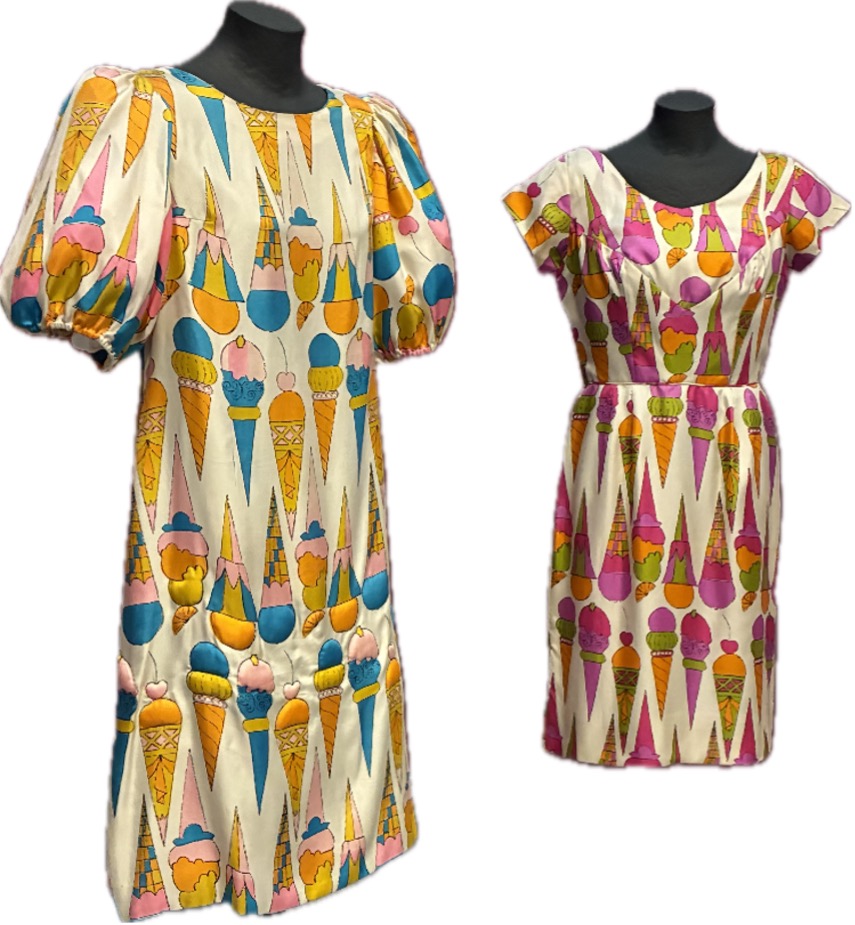 “Ice Cream Cones”. Printed silk, circa 1962-1963. (L) Maker unknown; (R) By Castelli.
That imperfect line is one of the easiest ways to recognise Warhol's early work. It has a lightness and spontaneity that a perfectly drawn line does not have. Because Warhol could repeat the process from the same original drawing, he could create variations of an image quickly. This handmade technique allowed him to produce images not unlike a printing machine.
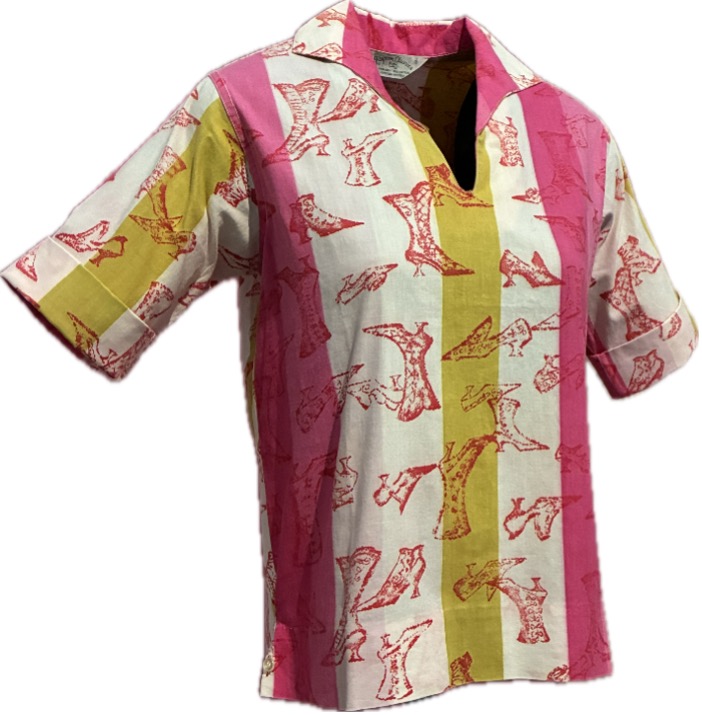 “Shoes and Boots”. Blouse by Jayson Classics. Printed cotton, circa 1957-1958. Attributed to Crompton-Richmond Company, Inc. This makes his textiles especially intriguing today. Most surviving examples of Warhol’s textiles do not carry his name on the selvedge. Identifying them can be something of a detective game. Instead of looking for a signature, you look for the combination of motifs, the characteristic line, the playful composition, and the rhythm of the repeated images. Warhol's hand is often there even when his name is not.
His textile work also helps explain where some of his later Pop Art ideas originated. Repetition, commercial imagery, ordinary consumer objects, and mechanical reproduction were already part of his working life. It is easy to see how these early textiles were an important part of his artistic evolution.
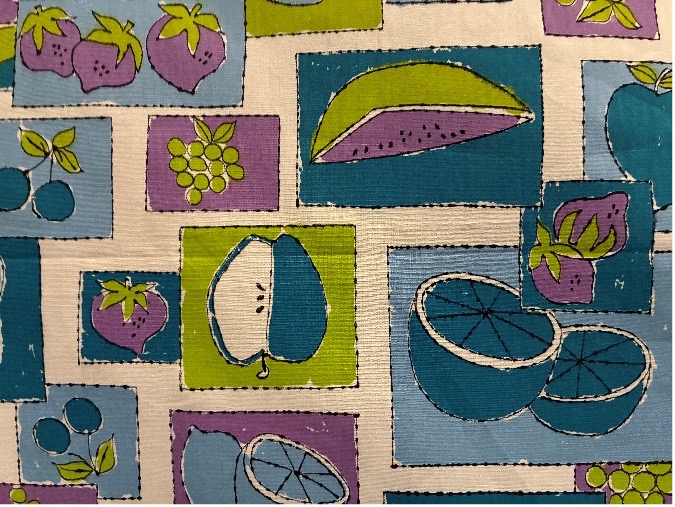 “Mellons”. Printed cotton, circa 1956-1957. Fuller Fabrics, Inc.Warhol was becoming Warhol. He was discovering how an ordinary object could become visually exciting simply through repetition, and how something that looked mass-produced could still retain traces of the artist's hand. Warhol’s Pop Art story did not begin with a bold can of soup. It began with a cheerful piece of patterned fabric.
The exhibition was earlier presented in 2023 in the Fashion + Textile Museum, London (see a blog by Gillian Vogelsang of 22 July 2023).
Loren Mealey, 6 September 2026