

At the end of the Second World War, Russian Mennonites fleeing west were allowed to temporarily stay in the Netherlands, provided that the Dutch Mennonite (Doopsgezinde) community would house, feed and clothe them. The Mennonites, who during the last few centuries spread all over the world, are named after Menno Simons from the village of Witmarsum in Friesland, in The Netherlands. He was a 16th century former Catholic priest whose first name was taken up by many of his followers inspired by his reformist ideas. The Amish in North America are an offshoot of this group, being followers of Jakob Ammann.
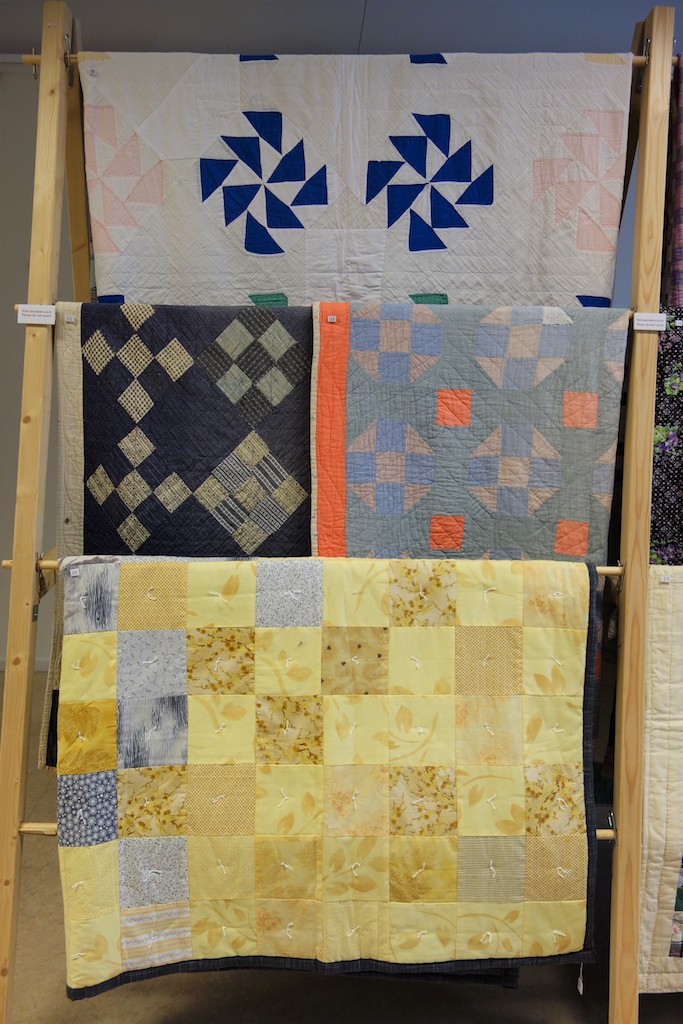 Display of quilts at the TRC Gallery exhibition 'Textile Tales from the Second World War'. The quilt on top is the twin of the missing quilt that was sent to Syria. The yellow quilt at the bottom of the rack was given to replace the missing quilt.
During and just after the war, Mennonites in Canada and the US sent over pallets of food, clothing and quilt blankets to support those in need in Europe, including the Mennonite refugees from the Soviet Union.
An Keuning-Tichelaar and her husband Herman, a Mennonite minister in Friesland, hosted several of these refugees. But they soon had no mattresses left. An called the Mennonite Central Committee office in Amsterdam, asking for mattresses. The next day she received a truck with eighty quilts. No mattresses, much to her dismay – these quilts were so thin! She was told to pile four or five of them together in a ticking and sleep on top as well as under them.
After her house guests left a year later for Paraguay, An kept the quilts as silent reminders of her wartime experiences. I happened upon them as a guest and recognized them from growing up in the US with Mennonites. In 1994 she turned this collection of twenty quilts over to me in stewardship.
Recently, European Mennonites have also started making quilts for refugees. At the European Mennonite conference in France in 2018, An’s quilts from the Second World War were on exhibit. Simultaneously, hundreds of newly made quilts were being lovingly loaded into a freight container, bound by sea for Syria.
One of An’s quilts had been displayed on an easel to entice visitors to the other building where quilts were being made for Syria. At the end of the conference, we could not find it. The old quilt must have gone into the container somehow! In its place, the organizers urged us to take a modern quilt with us to tell the continuing story – we chose a special yellow one, with shadings from black to white. The 'new' quilt is now on display at the TRC in Leiden, together with an old 'twin' of the quilt inadvertently sent to Syria.
When the container was unpacked in Syria, the old quilt was tucked amongst the new ones. It now hangs on the wall of a church in Damascus where the relief goods were first distributed. There it serves as an ambassador from the past, linking the women who fled generations ago to people now in need, ever passing on the comfort.
For more information on the WW2 comforters, see the Dutch website or (in English), click here.
Lynn Kaplanian-Buller, 23 September 2020