

The world of textiles is sometimes mistakenly thought of as an all female realm. This is simply not the case. The TRC has many examples of textiles and accessories made and decorated by men. One such example is a small collection of Asafo flags from Ghana. The word Asafo comes from the words ‘sa’ (‘war’) and ‘fo’ (‘people’). Asafo flags represent different village male military companies. The Akan language of the Fante is rich in proverbs, and the images appliqued on Asafo flags often reflect this. Asafo refers to the military unit, while the flag itself is called ‘frank’ or ‘frankaa’.
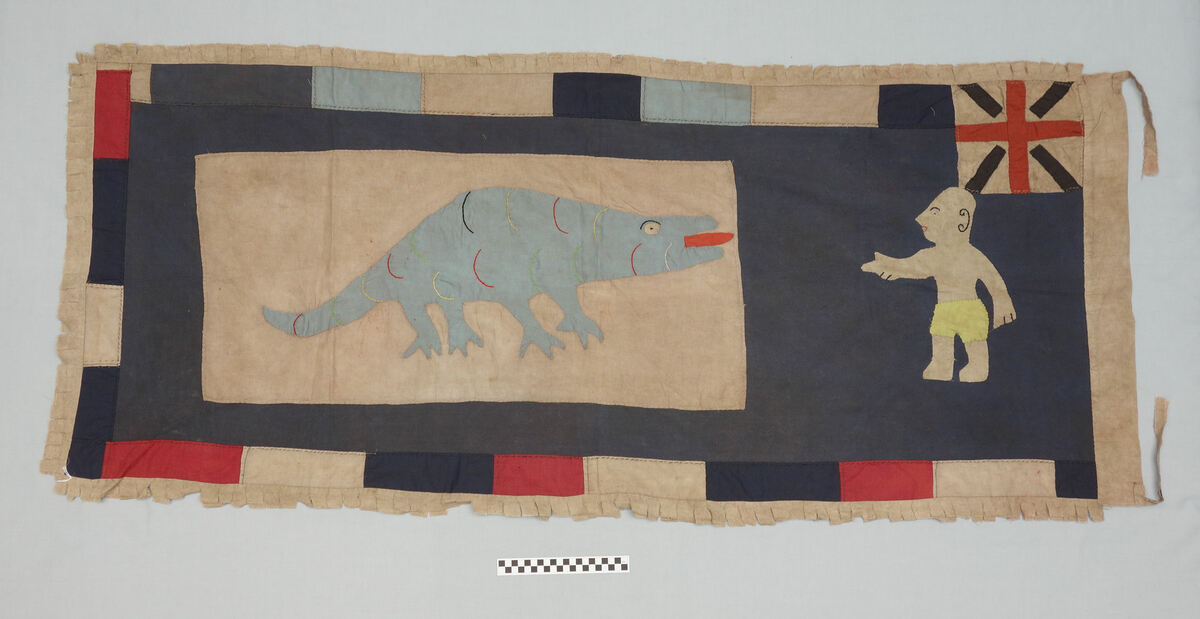 Asafo flag from Ghana, mid-20th century (TRC 2015.0220).
The three Asafo flags in the TRC collection were all made from cotton in the mid- to late 20th century. TRC 2015.0220 is a double-sided flag which shows a man facing a crocodile, with a simplified British flag in an upper corner. Proverbs and folk tales about crocodiles emphasize its strength, an obvious useful military attribute, while the flag shows the company’s alliance with the British. TRC 2015.0221 is a one-sided flag, 93 X 62 cm, which depicts a colourful stylized peacock spreading its tail. Near the peacock’s claws is another appliqué, perhaps a jar or bag. Lastly, TRC 2015.0222 features a variety of animals, including two fish, at least one bird and five larger, four footed animals.
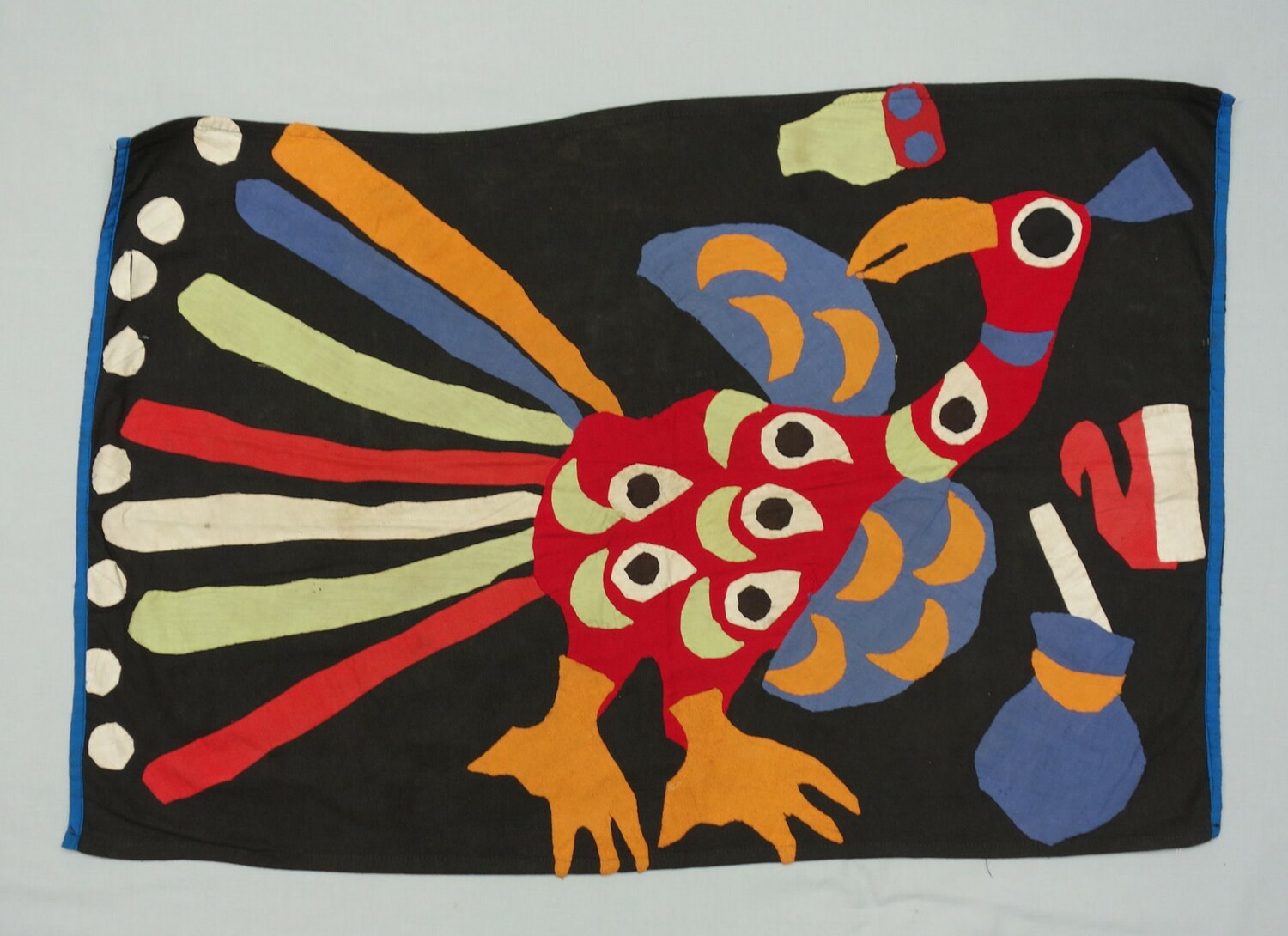 Asafo flag from Ghana, late 20th century (TRC 2015.0221).
The Asafo tradition began around the 16th century when Europeans first appeared in what was then called the Gold Coast, eager to trade European goods such as textiles and iron for gold, ivory and enslaved people. The influx of new political powers forced villages to create military companies to ensure their own security. European regimental flags (and some heraldic motifs, such as the dragon) were adapted, and each Asafo company had its own unique flag. From 1874 to 1957 a British colonial government ruled Ghana, and many Asafo flags showed allegiance by including a Union Jack in their design, or other symbols of British power, such as guns, airplanes, railroads or ships.
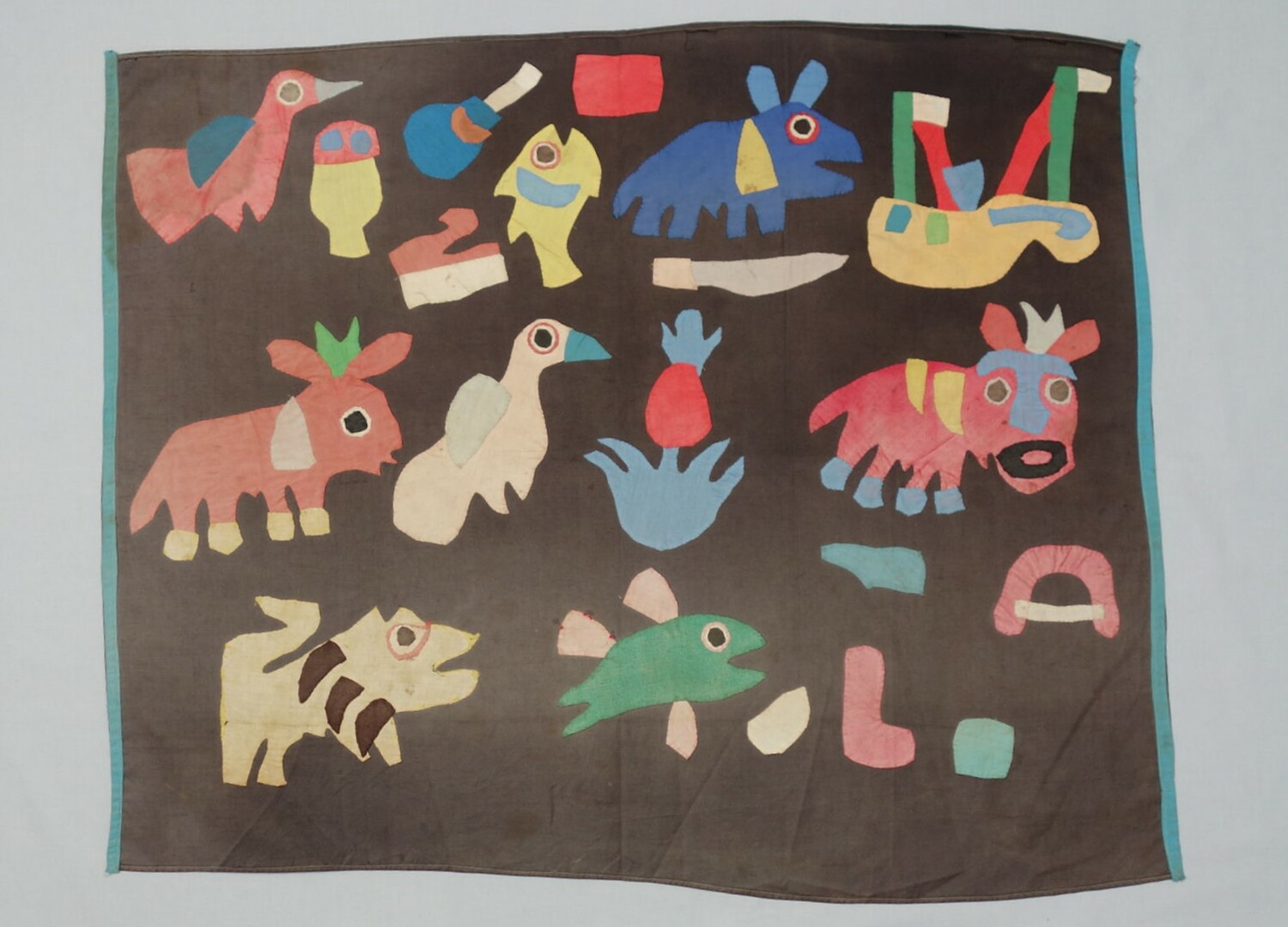 Asafo flag, mid-20th century, Ghana (TRC 2015.0222).
Independence ended the military use of Asafo companies and their flags. The Ghanaian flag replaced the British flag on some of the Asafo flags, but the companies' importance in Fante culture remains. New flags are commissioned when new members join a company, or a new leader is elected. Both new and old flags are kept around a shrine, and are proudly used in village processions and at festivals, in public dances and at funerals of company members. Asafo flags have become highly collectible in the last decades. Pre-Independence Asafo flags may cost over a thousand euros, and there is now a trade in appliqued flags made for the tourist market.
The Asafo flags are also discussed in the forthcoming TRC-edited and supported World Encyclopedia of Embroidery, Vol. 3, which focuses on sub-Saharan Africa (Bloomsbury, London). The publication is planned for 2022. The flags from the TRC collection also featured in a TRC exhibition 'Silhouette of Africa' (Febr. - May 2014).
Recently a digital exhibition of Asafo flags from the Karun Thakar collection has been put on-line. For more formation, click here.
Shelley Anderson, 17 April 2021