
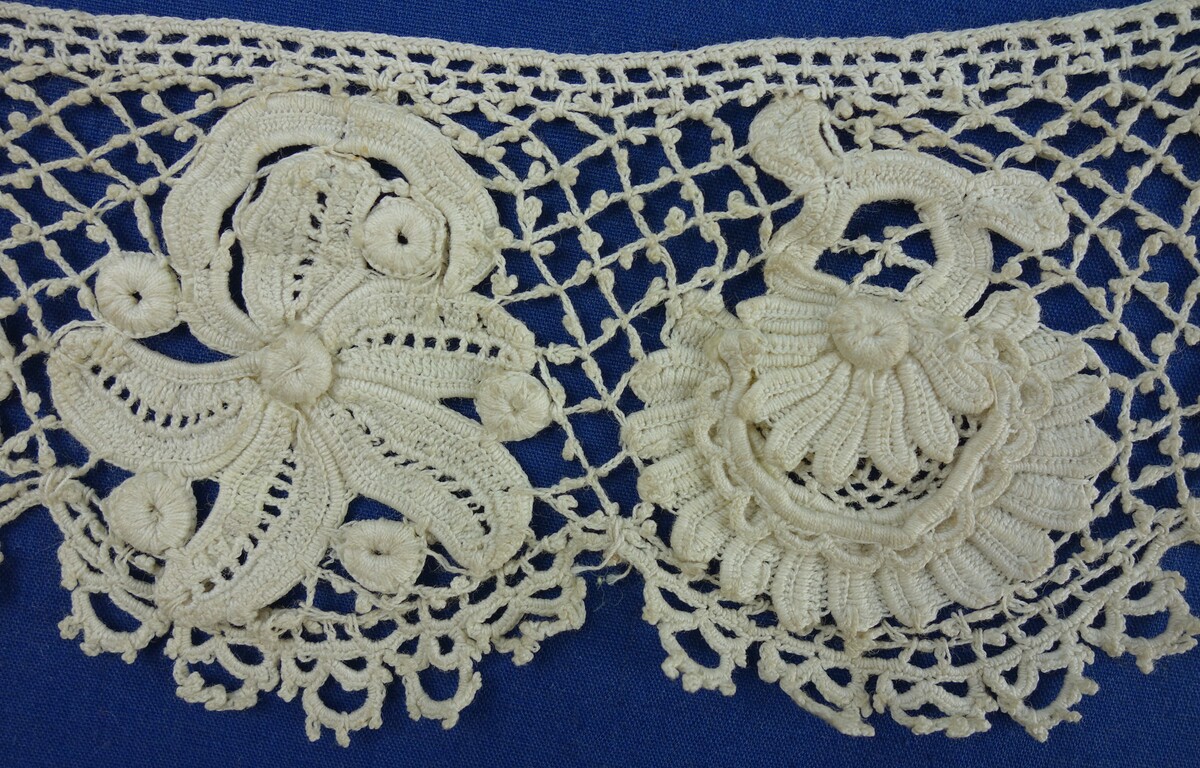
 Sample of Irish crochet lace (TRC 2007.0674).Citizen Culture has been active again at the TRC!
Last Saturday, 26 August, we had the first of a series of sessions with the aim of sorting out the TRC’s collection of hand and machine made lace. And by lace we mean “a textile patterned with holes which are created by the manipulation of threads” (Earnshaw 1984:91; see below), which is a very broad definition that includes a wide range of techniques, from needle forms and bobbin laces to crocheted, knitted, knotted and tatted techniques, not to mention machine made examples!
The TRC Reference Lace Collection currently stands at over 1000 pieces of lace. Some are small samples, others are complete items such as collars, lappets and shawls. They range in date from the early 19th century to the present day. The collection not only includes samples of lace, but also the tools and patterns required for lace making, such as bobbins, threads and pillows, crochet hooks, netting and tatting shuttles, as well as discs for making Tenerife lace.
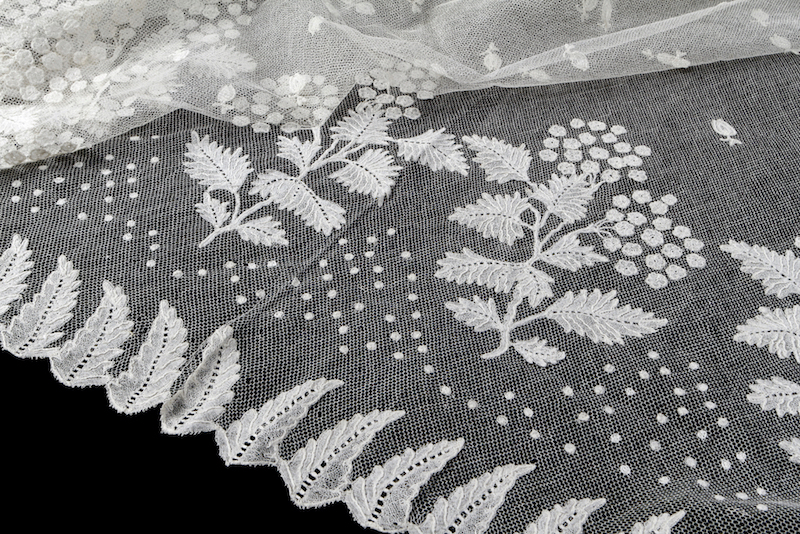 Fragment of a lace shawl (embroidered net lace) given by Princess Anne Paulowna (1795-1865), daughter of Tsar Paul I of Russia (and the wife of the later King Willem II) to Maria Petronella s’Jacob-Rochussen (1792-1848) for the christening of her daughter in 1822 (TRC 2014.0831).
In addition, in the main TRC collection there is a range of lace objects such as Belgian, Dutch and French lace caps. There are also garments embellished with lace, such as lace bags, fans and parasols. The TRC collection even includes a shawl that was owned by Princess Anne Paulowna (1795-1865), daughter of Tsar Paul I of Russia (TRC 2014.0831).
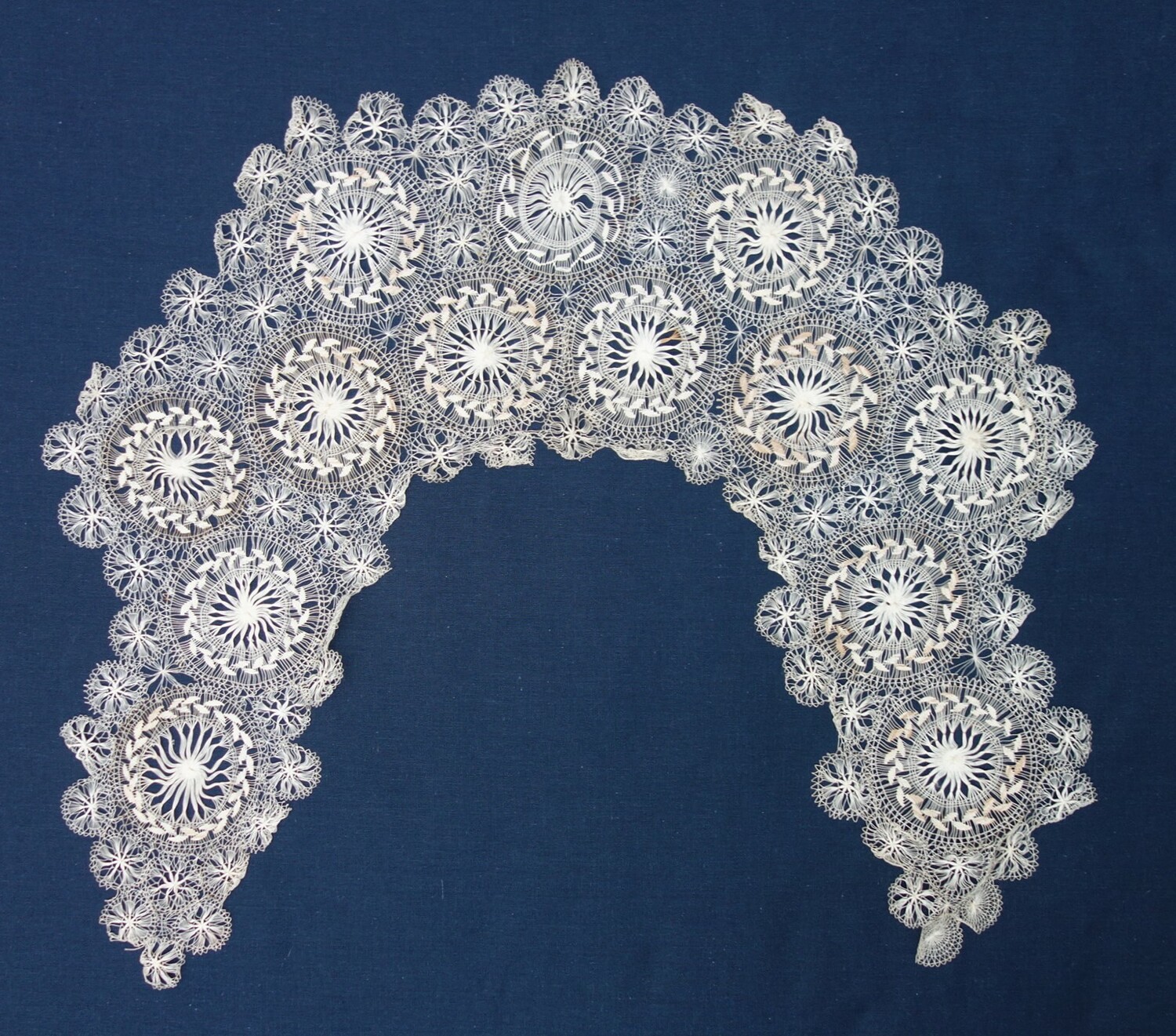 A collar made from Tenerife lace, late-19th century (TRC 2020.0462).Setting up the Reference Lace collection was started in 2006 and for a while we were helped by Olga Ieromina, to sort out the various types, something that requires specialist knowledge since there are so many variations and combinations. After Olga moved jobs, etc, she stopped helping at the TRC and we did our best to sort things out, but we were much very aware that more experienced help was needed.
For the last few years we have been running bobbin lace workshops at the TRC, given by Gon Homburg (member of the Administrative Council of OIDFA (International Bobbin and Needle Lace Organization, www.oidfa.com) and board member of OIDFA Nederland (http://www.oidfanederland.nl).
We have also been talking about setting up a group to help check and add details to the TRC Collection database. By we, I mean a group from the OIDFA Nederland, the Dutch chapter of an international lace organisation, which includes both experienced teachers and people learning bobbin lace of various types and indeed at various levels.
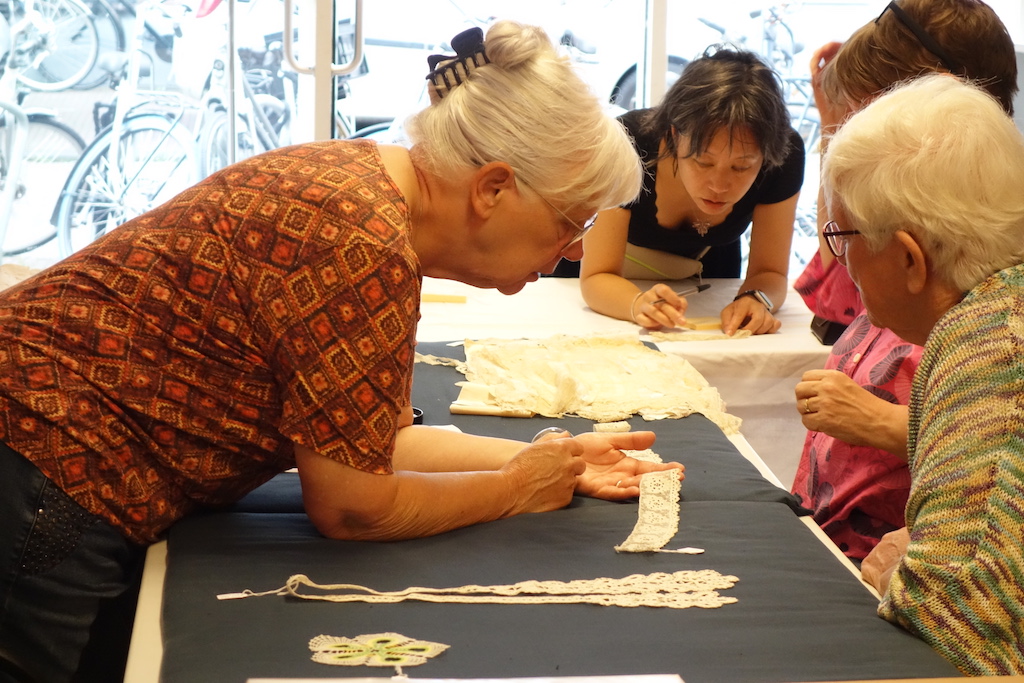 Studying samples of lace at the TRC, Saturday 26 August. Photograph by author.For the first session there were four lace makers at the TRC, Riet Delescen, Gon Homburg, Annemieke Solleveld and Caro Thé. This session was used to develop a working method, see the extent of the ‘challenge’ and to suggest possibilities for how the collection can be presented and used.
Four boxes (out of over forty) with about 100 samples were sorted according to technique, such as chantilly, guipure, Le Puy, Bruges, Brussels appliqué, Bucks point, tape laces, as well as a piece of ‘s Gravenmoer, etc.
One of the questions that was raised is: why is the TRC collecting all these samples, some of which are not well made? Once again I stressed that we are not an art gallery filled with beautiful items. One of our core activities is textile techniques, including understanding, identifying and the passing on of knowledge, and for that to take place it is necessary to have a wide range of examples. Compare a previous study of a piece of 's-Gravenmoer lace.
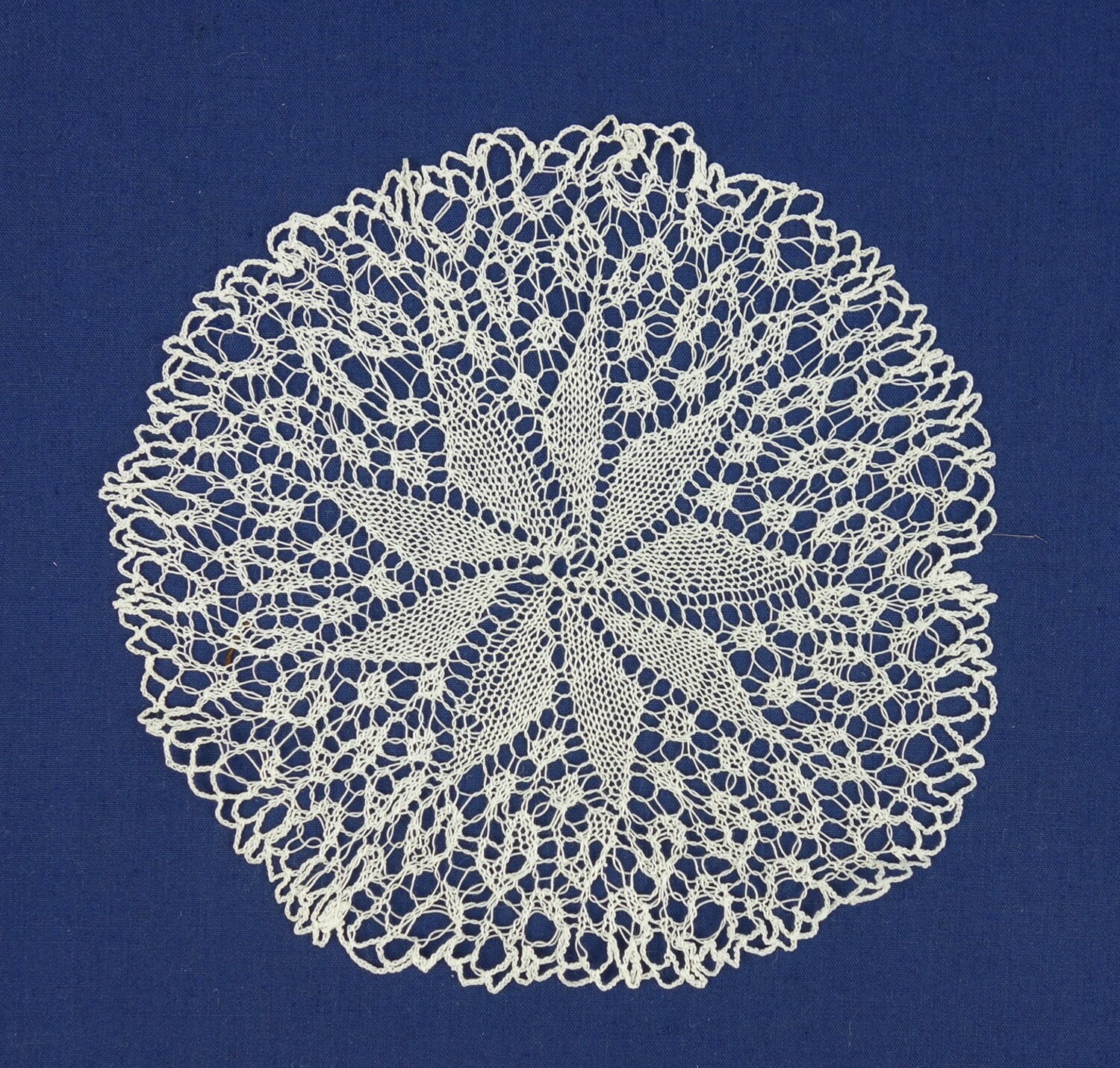 Doily made of knitted lace (TRC 2014.0555).Over the next few weeks we will be adding the initial divisions and comments to the TRC collection database. The next meeting will take place in six weeks’ time. I am really looking forward to it as it is a great way to learn more about lace techniques and types, from people who really know as they have been making and working with lace for decades.
Our joint aim is to make the TRC Lace Collection an international level facility that is not stuck behind glass, but is a handling collection that can be used by anyone who is seriously interested in learning more about the wide variety of lace forms that have and are being produced and used.
In addition, we want to increase the number of lace courses and workshops, as well as an artisan centre with suitable tools and equipment. Lots to think about.
Perhaps one day we can have a new slogan – Leiden, City of Lace!
Gillian Vogelsang-Eastwood, 28 August 2023
* Pat Earnshaw (1984). A Dictionary of Lace, Aylesbury: Shire Publications Ltd