

 Participants to the ikat workshop having lessons on how to weave on a body-tension loom.For the last fortnight (12th – 24th August 2017), the TRC has been host to two weavers, Mapung Salomina and Emiliana, and Mrs. Musrikah Siti. Mrs. Siti is a museum curator and representative of the Koperasi Jasa Menenun Mandiri, a weaving co-operation with well over 1200 members, of which c. 300 weave on a daily basis. All are from from Sintang, Kalimantan (Borneo) in Indonesia. Their visit was facilitated by Esmeralda and Theo Zee, both of whom with strong connections with Indonesia.
A series of ten workshops and lectures were presented to over seventy participants. These meetings helped people to understand the process of ikat production, from the preparation of the cotton threads (using a spindle wheel), to the binding of the warps for ikat making, the dyeing of the threads and the weaving of the end product. In addition, there were extra workshops on various basic basketry and beading techniques.
The weavers, Mapung Salomina and Emiliana, set up two ikat looms in the TRC Gallery and this number was increased to four for the weaving workshops. This meant that each of the participants had at least thirty minutes working on the loom, learning and understanding the basic movements and techniques required. Every movement was watched and corrected by Mapung and Emiliana. It was hard work, especially for people who are not used to working with body-tensioned looms. But it certainly increased everyone’s appreciation of, and respect for what is involved in making an ikat textile in this manner.
The strict approach of the teachers was reflected in the binding lesson, when one (unfortunate) participant had spent a long time binding some warp threads only to have all bindings removed because they were not done in the ‘proper’ manner! A fact that was appreciated by the participants, as Mapung and Emiliana made it clear that the groups were there to learn new techniques and not to develop their own forms. The need for the participants to change how they thought about a design, how to describe it and more importantly how to communicate it from the brain to fingers was very apparent. People learnt a lot about themselves as well as about Sintang forms of working.
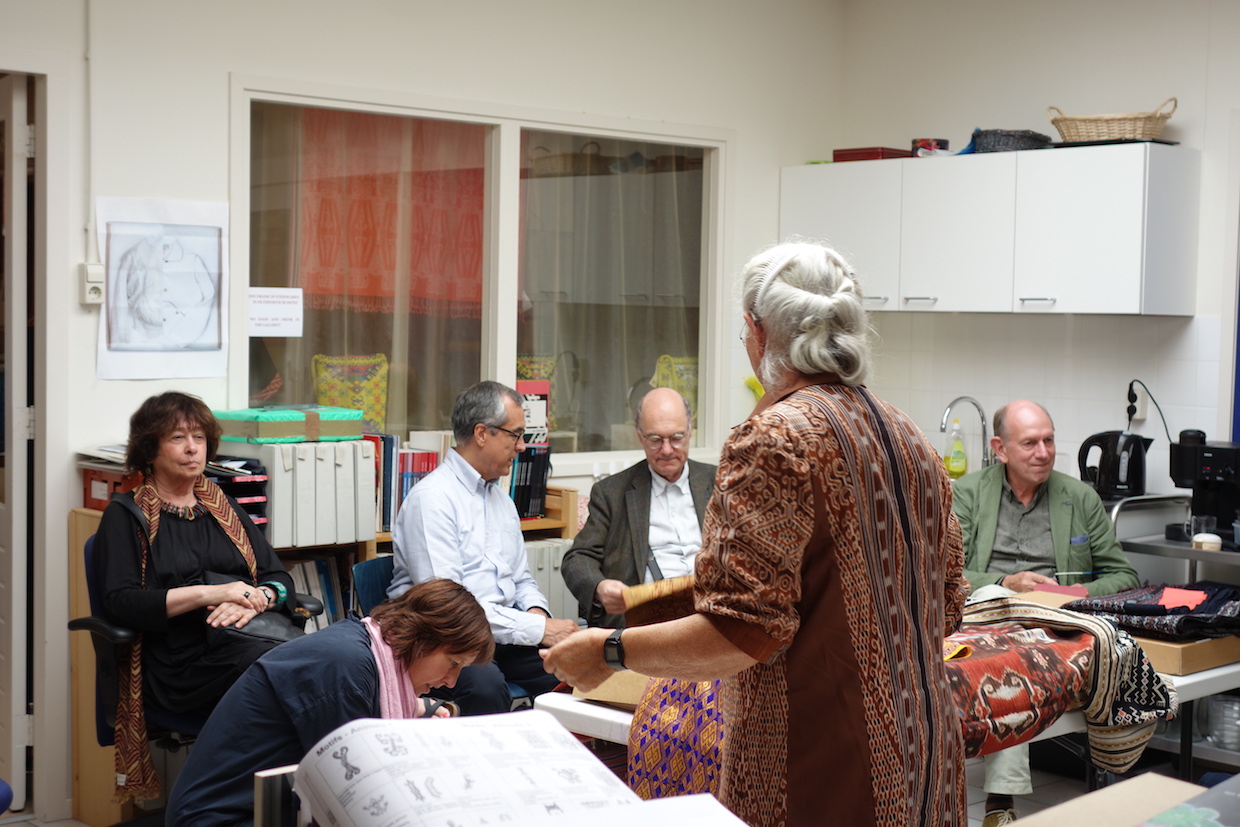 Lecture on the identification of Indonesian ikats, by Esmeralda Zee.These workshops were very well attended and intensive – there was a lot to take in within a relatively short period (generally three hours), so the socialising and gossiping that is found in many Western sewing bees and quilting parties was not encouraged! Which is not to say that the TRC staple of tea/coffee and biscuits was absent. These were seriously needed.
The educational function of the TRC also came to the fore in two lectures that were given, one by Mrs. Esmeralda Zee, assisted by Mrs. Musrikah Siti, Mapung Salomina and Emiliana, and the second by myself, about non-Indonesian ikats, based on historical and modern examples in various museums, as well as in the TRC Collection. The use of deep fringes on the Ecuadorian ikats was especially noted. Mrs. Musrikah Siti is now going to develop a series of talks about non-Indonesian ikats to show how Indonesian forms fit within a global setting.
The weavers came with a variety of items for sale, some of which the TRC has purchased. In addition, we have acquired one of the looms used for the workshops – with the web, heddles and sticks all in place as well as ordering a series of small-scale frames that show step-by-step how a Sintang ikat is made. These will form the basis of a digital exhibition about ikats from around the world to be published in the near future.
The closing ceremony on Thursday afternoon (24th August 2017) was carried out by Prof. Bambang Hari Wibisono, the cultural attaché of the Indonesian Embassy in The Hague. His presence was greatly appreciated by all, as it confirms how important such cultural exchanges and events are, both in Indonesia and the Netherlands.
Gillian Vogelsang, 27th August 2017.