On 24 October 1811, while on his way from Amsterdam to The Hague, Napoleon Bonaparte stopped briefly at a stately canal house along the Rapenburg (No. 48) in Leiden. The house still rises majestically opposite the medieval Academy Building of Leiden University. It is located some hundred metres from the place where his younger brother, Louis Napoleon, as King of Holland, had visited the site where on 12 January 1807 a ship loaded with gun powder had exploded, thereby devastating part of the inner city of Leiden.
Last week, the Textile Research Centre (TRC) in Leiden, located at a ten minutes' walk from the Rapenburg, received a fragment, kindly donated by Kees van der Zwan, of what may have been the pall that covered Napoleon's coffin. The cloth was allegedly used when Napoleon's remains were transported back from St. Helena in the southern Atlantic (his place of exile from 1815 until his death in 1821) to France, on board the frigate La Belle Poule. This occurred in the second half of 1840, and Napoleon's remains were eventually laid to rest in the Domes des Invalides in Paris.
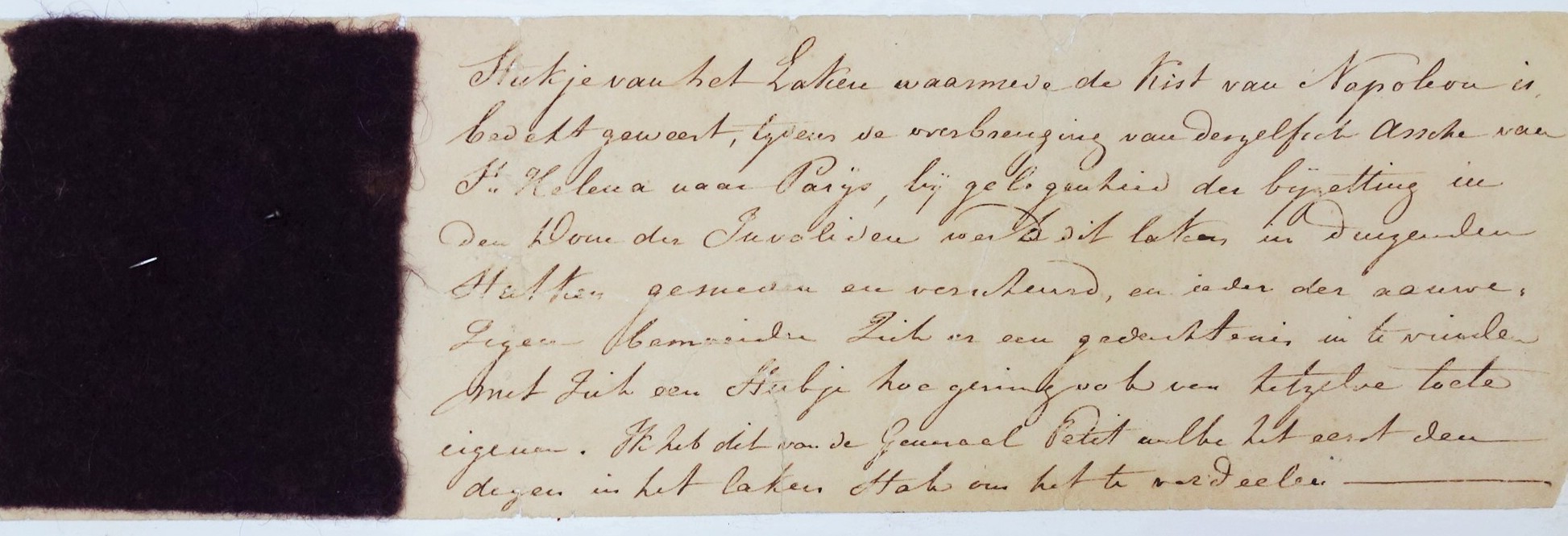 Fragment of broadcloth (to the left), purportedly cut from a pall of Napoleon's coffin in 1840/1841. To the right is a piece of paper with a text in Dutch identifying the piece of cloth (TRC 2020.4528).




 Photograph of the TRC workshop on pre-industrial sewing techniques, 9 December 2020.