• F2
  • F4
  • F1
  • F3

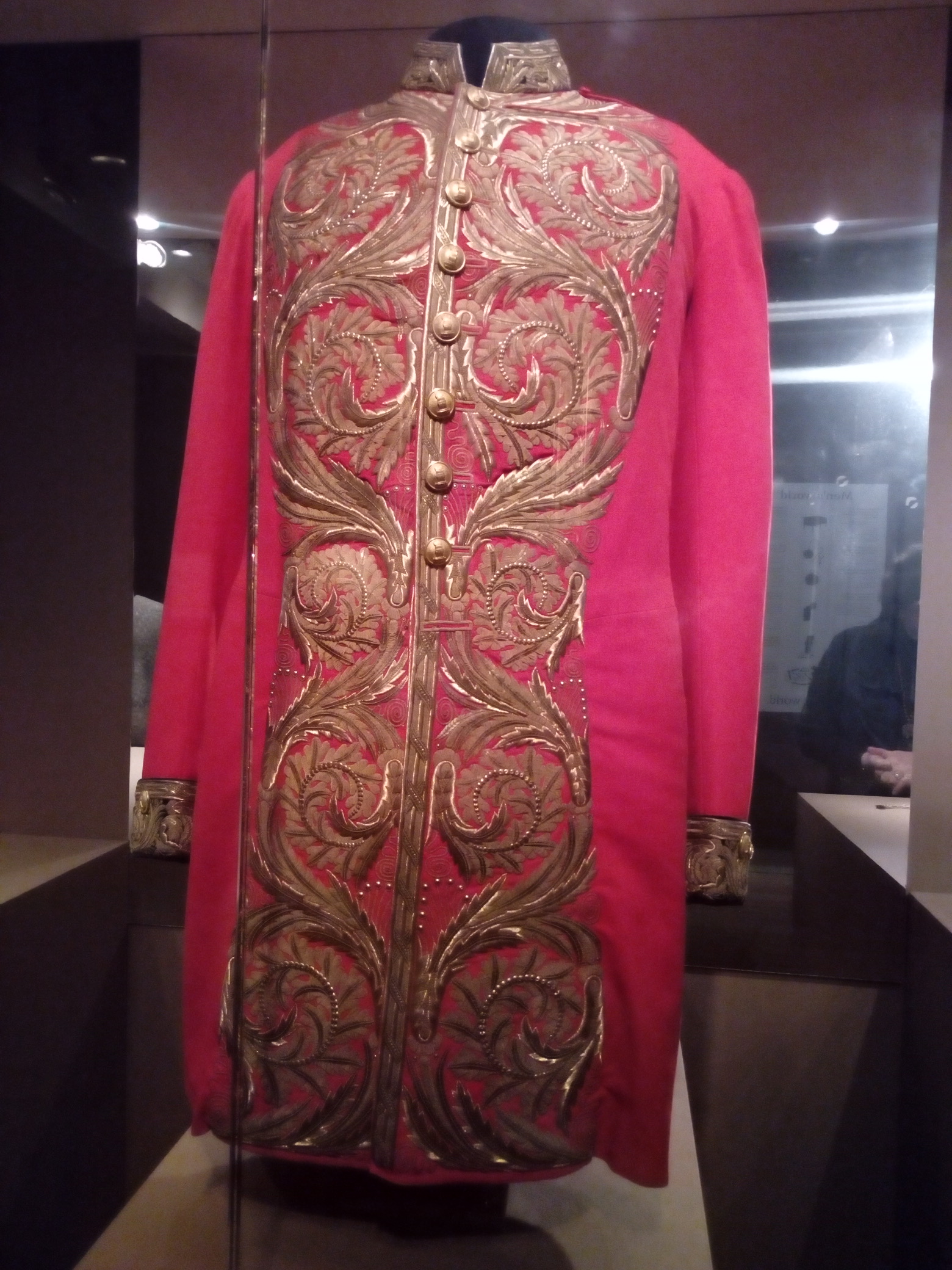
Parade uniform of a Russian senator, velvet and silk. The gold thread embroidery and buttons were considered a sign that the Emperor respected the senator's status. Late 19th-early 20th century.Parade uniform of a Russian senator, velvet and silk. The gold thread embroidery and buttons were considered a sign that the Emperor respected the senator's status. Late 19th-early 20th century.On Sunday, 9th February 2020, TRC colleague Shelley Anderson wrote:

The exhibition “Jewels: Glittering at the Russian Court” may be its most popular exhibition ever, according to the Hermitage in Amsterdam. It is easy to understand why. On display are over three hundred pieces of jewellery and dozens of court ball gowns, many complete ensemble of gowns, shoes, fans and jewellery. Also on display are some hundred portraits that show how the Russian aristocracy used dress to project wealth and power.

The exhibition is stunning. It showcases over two hundred years of royal fashion (mostly women’s fashion, although there are some beautiful examples of children’s clothes, and of men’s. The emphasis is on three important trend setters: Anna Ioannovna (who ruled 1730-1740), Empress Elizabeth (who ruled from 1741 to 1761), and Catherine the Great, ruler from 1762 to 1796.
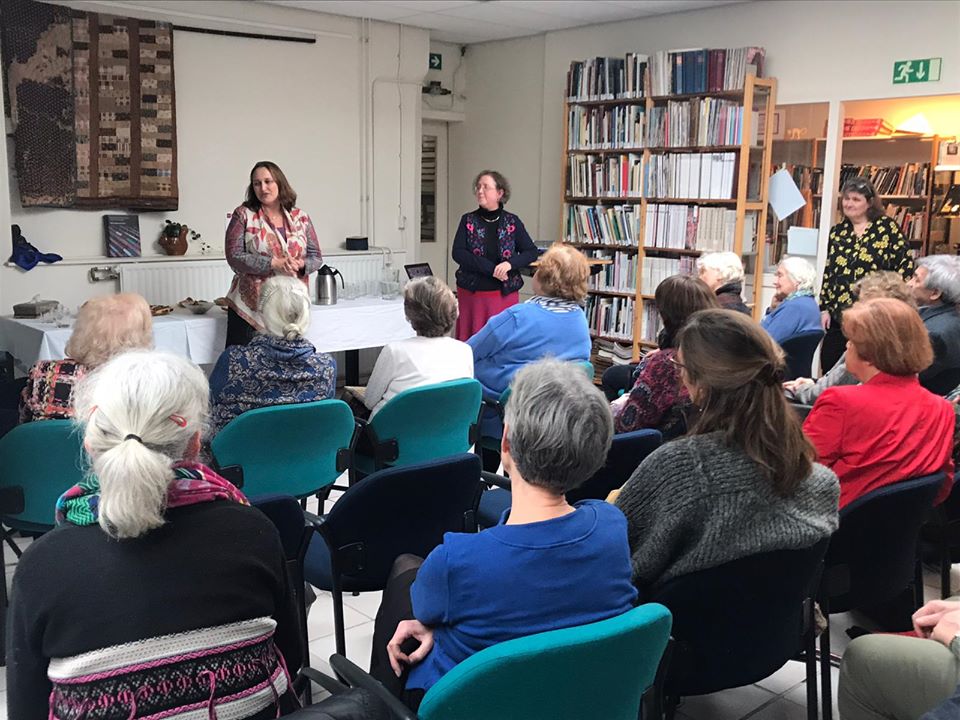
Opening of the TRC American Quilts exhibition, 5th February 2020, by Marja Verloop, the Deputy Chief of Mission of the American Embassy, The Hague.Opening of the TRC American Quilts exhibition, 5th February 2020, by Marja Verloop, the Deputy Chief of Mission of the American Embassy, The Hague.On Friday, 7th February 2020, Gillian Vogelsang wrote:

The American Quilt exhibition has just been officially opened (5th February 2020) and it was a most inspiring event with lots of visitors!

It started with a lecture by Susan Cave on the history of American quilts. The talk was illustrated with photographs of quilts form the exhibition and numerous anecdotes based on Susan’s long experience of working with quilts.

Additional, and more technical details were provided by Beverley Bennett. Lynn Kaplanian-Buller presented details about Mennonite relief quilts (three of which are on display in the exhibition).

A few days ago I published a blog about TC (Technically Correct) embroidery, and I have just come across a fascinating example from the 17th century of something Non-Technically Correct. It is the initialled handkerchief of King Charles I (reign: 1625-1649) of England, who was executed on the 30th January 1649.

The handkerchief and other items such as his silk shirt, pair of gloves (also embroidered) and part of his black cloak are now in the Museum of London, They will shortly go on display in an exhibition at the Museum about executions in the city. All of the items mentioned above were worn by King Charles when he went to his own execution.

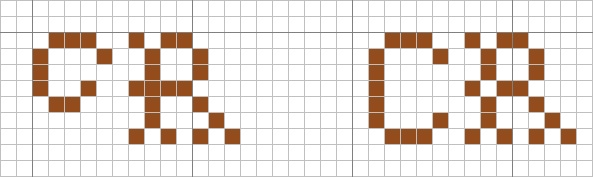
Embroidery chart for the initials of Charles I, used for his handkerchief associated with his execution on 30th January 1649. To the right the TC version, to the left the actual, non-TC version.Embroidery chart for the initials of Charles I, used for his handkerchief associated with his execution on 30th January 1649. To the right the TC version, to the left the actual, non-TC version.

On a much lighter note, the handkerchief bears the initials C.R. (Carolus Rex) under a royal crown. The crown is worked in back stitch using a black silk thread, while the initials are in cross stitch. The original cross stitches are of varying sizes, in order to create the appearance of regularity. They were worked over various numbers of warp and weft threads. If an actual version of the initials is produced based on the number of stitches then the letters are of different sizes (to the left in the chart). If a 'correct' version is produced (to the right), then more stitches would be required than actually was the case!

Is this an example of quick work that looked okay from a distance due to the circumstances of when it was required? Or something else? We will probably never know.

Gillian Vogelsang, 1 February 2020

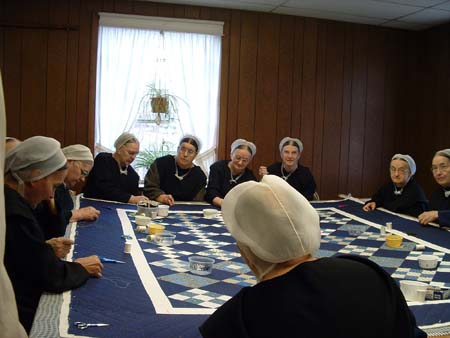
Mennonite women in North America engaged in making quilts, 2005. Mennonite women in North America engaged in making quilts, 2005. In 1994, twenty relief quilts made in 1945 by North American Mennonites for the Dutch were given into my care. Last year I lost one…. and that was okay. Here’s the story.

After WW2, Russian Mennonites fleeing westward were allowed to stay in The Netherlands for a short time providing that the Dutch Mennonite (Doopsgezinde) community would house, feed and clothe them.

Short of supplies themselves after the Honger Winter, Mennonites in Canada and the US sent over pallets of food, clothing and quilt blankets, which they’d been preparing since 1940.

The relief was coordinated by the Mennonite Central Committee (MCC), founded in 1920 to assist Russian Mennonites to emigrate to Canada after WW1. Many of the key people in the 1945 efforts were themselves refugees from the previous war. Helping now was their way of repaying and passing on the comfort they had received.

Wissa Wassef tapestry panel woven by a young boy, Imam, aged 12 (TRC 2020.0214).Wissa Wassef tapestry panel woven by a young boy, Imam, aged 12 (TRC 2020.0214).A major influence on Egyptian decorative textiles in the 20th century was the work of Habib Gorgi and his son-in-law, the architect Ramses Wissa Wassef (1911-1974). Both believed that children were (and are) endowed with creative powers and potential that should be encouraged.

In 1951, Wissa Wassef established the Ramses Wissa Wassef Art Centre, near the Giza pyramids. The aim of the Centre was to teach Egyptian village children to create art, and tapestries in particular. Ramses Wissa Wassef encouraged the children to weave images based on things they saw around them in their villages, such as women talking, making bread, washing, men working in the fields or fishing, weddings, birds, fish and so forth.


Uncoverings 2019Uncoverings 2019On Tuesday 28th January 2020 Gillian Vogelsang wrote:

A few weeks ago Kim Baird (North Dakota, USA) got into contact with the TRC about her visit to the TRC in Leiden last year, how much she enjoyed it and also our forthcoming American Quilt exhibition. She mentioned her work with the American Quilt Study Group.

This organisation was founded by Sally Garoutte in 1980. What began as a small group has now grown into a unique and highly respected international organisation. Its goal is to preserve the story of quiltmaking - past, present, and future, and it has become a major source of information about the study of quilts, quiltmakers, related textiles, and processes. 

Coptic medallion of linen and wool, tapestry weave, 6th-7th century, Museo Nazionale di Ravenna.Coptic medallion of linen and wool, tapestry weave, 6th-7th century, Museo Nazionale di Ravenna.On Sunday, 26th January 2020, Shelley Anderson wrote:

Ravenna, Italy, is better known for its Byzantine mosaics than it is for its textile collections. But during a recent visit I saw some beautiful textiles. The first collection was in the Museo Nazionale di Ravenna, housed in a former monastery next to the Basilica of San Vitale. This museum is home to a large collection of Coptic textiles. The display rotates regularly, but some current pieces include a lovely tunic band showing the birth of Aphrodite (7th-8th centuries CE), and a wider decorative band (7th century CE) of pomegranates and leaves. There was also a large Coptic medallion depicting flowers and fruit (6th to 7th centuries CE), made in a tapestry weave from wool and linen. Next to this was a case displaying, again in a linen and wool tapestry weave, two long bands showing a warrior saint (7th to 8th centuries CE).

An embroidered panel with a cross stitch centre and a drawn thread work border (1794, Amager, Denmark; bequest of Mrs. Henry E. Coe, courtesy of the Cooper-Hewett Museum, New York 1941-69-116).An embroidered panel with a cross stitch centre and a drawn thread work border (1794, Amager, Denmark; bequest of Mrs. Henry E. Coe, courtesy of the Cooper-Hewett Museum, New York 1941-69-116).On Saturday, 25th January 2020, Gillian Vogelsang wrote:

While working on the forthcoming quilt exhibition at the TRC and on the Encyclopedia of Embroidery series at home, I was struck by the modern need for precision and symmetry and how computers and their need for 'accuracy' have changed our lives. And in this case, also embroidery.

A feature of early twenty-first century embroidery, for example, is the use of computer programmes in order to create and re-create certain designs, and the distribution of such patterns online via social media groups such as Pinterest. Many of these designs are worked out on graph paper (or rather the computer equivalent) and then copied and mirrored, so quickly producing a symmetrical design.

However, when working with sixteenth century and later designs it is clear that what may look symmetrical was not necessarily identical on both sides of a central line. For example, eighteenth century cross stitch samplers from Amager in Denmark are full of small variations in the place and the way different parts of the overall design are worked out. Furthermore, it is clear that the embroiderer did not always ‘correctly’ count how many ground threads, and indeed which of these threads they were working the stitch over. From a distance these samplers look visually regular, but they are not ‘computer’ regular. But are these samplers therefore inferior?

Zoek in TRC website

Contact

Boerhaavelaan 6
2334 EN Leiden.
Tel. +31 (0)71 5134144 (kantooruren)  
office@trcleiden.org

Het TRC is elke dag geopend tussen 10.00 en 15.00 uur.

facebook 2015 logo detail


instagram vernieuwt uiterlijk en logo


Bankrekening

NL39 INGB 0002 9823 59, t.a.v. Stichting Textile Research Centre.

Financiële giften

Het TRC is afhankelijk van project-financiering en privé-donaties. Al ons werk wordt verricht door vrijwilligers. Ter ondersteuning van de vele activiteiten van het TRC vragen wij U daarom om financiële steun:

Giften kunt U overmaken op bankrekeningnummer (IBAN) NL39 INGB 000 298 2359, t.n.v. Stichting Textile Research Centre. BIC code is: INGBNL2A

U kunt ook, heel simpel, indien u een iDEAL app heeft, de iDEAL-knop hieronder gebruiken en door een bepaald bedrag in te vullen: 


Omdat het TRC officieel is erkend als een Algemeen Nut Beogende Instelling (ANBI), en daarbij ook nog als een Culturele Instelling, zijn particuliere giften voor 125% aftrekbaar van de belasting, en voor bedrijven zelfs voor 150%. Voor meer informatie, klik hier