• F4
  • F1
  • F3
  • F2

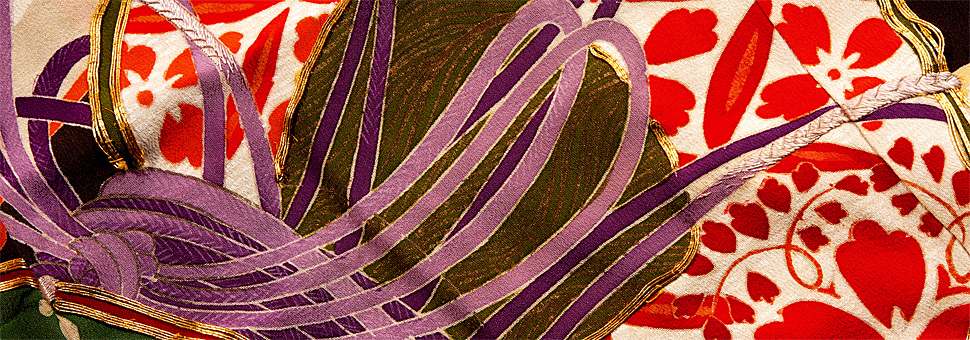
National festive women's costume designed mid-19th century by the Icelandic painter, Sigurdur Gudmundsson.National festive women's costume designed mid-19th century by the Icelandic painter, Sigurdur Gudmundsson.Shelley Anderson, TRC volunteer, recently visited Iceland. On Sunday, 21st October, she writes:

A visit to the National Museum of Iceland  in Reykjavik is a must for anyone who loves textiles. While there is no specific section devoted to textiles, the museum’s third floor houses the permanent exhibition “Making of a Nation: Heritage and History of Iceland”. Some beautiful examples of costumes, altar frontals, ecclesiastical clothing and domestic textiles are scattered throughout this display.

Two costumes struck me in particular, as they illustrate the close connection between dress and identity. The first is a pre-1860 ensemble that was considered the national festive dress for women. Called faldbuningur, it includes a high white headdress with a multicoloured silk kerchief; another silk neckchief (dated to 1780-1800); a jacket worn over a sleeveless bodice, both of black, woollen broadcloth with embroidered borders; a velvet belt, with a large white handkerchief in drawn thread technique hanging from it; and a blue broadcloth skirt and apron.

Sherry Cook and Adrian Pratt, with Gillian Vogelsang, at the TRC, 12th October 2018Sherry Cook and Adrian Pratt, with Gillian Vogelsang, at the TRC, 12th October 2018On Saturday, 13th October 2018, Gillian Vogelsang writes:

Since August 2018 we have had an exhibition called ‘Sherry’s American Quilts’ on display at the TRC. It includes over twenty quilts  and quilt tops donated by Sherry Cook. It is a gentle exhibition with some lovely items dating from the 1830’s onwards.

A few days ago we had the great pleasure of actually showing Sherry and her husband Darwin around the exhibition. They have come all the way from their home near Portland, Oregon (USA), to hand deliver another group of quilts, which they have donated to the TRC. These ‘new’ quilts date from the 1840’s to the present day (compare TRC 2018.3121TRC 2018.3127; TRC 2018.3118) and represent many aspects of American history and cultural heritage, as well as changing artistic tastes and textile technology.

Beverley Bennett sewing on sleeves for the quilts (TRC October 2018).Beverley Bennett sewing on sleeves for the quilts (TRC October 2018).Beverley Bennett, a TRC volunteer, reports on her work with the American quilts recently donated to the TRC (Monday, 8th October 2018):

Sherry’s American Quilts is the current exhibition at the TRC and I have taken on the task of making ‘hanging sleeves’ for some of the quilts. Why is this necessary? Well, quilts were made for beds – mostly for the warmth that the three layers (top, bottom and some form of ‘padding’) provided. However, they soon became decorative objects in their own right.

Striving to be the best at making quilts led to competitions at County and State Fairs, where quilters would show their work and compete for first place and a blue ribbon – later there were larger quilt contests where cash prizes could be won. Today there are huge Quilt Shows with prizes for every category that you can think of.

Kashmir shawl, attributed to Mohammed Azim Khan, the Pashtun governor of Kashmir between c. 1813 and 1819 (courtesy Metropolitan Museum of Art, New York, MMA x.103.4).Kashmir shawl, attributed to Mohammed Azim Khan, the Pashtun governor of Kashmir between c. 1813 and 1819 (courtesy Metropolitan Museum of Art, New York, MMA x.103.4).Sunday, 16th September: Not many people may know this, but for many years Kashmir in the northwest of the Indian subcontinent was ruled by a series of Pashtun governors sent to the mountains of Kashmir from the Afghan/Pashtun capital in Kandahar or Kabul.

Pashtun rule started in the mid-eighteenth century and came to an end around 1820 when the province was captured by the Sikhs, who were rapidly expanding their realm from their capital in Lahore, now in northern Pakistan.

Not much is known about the period of Pashtun domination in Kashmir. But while preparing the Encyclopedia of Embroidery from Central Asia, the Iranian Plateau and the Indian Subcontinent (London: Bloomsbury 2019), we came across a Kashmir shawl now in the Metropolitan Museum of Art (MMA x.103.4). It measures 183 x 131 cm and was woven out of goat’s hair (pashmina). The Museum has dated this example to c. 1825. What is so exciting is a Persian text stitched onto the shawl, which reads (in English): ‘O Hoseyn; ordered by the most noble governor [nawab], Mohammed Azim Khan’.

The title of nawab was commonly used in the Indo-Iranian lands for ‘governor’. So who was ‘the governor’ Mohammed Azim Khan, who ordered this shawl? And yes, Mohammed Azim Khan Barakzai was indeed one of the last Pashtun governors of Kashmir, between c. 1813 and 1819. He was a younger brother of Fath Ali Khan Barakzai, the king’s vizier, who had obviously appointed his younger brother to the governorship in Kashmir. However, Fath Ali Khan was tortured to death (blinded, flayed and dismembered) in 1818 on the orders of the king, Shah Mahmud Sadozai. Upon hearing the news of his elder brother’s death, Mohammed Azim Khan left his position in Kashmir and managed, together with his many other Barakzai brothers, to oust Shah Mahmud and his Sadozai clan and take charge of the Afghan capital, Kabul.

A few years later, in 1823, Azim Khan was defeated by the Sikhs at Nowshera east of Peshawar, and soon afterwards he died of dysentery in the Lataband Pass, just east of Kabul. His son, Habibullah Khan, succeeded him in Kabul, but he was soon pushed aside by his uncles. One of these, Dost Mohammed Khan, would by c. 1825 take charge in Kabul and gradually extend his control, until, by his death in 1863, he would rule almost all of what today we recognize as the republic of Afghanistan.

The Barakzai family would dominate Afghan politics until the communist coup of 1978.

Gillian and Willem Vogelsang, 16th September 2018

Hand embroidered bride's dress from 19th century China, decorated with wisteria flowers woven in a delicate tapestry weave (TRC 2018.2840).Hand embroidered bride's dress from 19th century China, decorated with wisteria flowers woven in a delicate tapestry weave (TRC 2018.2840).Saturday 8th September. Gillian Vogelsang, director TRC, writes:

The last two weeks has seen a very diverse group of textiles and garments being donated to the TRC Leiden. These include nineteenth century Chinese garments, some of them for court officials, another for a bride, and also a number of Zoroastrian textiles and garments from Yazd in Iran and dating to the early 20th century (see below). The Zoroastrian garments are part of a donation by the Katayoun Keyani and Mehraban Bondarian family in America.

There is also a group of Peruvian hand knitted caps form the 1970’s (compare TRC 2018.2913). Some of these will appear in the TRC’s exhibition about hand knitting, planned for the autumn of 2019. And from the Indian subcontinent we received a donation of ralli quilts from Pakistan/western India, and these date from the 1960’s and 70’s (compare TRC 2018.2896, TRC 2018.2897, TRC 2018.2898 and TRC 2018.2899).

Setting up the quilt exhibitionSetting up the quilt exhibitionThe last few weeks have been dedicated to getting the TRC’s latest exhibition ready. It is called Sherry’s American Quilts and is a ‘thank you’ to Sherry Cook for donating over 25 American quilts, tops and related items. It runs from 20th August until the 18th October 2018. On Thursday afternoon we started to take down the feedsack exhibition, which was a sad moment as we all loved this colourful and intriguing exhibition. Then we started to put up the new display with initially 25 items, but it was increased to over thirty objects as we changed position, proposed order, colours, etc.

Work continued on Friday morning and then, all of a sudden, it was there! The right objects in the right place. Highlights? Well, there is a late nineteenth century velvet crazy quilt that is made of silk velvet in jewel colours. There is also a quilt with appliqué airplanes, a design that celebrates Charles Lindbergh’s flight across the Atlantic in 1927 (click here). But perhaps the quilt that is causing the most comment is a blue/white pieced quilt with a Feathered Star design. It is believed that this quilt dates to the mid-nineteenth century, or possibly earlier. It is beautifully quilted and by itself worth coming to Leiden for. But there are other quilts to see, dating from the late nineteenth century to the 1950’s, as well as items that were worked and finished by Sherry and her Amish friends.

Gillian Vogelsang, Sunday 19th August 2018


Detail of a quilt with airplanes, in commemoration of Charles Lindbergh's first solo-flight across the Atlantic, in May 1927, USA, late 1920s (TRC 2018.2627).Detail of a quilt with airplanes, in commemoration of Charles Lindbergh's first solo-flight across the Atlantic, in May 1927, USA, late 1920s (TRC 2018.2627).The TRC recently received another box with quilts from Sherry Cook in America, in preparation of the upcoming TRC exhibition 'Sherry's American quilts', which will open at 20th August and be on display until 2nd September.

One of the quilts (TRC 2018.2627), some two by two metres, has a patchwork top made out of blocks that are decorated with an appliqué design of an airplane. The quilt probably dates to the late 1920s. The design became popular after the historic and first solo and non-stop flight by Charles Lindbergh across the Atlantic. The epic flight took place on 20-21 May 1927.

Mengying Zhang, familiarly known as Eden, is a TRC volunteer and student at Leiden University. She has been helping with cataloguing the TRC Collection and getting to know and understand about the running of a small collection, the setting up of exhibitions, and how to come to grips with some of the many stories behind the objects. This is the second in a series of blogs she is writing about her work and the TRC collection.

She writes: I would like to bring your attention to a particular variant of Dutch regional dress, namely women's upper body garments from Marken, until recently an island in the province of Noord-Holland, in what is now called the IJsselmeer, and what used to be called the Zuiderzee.

The local dress of this village is one of the most famous regional dress forms in the Netherlands, because it has been kept and worn for centuries. My personal interest in these garments is the unique ways in which the garments are worn and their interesting structures. There are three types of upper body garment, namely the mouwen, het buisje and the borsik.
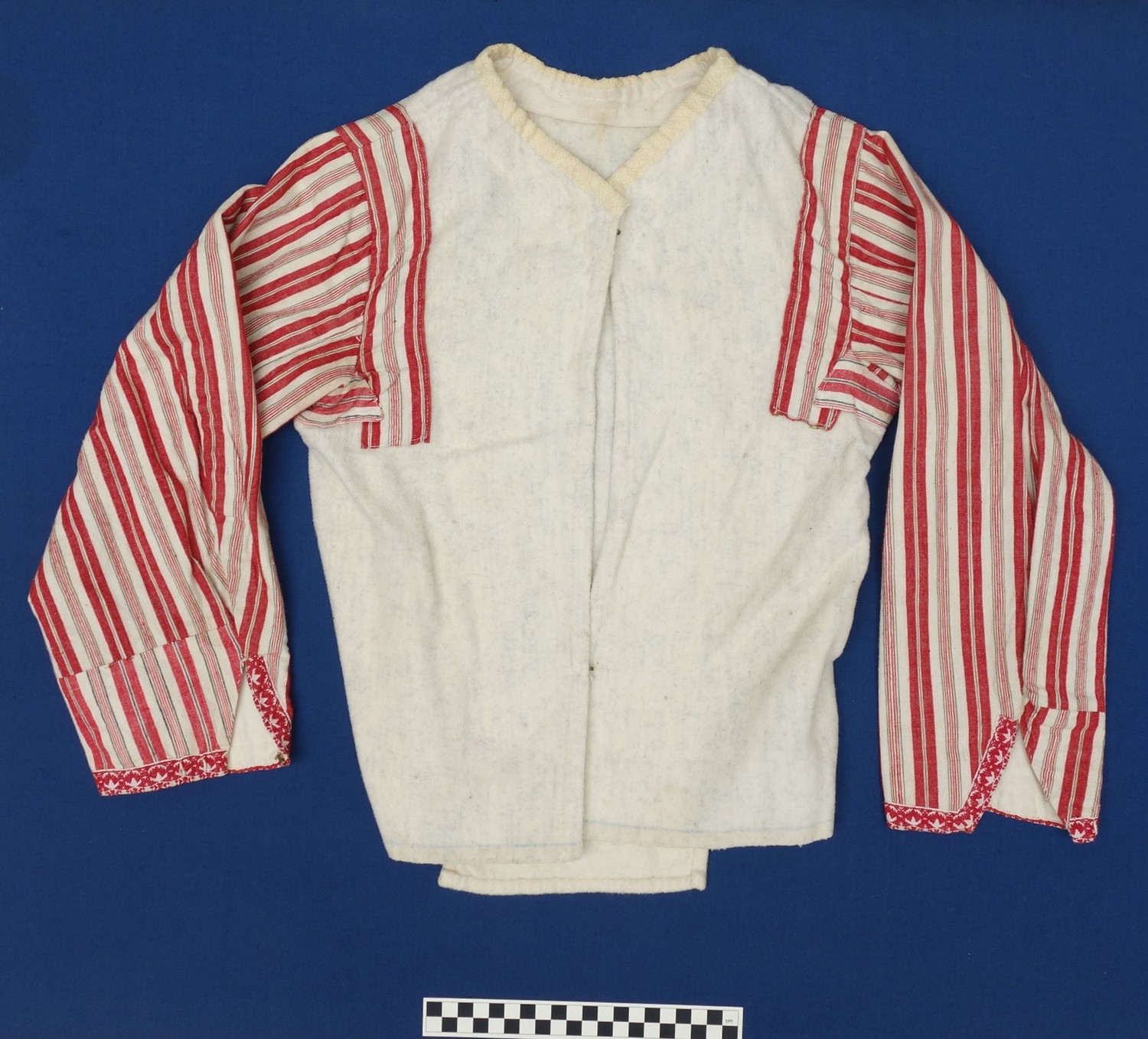
Mid-20th century mouwen from Marken (TRC 2014.0681).Mid-20th century mouwen from Marken (TRC 2014.0681).Mouwen

The mouwen are worn in the summer time, while the buisje and borsik are winter wear and are worn over the mouwen. The buisje and borsik are not worn at the same time! Twentieth century mouwen are normally made of white cotton flannel with characteristic, red striped sleeves. Mouwen generally have a high neckline. They are fastened down the front with small hooks and eyes.
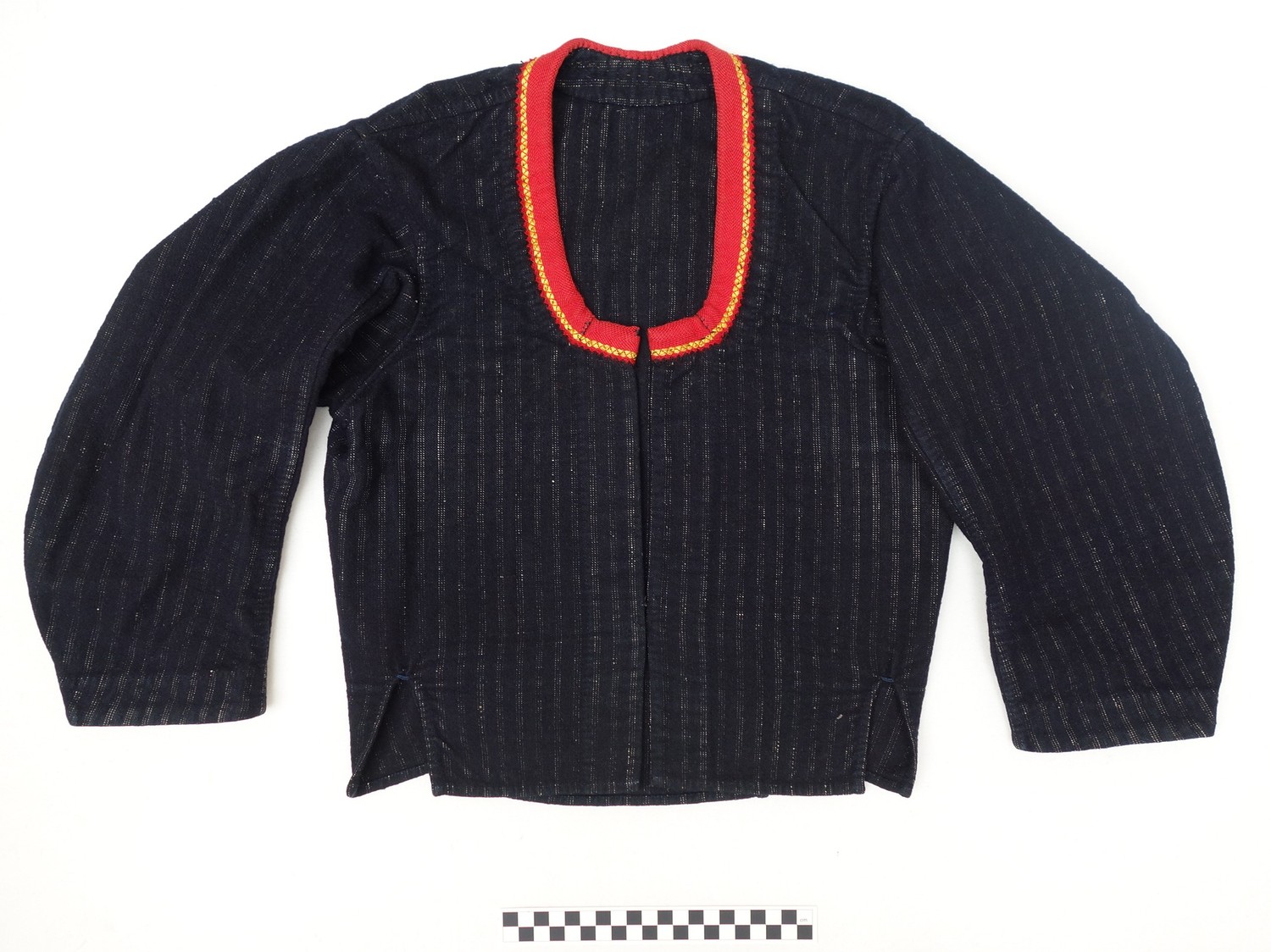
Buisje made of wool and silk, from Marken, mid-20th century (TRC 2012.0285).Buisje made of wool and silk, from Marken, mid-20th century (TRC 2012.0285).


Buisje

A buisje is a black or dark blue garment decorated with woven bands that can vary in forms of decoration. There are seven buisjes in the TRC collection and they are all made of felted wool. Three of them have vertical, thin, white smouwen tripes woven throughout the garment. The neck opening of a buisje is normally trapezoidal, with bands sewn around it.
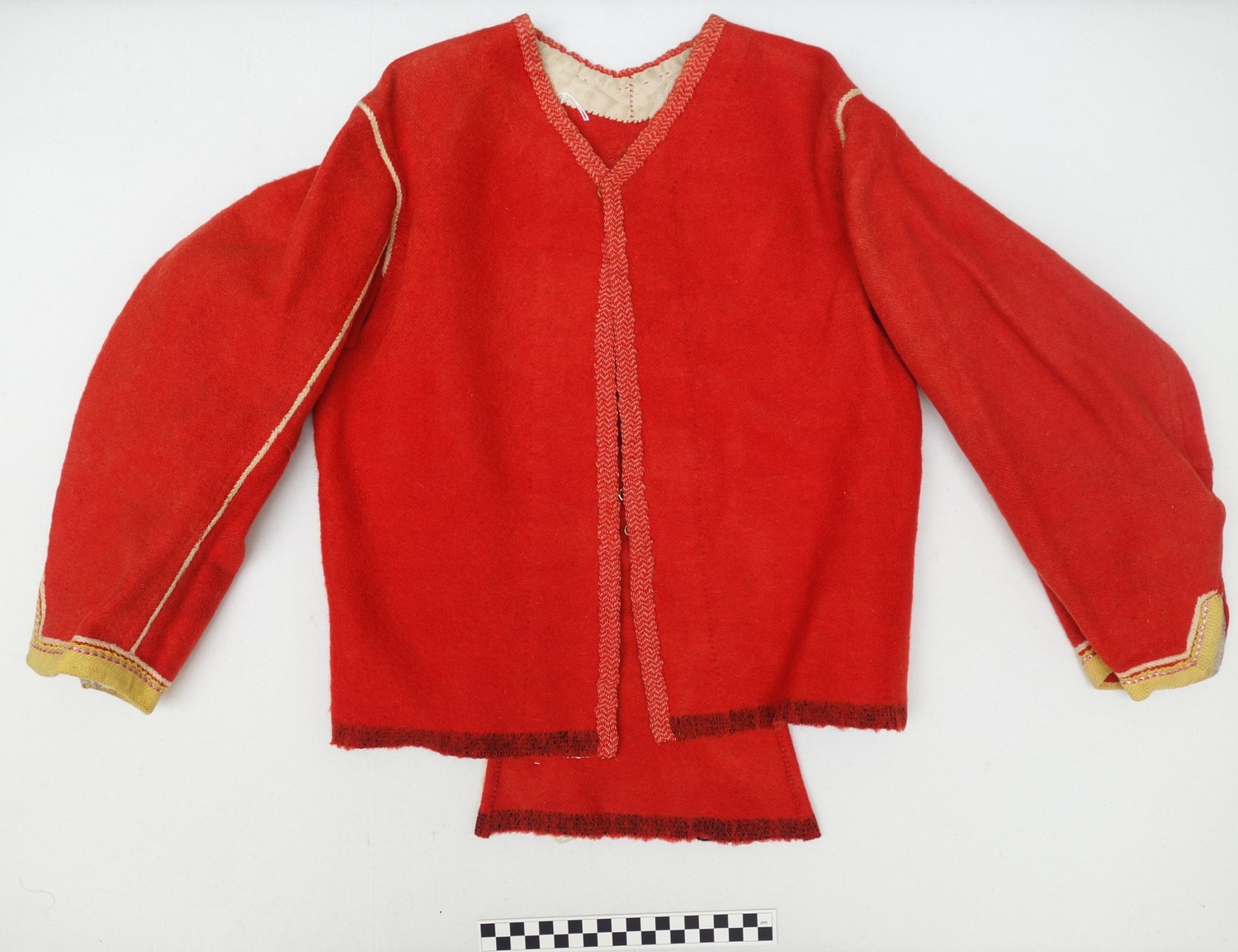
Borsik in red woollen flannel, Marken, mid-20th century (TRC 2016.0715).Borsik in red woollen flannel, Marken, mid-20th century (TRC 2016.0715).


Borsiks

Borsiks are made of a similar dark material as the buisjes, but some are made of red cotton flannel. The main differences between a buisje and a borsik lie in the shape of the neckline and the use of decorative bands sewn not only onto the neckline (as in the buisje), but also along the sleeve vents and the front opening. Many borsiks are also decorated with embroidered lines on their shoulders and front sleeve seams.


Terminology

These three types of garments are often called either a jacket or a bodice, which are terms derived from the West European urban dress system. However, these terms are not always suitable. First of all, I would not consider any of them as a bodice, because a bodice is properly speaking the upper part of a dress, while all three types of Marken garments are independent garments that only cover the upper body.

When considering the term ‘jacket’, only a buisje and a borsik are appropriate terms, because a jacket is worn as the outermost layer. However, the way the mouwen are worn is much too dynamic to match a term from of the West-European urban dress system, since mouwen can be worn as inner wear, as well as an outer.

We may ask ourselves why we feel the need to define garments from other dress systems on the basis of terms designed for and originating from the West European urban dress system? Mentioning a familiar term that shares similarity with the unknown element could improve the understanding of the unknown, but replacing or translating one term with another can cause misunderstandings or make certain meanings disappear.

Mengying Zhang, Saturday 4th August 2018

Zoek in TRC website

Contact

Boerhaavelaan 6
2334 EN Leiden.
Tel. +31 (0)71 5134144 (kantooruren)  
office@trcleiden.org

Het TRC is elke dag geopend tussen 10.00 en 15.00 uur.

facebook 2015 logo detail


instagram vernieuwt uiterlijk en logo


Bankrekening

NL39 INGB 0002 9823 59, t.a.v. Stichting Textile Research Centre.

Financiële giften

Het TRC is afhankelijk van project-financiering en privé-donaties. Al ons werk wordt verricht door vrijwilligers. Ter ondersteuning van de vele activiteiten van het TRC vragen wij U daarom om financiële steun:

Giften kunt U overmaken op bankrekeningnummer (IBAN) NL39 INGB 000 298 2359, t.n.v. Stichting Textile Research Centre. BIC code is: INGBNL2A

U kunt ook, heel simpel, indien u een iDEAL app heeft, de iDEAL-knop hieronder gebruiken en door een bepaald bedrag in te vullen: 


Omdat het TRC officieel is erkend als een Algemeen Nut Beogende Instelling (ANBI), en daarbij ook nog als een Culturele Instelling, zijn particuliere giften voor 125% aftrekbaar van de belasting, en voor bedrijven zelfs voor 150%. Voor meer informatie, klik hier