
Opening a box full of American quilts
I have had several emails from TRC Followers about the box from America, which I wrote about last week. Did we open it ? Can people see what is inside? What type of quilts are they?


I have had several emails from TRC Followers about the box from America, which I wrote about last week. Did we open it ? Can people see what is inside? What type of quilts are they?
 Kangas at the exhibition “Our Kisses are Petals’, at Newcastle’s BALTIC Centre for Contemporary Art. Photograph: Shelley Anderson.Shelley Anderson, volunteer at the TRC, writes about a recent visit to England:
The words ‘textile’ and ‘art’ caught my eye, of course, on a recent visit to the city of Newcastle in northern England. The exhibition “Our Kisses are Petals’ was on at Newcastle’s BALTIC Centre for Contemporary Art.
The artist was Lubaina Himid (born 1954, in Zanzibar), who won last year’s prestigious Turner Prize for modern art. The exhibition consisted of over a dozen large, banner-like canvases, attached to a system of pulleys. Each canvas depicted a part of the body, for example, the eyes, tongue, or heart, and a line of poetry by a black British or American poet.
Himid herself is the first black woman to win the Turner Prize. She is also the oldest, at 63, winner in history. Visitors were encouraged to rearrange the order of the quotes on the canvases by pulling on the pulleys. The paintings were based on the East African textile known as kanga. Also worn in Oman, the kanga is a versatile garment used by women as a dress, a head wrap, and sometimes a baby carrier.
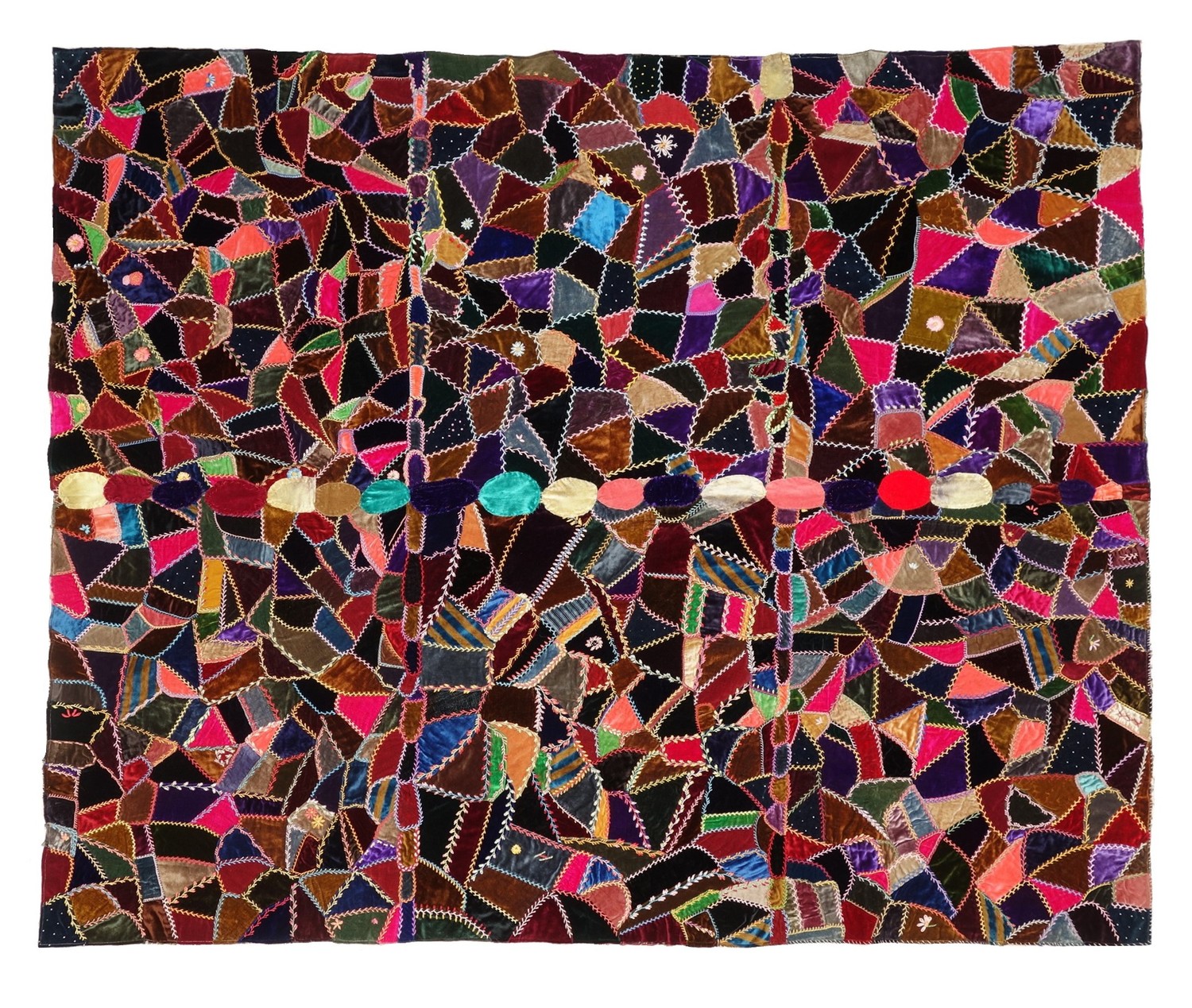 Late 19th century American 'crazy quilt', 159 x 135 cm, donated by Sherry Cook (TRC 2018.2407).Sherry Cook writes from America: My husband, Darwin, and I downsized from a large home in the fall of 2014 and have had a lot of boxes in storage since that time. We are now building a barn that will have small living quarters and storage space so I can get myself and the boxes organized. We also have our 60th wedding anniversary in September, so the decision has been made to downsize even more, to get everything organized, and at a faster pace.
We have been donating textiles to the Center for American History (CAH) in Austin, Texas since 2008. You can google the “CAH” or “Sherry A Cook, Quilter” to see some of the items we have donated. But we have now decided to support and encourage the TRC Leiden. We are very impressed with TRC’s leadership team, volunteers and all their efforts to work with world textiles.
 It is not often that I am hesitant to open a box of textiles, but this one has got me thinking very hard and long! By opening it we commit ourselves to increasing the USA textile and dress collection (a good thing) and to setting up the TRC Quilting Centre (also a good thing, but with lots of implications!).
The parcel comes from Sherry Cook in the USA and has eight quilts and quilt tops, plus feedsacks and other items. This is the first of several parcels, with the idea of Sherry donating many of her American quilts to the TRC in order to make a European based quilting centre that will look at quilting through the centuries from Roman times onwards, and throughout the world.
I have been discussing this idea with various colleagues, friends and quilters, and everyone things it’s the right thing to do, but it does have implications with respect to space, storage, exhibitions, workshops, etc. Within the last few days we have already been offered another collection of quilts from various countries, including Switzerland and New Zealand.
So I am taking a deep breath, drinking a cup of tea (I am British after all…..), and thinking about where further financial and logistical help can come from! But I know the TRC, we will do it and the TRC Quilting Centre will be a major addition to the study of textiles in the Netherlands (and elsewhere!). But it is going to be a very large pot of tea!
Gillian Vogelsang-Eastwood, 28th June 2018
 Karen Finch (1921-2018) at the Textile Conservation Centre, Hampton Court (copyright The Guardian)We have just heard the sad news that Karen Finch has died. A Grande Dame in the best sense of these words. She was responsible for creating the Hampton Court Textile Conservation Centre and for bringing textile conservation into the professional world in Britain. She hammered home the message that textiles have a story to tell and should be treated with respect (and not simply as an ‘old rag’). A message that the TRC will continue to push, shout and battle for!
Karen also had an influence on me as a young student, she was always willing to answer questions, make suggestions and tell stories. When I first started as a textile archaeologist in the early 1980’s she gave me a one week ‘conservation’ course at Hampton Court – basically first-aid for textiles – free of charge and with the willing help of all her staff. A week that gave me confidence and helped me to the present day. We have kept in contact, as have many of her former students, even if it was only a Christmas card, or a quick chat at this meeting or that conference. I am proud to say I am one of her ‘girls’. Thank you Karen.
Gillian Vogelsang-Eastwood, Director, TRC Leiden.
For a full obituary of Karen Finch, click here.
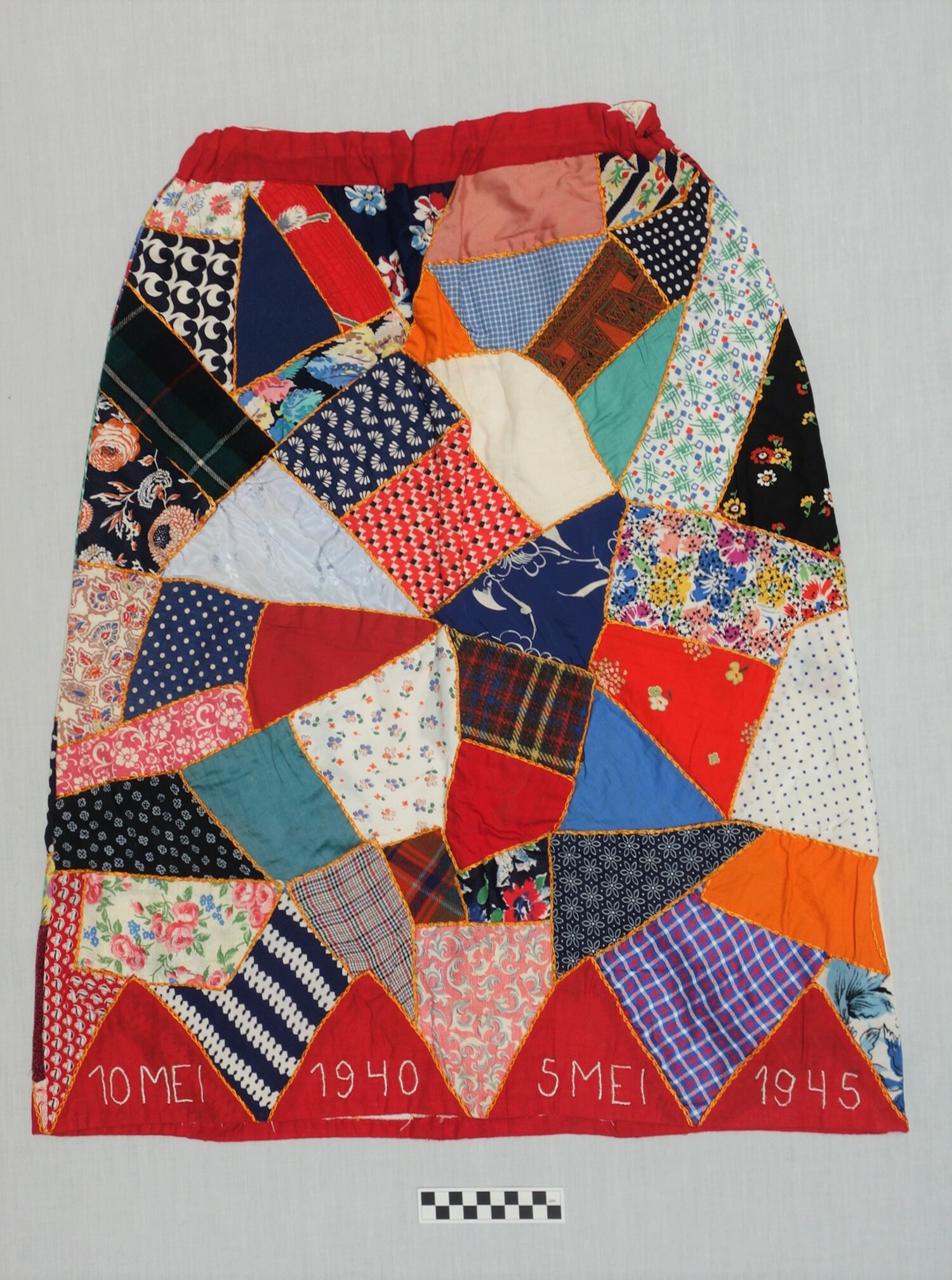 A 'Feestrok' from The Netherlands, celebrating liberation from Nazi-Germany, late 1940's (TRC 2011.0001a).The June 2018 issue of the British magazine 'Selvedge' contains an article by Gillian Vogelsang-Eastwood, director TRC, about the so-called 'feestrok'. These were patchwork skirts made in The Netherlands after World War II to celebrate the liberation of the country.
 Embroidered coat of the parliamentary uniform of Laurens de Groot (TRC 2018.2133a).A few weeks ago the TRC received a donation of a group of items belonging to Mariet Portheine-ter Kuile. This donation included fifty Berlin wool work charts that formed the basis for a digital exhibition on this subject [click here].
Since then various other items belonging to the Portheine-ter Kuile family have been given to the TRC, including a gala uniform associated with the Tweede Kamer der Staten-Generaal (commonly known as the Tweede Kamer), the Dutch equivalent of the British House of Commons.
The uniform consists of a gold embroidered coat, matching trousers, a bicorn hat with orange cockade, gloves and, of course, a sword. The uniform belonged to the politician, Frederick (Frits) Portheine (1923-1990), who had been a member of the Tweede Kamer between 1963 and 1981.
This type of uniform was worn by members of the Tweede Kamer in the late 19th and early 20th centuries on all formal occasions. There were various rules concerning how such garments were worn, as well as colour coding. Ministers, for example, had white trousers with a dark blue coat, while members of the Kamer had dark blue trousers and coat. So what is the history of this particular uniform?
 Sword, sheath and felt carrier that go with the parliamentary uniform of Laurens de Groot (TRC 2018.2133e-g).The embroidery decorating the coat is similar to that used on formal military and diplomatic uniforms from many countries in northern Europe. It is made using cardboard templates that are covered with various types of metal thread. One of the important accessories for the uniform, which reflects much earlier norms for gentlemen, is the presence of a sword (whether the 20th century wearer knew how to use it was a totally different matter).
Such uniforms were already regarded as old fashioned by the time that Frederick Portheine became a politician. Since the Second World War (1939-1945) these uniforms had not really been worn by most of the members of the Tweede Kamer. So did Frits Portheine ever wear it? Thanks to a tip from Madelief Hohé (Gemeente Museum, The Hague) to literally look deep into one of the inside pockets of the coat, we were able to find a tailor’s label that gave us some more information about the history of the uniform.
 Tailor's label of coat (TRC 2018.2133a, above).The uniform had been made by "GEBRS. DOMHOFF, ROTTERDAM. HOFKLEEDERMAKERS VAN Z.K.H. DEN PRINS DER NEDERLANDEN” (The Brothers Domhoff, Rotterdam. Court garment makers to H.R.H. the Prince of the Netherlands). In addition there was further information saying “L. de Groot 4-3-20”, apparently the name of the original owner.
The company of Domhoff Tailors still exists, but it is no longer in Rotterdam, but now based in Haarlem. The sword has an etched label on the blade near the handle, which says "FRANS PAUWELS 's GRAVENHAGEN." The company of Pauwels has been producing swords and related items since the late 18th century. The company ran by Frans Pauwels went bankrupt in 1925, although an Amsterdam branch continued into the 1930’s.
 Bicorn hat that belongs to the parliamentary uniform of Laurens de Groot (TRC 2018.2133c).In addition to providing the sword, the bicorn hat associated with the uniform also originated from the company of Frans Pauwels and on the outside of the accompanying hatbox there is the inked name of DE GROOT, so giving a clear link between the two items. In addition, the pair of gloves came in a paper bag, again with the name DE GROOT.
Apparently the first owner of the gala uniform was therefore a gentleman called De Groot. But who was he and why did he need a gala uniform? According to the database of the Dutch Parliament, Laurens de Groot (1874-1963) was a Dutch politician who was involved in various liberal economic policies and in particular involved with the Vrijheidsbond [officially known as the Liberale Staatspartij, the predecessor of the modern Volkspartij voor Vrijheid en Democratie, VVD, currently led by Mark Rutte, PM]. He was twice elected a member of the Tweede Kamer, in 1919-1922 and for the second time in 1924-1925. It would appear, from the date of 4th March 1920 writtten on the tailor's label, that the gala uniform was acquired by De Groot during his first period in the Tweede Kamer.
 Laurens de Groot, liberal parliamentarian (1874-1963).De Groot was also involved in the city council of Rotterdam and on several occasions he was the wethouder (alderman) responsible for education and social development. Following the liberation of Rotterdam from the Germans in 1945 he became a member of the Raad van Advies for Rotterdam, advising about the rebuilding of the city after the German bombardments in May 1940. De Groot died in 1963. How exactly his gala uniform came into the possession of Frits Portheine is not clear, perhaps they had been friends as both were prominent members of the same political party. On the other hand, it was also common for new members of parliament to buy a second-hand outfit, since these gala uniforms, although rarely worn in the early 1960s, were very expensive.
Gillian Vogelsang, 11 June 2018. With many thanks to Mariet Portheine and her family.
Sources of information:
 A late 15th century Italian voided velvet in silk and linen (TRC 2011.0362).Plans are being developed for a TRC exhibition about the history, production, types and forms of that most luxurious of fabrics, namely velvet. This subject was chosen because the TRC Collection includes thirty Renaissance-period examples that date from the 15th-17th centuries. They mostly come from Italy, but there are some French and Spanish pieces as well. In order for visitors to really understand these luxury, court-level items and to see how they originally looked, the planned exhibition will include modern examples of the same quality, with comparative designs.
I have have been talking with the Lunsingh firm in Leiden, who are furniture restorers with many connections in the luxury textile world. They have shown me some hand woven velvets that can cost up to €2000 per metre. Some forms are made of pure silk with gold thread. Not surprisingly this type of velvet has to be specially ordered and is not widely available! Some of the other examples they showed me were used for Parliament in The Hague, another for the Royal Palace in Amsterdam and yet another form was used for the Spanish court. They also have examples of so-called Utrecht velvet, which is made out of mohair (only €650 per metre). What amazing, gorgeous pieces.
 A 16th century Spanish silk velvet with stamped design (TRC 2011.0367)We have estimated that to get some stunning samples of the main types of velvet currently available will cost about €15000. But it would make a fantastic exhibition and show items that most people will have never seen before. The temptation to touch will be enormous!
The TRC is currently looking for an individual, family or company that would be willing to help with this exhibition (they will, of course, be properly acknowledged). We need to find €15000 for the velvets and if a fully illustrated publication about the history of velvet and the many different types is also produced, then this will require a further €7500 euros. Basically we are looking for a total of €22500 (US$ 26500, GB£19500).
Please let me know if you can help with the realisation of this exhibition as soon as possible, as it is going to take at least a year to organise, but it will be well worth it!
Gillian Vogelsang-Eastwood, Sunday 10th June 2018
Boerhaavelaan 6
2334 EN Leiden.
Tel. +31 (0)71 5134144 (kantooruren)
office@trcleiden.org
Het TRC is elke dag geopend tussen 10.00 en 15.00 uur.


NL39 INGB 0002 9823 59, t.a.v. Stichting Textile Research Centre.
Het TRC is afhankelijk van project-financiering en privé-donaties. Al ons werk wordt verricht door vrijwilligers. Ter ondersteuning van de vele activiteiten van het TRC vragen wij U daarom om financiële steun:
Giften kunt U overmaken op bankrekeningnummer (IBAN) NL39 INGB 000 298 2359, t.n.v. Stichting Textile Research Centre. BIC code is: INGBNL2A

Omdat het TRC officieel is erkend als een Algemeen Nut Beogende Instelling (ANBI), en daarbij ook nog als een Culturele Instelling, zijn particuliere giften voor 125% aftrekbaar van de belasting, en voor bedrijven zelfs voor 150%. Voor meer informatie, klik hier.