• F2
  • F4
  • F3
  • F1

Watteau in the Teylers Museum, Haarlem.Watteau in the Teylers Museum, Haarlem.“Watteau” is an exhibition now at the Teylers Museum in Haarlem. There is much to interest anyone with a love for fashion and textiles at this exhibit. Jean-Antoine Watteau (1684-1721) was an influencial French painter, famous for his depictions of prosperous people enjoying themselves at the theatre, dances, hunts and in nature. Watteau himself was fascinated by costumes and fashion. Clothing is prominent in the many prints and chalk sketches on display.

During his life time, French dress was changing from a heavy and ornate style, espoused by King Louis XIV, to less restrictive and simpler wear. This trend was influenced by a revival of interest in ancient Rome and Greece—and in what 18th century Europeans thought the ancients wore. Silk, velvet and brocade were popular materials in 18th century France and a lighter material, a mix of silk and cotton called bombazine, was also coming into fashion.

Watteau’s passion for dress is clear from the dozens of etchings, prints and paintings on display. He drew peasants and soldiers, but also Persians (an official Persian envoy reached Paris in 1715), merchants and aristocrats, always highlighting their clothing. Watteau also drew fashion plates himself. These were commissioned, not by fashion houses, but by publishers who wanted to profit from the public’s eagerness for fashion.

A very clear idea of contemporary French style emerges: men in flared coats and breeches, women in long gowns with wide hips made using metal paniers or hoops. Both men and women’s clothing is beautifully embroidered, details which Watteau meticulously represents in his work. The patterns reminded me of many designs in TRC’s Van Gerwen collection of 16th to 18th century European silks and velvets.

Fortunately there is also a real 18th century woman’s dress on display at the exhibit, loaned by the Rijksmuseum in Amsterdam. This is a beautiful cream-coloured silk dress, dated around 1760, worn for both day and evening wear. The dress is damask, with woven stripes and tendrils, and decorated in a multi-coloured pattern of flowers. There are deep box pleats from shoulder to floor at the back. Watteau painted this type of gown so often that this style is actually called pli Watteau.

In an age without mass communication, Watteau’s paintings and drawings helped to spread ideas of fashionable wear. Also on display are masks and costumes, futuristic and whimsical in turn, created specifically for the exhibit by fashion students of the Rietveld Academy. Watteau is still inspiring fashion today.

“Watteau” is on until 14 May at the Teylers Museum: www.teylersmuseum.nl

Shelley Anderson, 25th April 2017

British wounded soldiers sewing for Syrian/Palestinian refugees.British wounded soldiers sewing for Syrian/Palestinian refugees.We just came across a remarkable photograph housed in the Library of Congress. The photograph is particularly poignant considering the current situation in the Middle East. But it also illustrates an old relationship between sewing, embroidering, and the military.

The Red Cross caption card tells the following: "British soldiers sewing for the Syrian refugees. A favorite pastime which has excellent results is the work of the convalescent soldiers now recuperating in Egypt... The men are busily making clothes for the destitute inhabitants of Palestine." The photograph probably dates to the period 1917-1920.

Sewing and working embroidery were often used in the past to help soldiers recovering from war-time wounds and traumas. TRC Needles provides some examples. Compare for instance the Bradford Khaki Handicrafts Club, which was established in 1918 in Bradford, West Yorkshire, UK, to provide occupational therapy and employment for men returning from the First World War (1914-1918).

Another example is a piece of embroidery made by Major Alexis Casdagli during the Second World War (1939-1945). He was captured in 1941 and remained a POW until the end of the war. While in The Casdagli sampler, 1941.The Casdagli sampler, 1941.captivity, he worked an embroidery that contained hidden messages worked in Morse code ("God save the King", and "Fuck Hitler"). During his captivity, Casdagli also ran a needlework school for other officers in the POW camps. He later said that the Red Cross saved his life with food parcels and letters, but his embroidery saved his sanity: “If you sit down and stitch you can forget about other things, and it’s very calming.”

Finally there is private Thomas Walker, who was wounded in 1854 during the Crimean War. He was painted by Thomas Wood while sewing triangles from pieces of military uniforms. The Morning Chronicle tells us the following:

Tuesday, December 25, 1855: The Queen has forwarded to Private Thomas Walker, 95th Regiment, a present of £10. On her Majesty's last visit to Fort Pitt she was struck with a quilt brought to her notice as the work of Walker, and desired that it might be forwarded to her Majesty, which has recently been done through Colonel C. B. Phipps.


Private Walker, by Thomas William Wood, 1856.Private Walker, by Thomas William Wood, 1856.Monday, March 3, 1856
: An artist is engaged in the Military Hospital, Fort Pitt, Chatham, completing an oil painting of Thomas Walker, 95th Regiment, who has been an inmate at the hospital for fourteen months, during which period the entire top of his skull has been removed by skilfull operation at different periods by Mr. William Perry, surgical operator. The painting, which is intended for an exhibition, represents Thomas Walker in bed, busily engaged sewing together pieces of different coloured cloth, for the purpose of making the quilt which the Queen, upon seeing, was pleased to order to be sent to the palace. A part of the pattern is represented in the picture lying outside the bed. It was at the battle of Inkerman this youth received his wound, by a shell bursting directly over his head, which it fractured in the most extraordinary manner, causing insensibility for several days, until a piece of bone which pressed on his brain was removed.

Gillian and Willem Vogelsang, 25th April 2017


Detail of a cowgirl shirt embroidered with horse rider. TRC 2017.0267Detail of a cowgirl shirt embroidered with horse rider. TRC 2017.0267Pepin van Rooijen of Pepin Press, Amsterdam, recently donated many boxes of textiles to the TRC. Among them are some welcome additions to our North American collection: cowgirl clothes. Sometimes called Western wear, these items include long sleeve, plaid shirts (TRC 2017.0252 and TRC 2017.0253) and shirts with distinctive piping around the yoke and snap buttons (TRC 2017.0269 and TRC 2017.0264), sometimes embroidered with horses or red roses (TRC 2017.0257, TRC 2017.0267, TRC 2017.0253). There is an iconic buckskin-like jacket with fringes and an accompanying leather skirt with fringes on the hem (TRC 2017.0274 and TRC 2017.0275).


Western wear evolved during the nineteenth century in the American West for work in harsh conditions. There were many influences: buffalo skin coats, moccasins (worn before the mass production of boots) and decorative fringes on leather garments came from Native Americans; broad-brimmed hats, heavy belts decorated with silver, and leather chaps originated from Spanish and Mexican riders, as did the custom of embroidering red roses on shirts. Chaps evolved from a sort of leather apron, split in half in order to wrap around the legs to protect valuable cloth trousers from being damaged by cacti or dirt.
Leather and snakeskin 'cowgirl' boots. TRC 2017.0272a-b.Leather and snakeskin 'cowgirl' boots. TRC 2017.0272a-b.

The story of Western wear is also the story of American business: the use of plaid, or tartan, supposedly arose from Scottish
traders exchanging such cloth for goods by Native Americans. The iconic ten-gallon hat was invented by a hat maker from New Jersey, who moved to the West for his health. John B. Stetson fashioned a felt hat with a wide brim to keep off the sun; he gave his hat a water proof lining so he could also use it as a water bucket. Westerners liked his invention: he started mass producing hats in 1865. Shoemaker Charles Hyer of Kansas is said to have created the cowboy boot in the mid-1870s, getting inspiration from the boots that soldiers wore during the American Civil War (1861-1865). Also in the 1870s, a German immigrant named Levi Strauss started marketing tough work trousers made of blue denim, reinforced with rivets for more strength.


Detail of a cowgirl shirt embroidered with horserider. TRC 2017.0267Detail of a cowgirl shirt embroidered with horserider. TRC 2017.0267Last but not least, many of the Western wear garments recently acquired by the TRC carry the brand name Roebuck. This brand was launched in 1949 by one of America’s biggest retailers, the Sears Company, to advertise their blue jeans. By the 1950s, films and television Westerns had made cowboy wear popular in all parts of the USA. The Sears’ jeans were advertised as “friendly fittin’ as a western saddle.” The brand continues today as Sears’s line of work clothes. You can see more images of the TRC’s collection of Western wear at the TRC’s on-line catalogue.

Shelley Anderson, 12 April 2017


In the March 2017 issue of TextielPlus there was a long article about the TRC, its origins, work and the people who run this amazing place (if I may say so myself….). TextielPlus also helped organise a special day (8th April) at the TRC for its subscribers. This event consisted of two groups, one in the morning and one in the afternoon, of textile lovers, who had the chance of a guided tour of the TRC and its latest exhibition about dress and identity in the Middle East.

Both sets of visitors were very enthusiastic and enjoyed the visit to the storages, workshop, shop, as well as the exhibition. No one within the group had ever been to the TRC before, so it was a welcome opportunity to get to know each other. People had the chance to see some embroideries from the recently acquired Pepin Collection, which have featured in an earlier TRC Blog, namely a First World War flour bag embroidery, and a Gudetenland [sic] embroidery dating to the beginning of the Second World War. Two embroideries with two very different stories behind them.

The forthcoming Banjara Embroidery Crowd Funding was also discussed (starting on the 10th April 2017) and the ‘thank you’s’ were shown, including various examples of hand embroidered panels made by a group of nomadic Banjara women in southern India. These are beautiful pieces and are definitely textile ‘wants’. I suspect several donations will be coming via this talk!

A wide range of questions were posed about the running of the TRC, donations (object wise and financial) as well as its future. A number of people also signed up to become Friends of the TRC and offered help in various manners, which is much appreciated.

It was fun having the TextielPlus visitors, a group who are very familiar with the world of textiles and use this medium for various art forms. It was clear that they also understood and appreciated the TRC and what we do. It is our intention to have more open days at the TRC in the future. The next one will be on the 28th May 2017 and is being organised with the Dutch group Merkwaardig and will be about samples and samplers.

Gillian Vogelsang-Eastwood, 9th April 2017

Machine embroidered memento of the German annexation of Sudetenland. TRC 2017.0423Machine embroidered memento of the German annexation of Sudetenland. TRC 2017.0423A few months ago we were given a large collection of textiles and garments by Pepin van Rooijen of Pepin Press, Amsterdam. We are slowly going through the many boxes, photographing, cataloguing and numbering the contents. Various pieces and groups are now online, including Lebanese fashion garments, cowgirl outfits and garments (part of the USA collection), as well as many items of hand and machine lace.

The last few days have seen us looking at the embroidery boxes. One box in particular contained many examples of machine embroidery that represent various techniques and machines types. The box also included some surprises, such as a skilfully worked piece of machine embroidery depicting the mythical phoenix bird and the text "Gruss aus Sudetenland!" (TRC 2017.0423).

Sudetenland used to be part of Czechoslovakia and consisted of a German speaking enclave. In 1938 it became part of Germany following Hitler's annexation of Austria, Sudetenland and the Polish Corridor. After the end of the Second World War (1939-1945), Sudetenland was once again made part of Czechoslovakia, its name was changed and most of the German population was forced to emigrate.

The use of a German text and the image of a phoenix (a bird image relating to re-birth and resurgence) suggest that this embroidery dates to the late 1930's or early 1940's and reflects the annexation by Hitler's Germany of parts of what was then Czechoslovakia.

A second embroidery from one of the boxes is also related to war, but this time the First World War (1914-1918). From October 1914, various American and Canadian charities purchased food, including flour, for sending to Belgium. The flour mills started to send their flour in cotton bags to the Netherlands (which was neutral during the war). This vital commodity was then sent onto war stricken Belgium. Many of these bags had printed designs wishing the Belgian people peace or with patriotic symbols and messages. See also the TRC Needle entry on this subject.

Embroidered flower bag, First World War. TRC 2017.0422Embroidered flower bag, First World War. TRC 2017.0422These bags were re-used for a wide variety of functions, including garments, curtains, bedding and so forth. Many were also cut up and the printed sections were embroidered in Belgium and some of them then sent back to Canada and the USA as souvenirs, to raise money and as a way of saying 'thank you' for the flour.

Among the collection we were given by Pepin there is the front section of a flour bag that has been hand embroidered. The embroidered flour bag includes the texts "Campbell and Ottewell Peace Maker Patent Edmonton - Alta Bemis Winnipeg". There is also a large image of a flying dove (symbol of peace) carrying stalks of wheat. All of this indicates that this is a WW1 embroidered flour bag. The bag was produced by the Canadian flour milling company of Cambell and Ottewell of Edmonton, Alberta. The company was founded in 1899 under the name of the Dowling Milling Company by Ezia Dowling (died 1907). Its general manager was A. G. Campbell. In 1906 the company was sold to the partnership of Campbell and a man called Richard Phillip Ottewell (1848-1942). The mill was initially called the City Flour Mills and shortly afterwards re-named Campbell and Ottewell Co.

Gillian Vogelsang-Eastwood, 5 April 2017

Publishing an on-line digital record of a collection allows the public greater access. That’s why the TRC has its entire collection of over 14,000 textiles, garments, accessories (headgear, footwear, jewellery, walking sticks, etc.), plus textile tools involved in hand spinning and weaving, on-line. While not every item has a detailed description or photograph yet, it does allow the interested public, including researchers and collectors, access to our international collection. This includes fragile items that might be damaged by light or moisture if put on public display.

Twelve Dutch museums for these same reasons joined hands in 2015 to share their collections via the on-line platform www.Modemuze.nl. A small but interesting display of real-time textiles and fashion accessories from this collaboration can be seen in Amsterdam’s Central Public Library (OBA). The handful of dresses chosen for display range from the traditional to the futuristic. The ‘traditional’ includes an evening gown of Queen Juliana (1909-2004), made in 1948 by the Swiss designer Erwin Dolder. It was worn on several occasions by the Queen, including during her first official visit to France in 1950. What intrigued me was that Princess Margaret wore the same gown in 1983, during a visit to Canada.

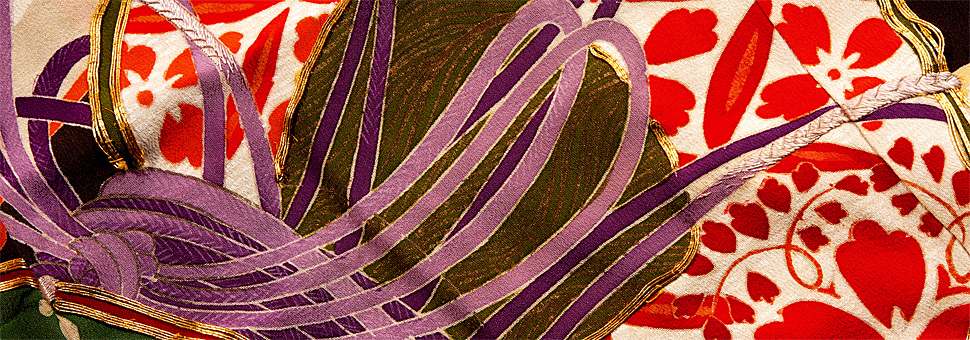
A more futuristic dress was made in 2015/2016 for the ‘Velero’ collection by designer Jef Montes, in cooperation with the Textielmuseum Tilburg. This was a floor-length, voluminous garment made with a mix of gold metallic thread, carbon and glass fibres. My favourite is a dress designed in 2002 by Dutch textile artist Claudy Jongstra. This is an elegant, strapless floor-length dress, made of felted wool and silk. It was commissioned by a Japanese woman for her wedding dress. It’s an off-white colour, which makes the vivid red phoenix stitched on the back even more striking. The large felted bow on the back is reminiscent of the obi on a traditional kimono. Interspersed between the dresses are displays of purses and hats—and lap tops where the visitor can access thousands of more textiles.

The exhibit is on until May 31. A series of lectures has also been organized: see www.oba.nl for more information. And don’t forget to look at some of the textiles in the TRC’s on-line collection at www.trc-leiden.nl/collection/. Every week new information is added to the database by a team of dedicated colleagues.

Shelley Anderson, 4th April 2017

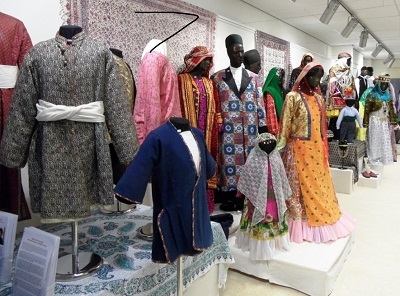
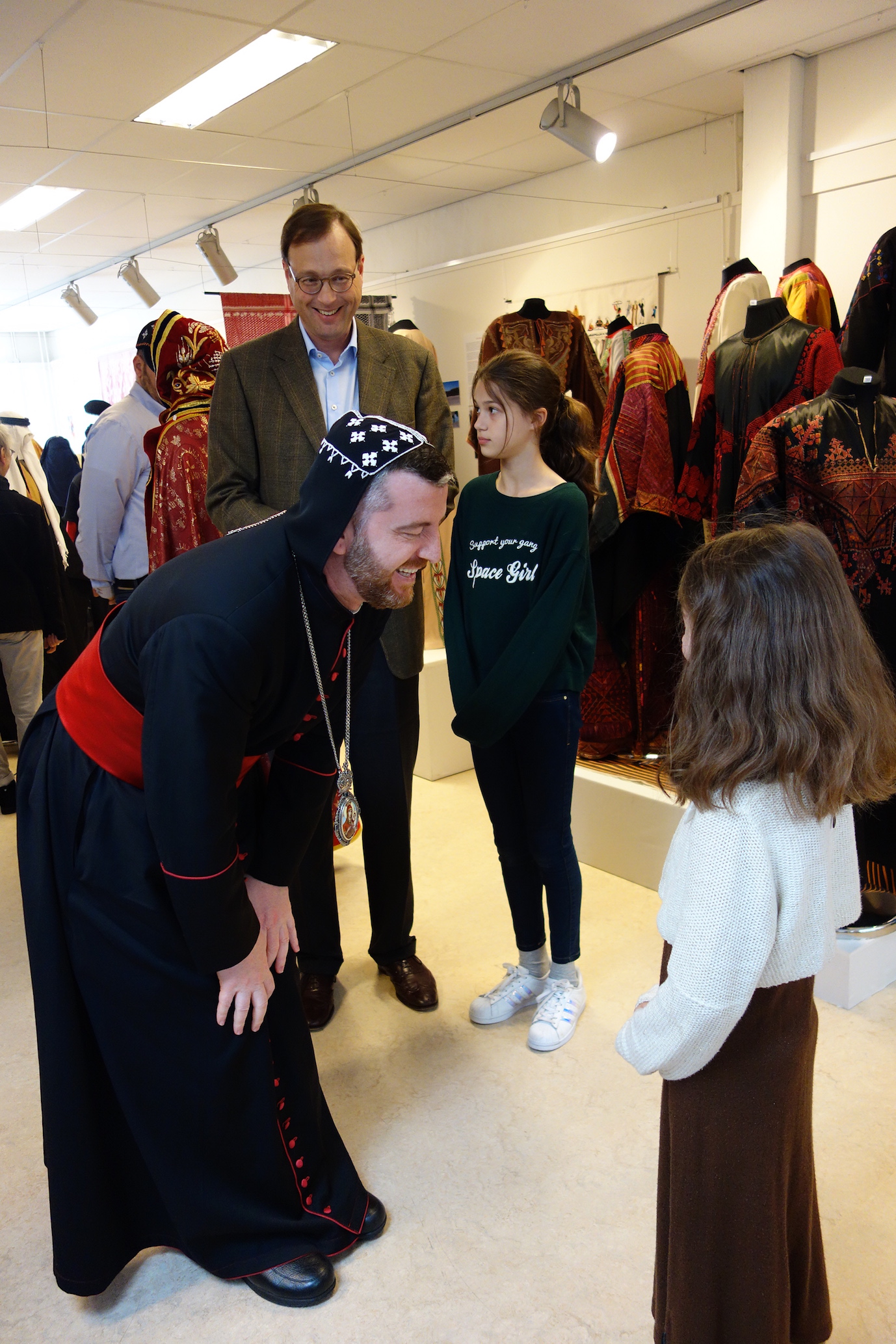
His Excellency Mor Polycarpus Augin Aydin (Metropolitan of the Syriac Orthodox Church in The Netherlands), talking with one of the young guests.His Excellency Mor Polycarpus Augin Aydin (Metropolitan of the Syriac Orthodox Church in The Netherlands), talking with one of the young guests.Yesterday (1st April 2017) His Excellency Mor Polycarpus Augin Aydin (Metropolitan of the Syriac Orthodox Church in The Netherlands), opened the TRC’s latest exhibition, From Kaftan to Kippa: Dress and Diversity in the Middle East. This crowded, colourful and varied exhibition is one of the most complicated (and full) exhibitions ever attempted by the TRC.

And it works! The exhibition is based on the PhD thesis of Tineke Rooijakkers (Vrije Universiteit, Amsterdam), who has been a TRC volunteer since she was a first-year archaeology student. It also forms part of a larger scale project (Fitting in / Standing out) of the Vrije Universiteit Amsterdam, which is funded by the Netherlands Organization for Scientific Research (NWO). The aim of the project, and the current exhibition, is to show how people use clothing to express their desire to stand out in a crowd, and in some cases the exact opposite, to blend into a crowd.

The exhibition includes historical pieces, modern Islamic dress, Coptic outfits for the laity and clergy, Druze, Palestinian, Samaritan, Jewish, Syriac Orthodox Christian, as well as Bedouin and Kurdish garments. There are over eighty outfits for men, women and children, as well as accessories and textiles.

The opening of the exhibition was attended by over sixty people, who mingled among the mannequins to create an even bigger crowd. The opening welcome came from Dr. Gillian Vogelsang-Eastwood, director of the TRC, who was followed by Prof. Bas ter Haar Romeny, who gave details about the history of the main project and how Tineke’s work fitted into the research programme.  Tineke subsequently gave a more personal view of her work on dress and diversity in Egypt and, more specifically, among the Coptic community. Prof Romeny presented His Excellency Mor Polycarpus with the first copy of the booklet accompanying the exhibition. His Excellency spoke some warm words of appreciation and expressed the wish to work with the TRC again in the near future. He thereupon officially opened the exhibition.

The Kurdish part of the exhibition was partially organized by the 'Federatie Koerden in Nederland' and it was only fitting that following the official opening Kurdish snacks and sweets were provided for the guests. The snacks were made by a Kurdish baker here in Leiden and were greatly appreciated by all.

The exhibition is open until the end of June 2017. It is then available to other institutes or museums for loan purposes. Every Wednesday afternoon at 14.00 there will be a guided tour of the exhibition. This will cost €7.50 pp (inc. tea/coffee) and will take about one hour. It is not necessary to book in advance, but if you are coming with a group it would be appreciated if you ring to make sure there are enough spaces free on the tour.

Gillian Vogelsang-Eastwood, 2nd April 2017

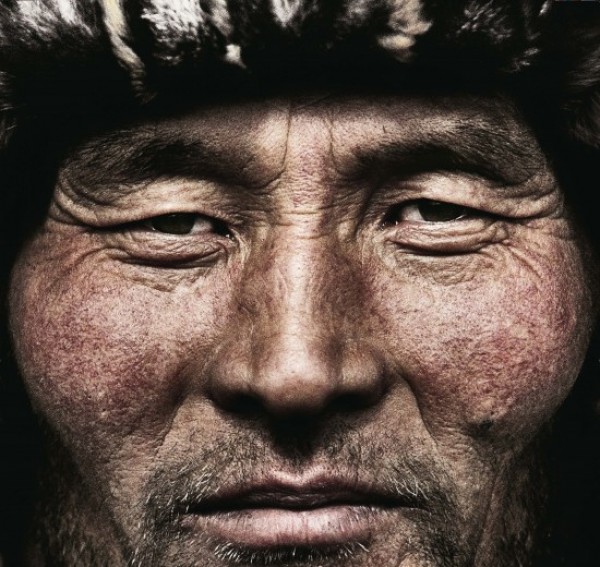
It is not often that you see the entrance to a military museum covered with hundreds of colourful cotton Buddhist prayer flags (see a previous blog, dated 16 August 2014). But that is what first greets the visitor to the latest exhibition of the National Military Museum (in Soest, the Netherlands). The prayer flags are not the only textiles in the exhibition “Genghis Khan: World Conqueror”. There are some 800 objects on view, most of them on loan from the Inner Mongolia Museum in Hohhot, China.

The bulk of the objects relate to Genghis Khan (1162-1227) himself or to the Mongol Empire he created during 21 years of constant war. The objects include iron arrows from the Liao Dynasty (circa 907-1125 CE); quivers of birch bark or leather from the early 13th century; an 800-year old iron helmet; and a silver saddle and stirrups used today in ceremonial sacrifices to Genghis Khan. There are also beautifully preserved garments from China’s Yuan Dynasty (1260-1368 CE), the period when Genghis Khan’s grandson, Kublai Khan, united and ruled over China.

The first Yuan garment is a pair of baggy silk trousers, excavated in 2010. These trousers would be worn by a wealthy Mongol man, under a long sleeved silk robe that would reach above his ankles. The Chinese had been spinning and weaving silk for over 2000 years by this time; in some parts of China bolts of silk had been used as currency. Wearing silk was a public statement of wealth and power that the Mongols eagerly adopted.

Also on display is a government official’s robe made of hemp and cotton, in what looked to me like damask. Kublai Khan had decreed that all official uniforms had to have the right side of the robe folded over the left. This was a reversal of tradition. Interestingly, this man’s robe had a left lapel. A subtle sign of resistance to Mongol authority? Or some lower level bureaucrat who could not afford a newer robe?

Another Yuan robe, also a man’s, is similar in shape but of much better quality. This robe is woven with gold thread (nasij) in a pattern of sphinxes with crowns on their heads. Nasij is a brocade. The word comes from the Persian for ‘gold thread’. This type of weaving was highly prized by the Mongols, who reportedly moved whole villages of weavers from Central and Western Asia to China, in order to teach Chinese weavers how to make this cloth of gold.

In another part of the exhibition there is another Yuan-period garment. This is a Barag Mongol tribe woman’s dress, a silk brocade robe with long sleeves and puffy shoulders. Two modern garments are also on display. One is a modern Sunit man’s robe and trousers, the other a modern Mongol wrestler’s outfit, with a leather harness, baggy trousers and high leather boots.

There are other interesting objects pertaining to dress. One is a shaman’s robe (Qing Dynasty, 1644-1911), a gown covered in long, broad, multi-coloured silk ribbons, some of which end in red tassels. The ribbons are thought to symbolize feathers, indicating that the shaman (who could be female or male) could turn into a bird and fly. Bells, arrows and animal bones are also sewn on the garment, as are differently sized bronze discs, used as mirrors. A mask is also worn with the dress during ceremonies.

One other object deserves mention. This is a gugu crown, worn by upper-class married Mongol women. This one, too, is from the Yuan period. It is a tall, cylindrical object, made from bamboo and covered in silk and jewelry. It’s bifurcated at the top. Given the bamboo frame, such high status objects are fragile and rarely found intact.

“Genghis Khan: World Conqueror” is open now until 27 August 2017.

Shelley Anderson, 26 March 2017

Zoek in TRC website

Contact

Boerhaavelaan 6
2334 EN Leiden.
Tel. +31 (0)71 5134144 (kantooruren)  
office@trcleiden.org

Het TRC is elke dag geopend tussen 10.00 en 15.00 uur.

facebook 2015 logo detail


instagram vernieuwt uiterlijk en logo


Bankrekening

NL39 INGB 0002 9823 59, t.a.v. Stichting Textile Research Centre.

Financiële giften

Het TRC is afhankelijk van project-financiering en privé-donaties. Al ons werk wordt verricht door vrijwilligers. Ter ondersteuning van de vele activiteiten van het TRC vragen wij U daarom om financiële steun:

Giften kunt U overmaken op bankrekeningnummer (IBAN) NL39 INGB 000 298 2359, t.n.v. Stichting Textile Research Centre. BIC code is: INGBNL2A

U kunt ook, heel simpel, indien u een iDEAL app heeft, de iDEAL-knop hieronder gebruiken en door een bepaald bedrag in te vullen: 


Omdat het TRC officieel is erkend als een Algemeen Nut Beogende Instelling (ANBI), en daarbij ook nog als een Culturele Instelling, zijn particuliere giften voor 125% aftrekbaar van de belasting, en voor bedrijven zelfs voor 150%. Voor meer informatie, klik hier