• F4
  • F2
  • F1
  • F3

The TRC’s latest exhibition Embroidered Europe is now open and attracting many visitors from all over the world – literally from Taiwan to Twente. In addition, on Thursday we had the privilege of showing the exhibition to H.E. Masoud Soltanifar, the Vice-President of Iran and his wife, as well as the wife of the Iranian Ambassador to the Netherlands, and other honoured guests. See my blog article about this visit.

In order to give people an idea of the scale and variety of the current exhibition, we are now working on a visual report with a number of photographs from the official opening that took place on Tuesday 30th August. This will be sent around next week to followers of the TRC as well as appearing on our webpage.

The opening was carried out by the well-known Dutch textile and costume curator, Ms. Gieneke Arnolli (who is also chair of the Dutch Kostuumvereniging), and Mr. Daniel Czonka of the Hungarian Embassy, The Hague, responsible for cultural affairs. But, quite rightly, attention at the opening was focussed on Mrs. Magdalena Kircher, whose collection (some 1500 pieces) has just come to the TRC. This exhibition was designed to honour her work, dedication and love of European regional dress. The TRC is now in a position to carry on her work in the form of this and more exhibitions, publications, and workshops.

Speaking of workshops, on Wednesday 31st August, the TRC’s Wednesday Workshop was on the theme of European Embroidery, with an in-depth guided tour of the exhibition, and a two-hour practical based on various techniques, from chain stitch to Hungarian braid stitch, in various materials (cotton cloths and felt) and threads (cotton, wool of various ply’s and thicknesses). The Hungarian braid stitch is fun to do, once the initial technique is mastered and it is a very effective method of decorating a garment.

The next Wednesday Workshop will take place on the 28th September and is about the Holbein stitch. In addition, there is a 5-day intensive textile course between 19 - 23 September (two places available), and again between the 17th and 21st October (one place available). On the 4th – 5th November there is a two-day workshop about veils and veiling – with a burkini available for people to see what it actually is and what all the fuss is about! Please get in contact with the TRC at Dit e-mailadres wordt beveiligd tegen spambots. JavaScript dient ingeschakeld te zijn om het te bekijken. if you wish to attend any of these, or indeed any other, TRC workshops.

Gillian Vogelsang-Eastwood, 9 September 2016

One of the blouses in the TRC collection and currently on display in the exhibition Embroidered Europe, is decorated on the sleeves with bands enclosing an intriguing design of ornate squares and tiny trefoils. The embroidery is worked in cross stitch and double running stitch (Holbein stitch) on a fine, even-weave cotton ground.

The blouse comes from Hungary/Romania and dates to the mid-20th century. The design is worked in a mid-green cotton thread. It can also be worked in silk, a six-stranded cotton thread (three strands at a time) or a fine, cotton perlé, but please remember that the ground material needs to be adapted to the type of thread used. At first glance the pattern looks easy, but you have to take care because of the mirror imaging and reversals in the pattern.

Chart for embroidery on an Hungarian/Romanian blouse. Please click the illustration for PdF file.Chart for embroidery on an Hungarian/Romanian blouse. Please click the illustration for PdF file.


Gillian Vogelsang-Eastwood, 10 September 2016

Rabbits and birds have created several ahhhh moments at the TRC after the opening of the new exhibition 'From Sweden to Sardina' (see TRC 2016.0732f). In fact, these 'cute' creatures are depicted on a broad band of beading that decorates the apron of a young, married woman from Hungary, which is on display in the exhibition. The garment is believed to date to the 1930s. It was worn on Embroidery chart of the beadwork design. Please click chart.Embroidery chart of the beadwork design. Please click chart.festive occassions, probably at Easter.

Numerous exampes of this type of apron are known and they are often decorated with flowers, but the rabbits and birds of this particular apron are most unusual.

The exhibition 'Embroidered Europe' contains many such ahhhhh moments, from beaded flowers to intricately worked geometric motifs. In order to celebrate the exhibition, the TRC is producing a series of pattern charts, suitable for cross stitch, knitting, beading, etc., that are based on designs to be found on the objects on display. The first one is the rabbits and birds pattern; other designs will be published in the course of the next few months. Please click on the chart, download it, print it, and enjoy.

Gillian Vogelsang, 2 September 2016

Rabbits and birds in beadwork on an Hungarian apron (TRC 2016.0732f).Rabbits and birds in beadwork on an Hungarian apron (TRC 2016.0732f).


Two garments on display in the exhibition 'A History of Fashion in 100 Objets', Fashion Museum, Bath, until 1 January 2019.Two garments on display in the exhibition 'A History of Fashion in 100 Objets', Fashion Museum, Bath, until 1 January 2019.Its the final day of our trip around southern and south-western England and we are in the Georgian city of Bath, home at one point to Jane Austen, and the location of the famous Assembly Rooms, where romantic balls took place over 200 years ago. The Assembly Rooms is now home to the Fashion Museum. A wonderful museum with over one hundred thousand items in its collection that date from the sixteenth century to the present day. The exhibition 'A History of Fashion in 100 Objects' (19 March 2016 - 1 January 2019) illustrates four hundred years of north European/Western fashion, literally from Elizabethan embroidered gloves, to items straight off the 2015 catwalks.

The items are on display in the basement of the Assembly rooms, where light is not a problem for the more delicate items. Both men and women's outfits are on show, although the majority are for women. In addition to the basic information about where a garment comes from, who wore it and who made it (if known), there are also titbits of local gossip and comments from contemprary written sources, and more serious historical facts.

A popular room, especially for children, is the dressing up area, with a wide range of (replica) garments that visitors can try on. There is also a section showing parts of the storage rooms, with the various types of card and plastic boxes that are used for flat as well as rounded objects, such as hats. This museum has provided inspiration for many of its visitor's, including myself, and I was left feeling a little jealous and wondering how we can lift the TRC and its growing collection of world textiles and costume to this level!

Gillian Vogelsang-Eastwood, 7 August 2016

Impression of the exhibition 'The Ornate and the Beautiful, Bishop’s Palace, Wells, from 16th April – 31st August 2016.Impression of the exhibition 'The Ornate and the Beautiful, Bishop’s Palace, Wells, from 16th April – 31st August 2016.Wells in south-west England was a surprise. I had not expected much, but it is a lovely medieval/Georgian city with a beautiful cathedral and bishop's palace (complete with moat, drawbridge and porticulis to keep the unruly citizens of the town at bay). Wells Cathedral likes embrodery and even has embroidery tours!

The main focus is on the embroideries designed and made for the quire (choir) of the Cathedral, between 1937 and 1952. They include 39 panels for the backs of the canopied stalls, many more hassocks, as well as seat runners and long kneelers. Also on display is an early-12th century cope chest. In the small St. George Chapel there are several hassocks and kneelers dedicated to those who fell during the First World War (1914-1918). These include several that were especially designed to fit around pillared seats.

Near the chapel there are several late-20th century altar frontals that are woven, as well as one that is embroidered. Several of the many tomb effigies depicting early bishops of Wells are still painted. These help to give an idea of the ornate nature of the ecclesiastical vestments worn and their design/colour combinations. In this respect, it is worth noting that until the 31th August there is an exhibition in the Palace called "The Ornate and the Beautiful" about ecclesiastical (embroidered) garments from the 14th to 20th centuries. Most of the thirty or so items on display are from the collections of nearby Downside Abbey (Catholic) and Wells Cathedral (Anglican). Many of the items have never been on display to the public before.

The items in the exhibition include a variety of chasubles, a few copes (as well as a large, medieval cope chest), and some orphreys, especially a beautiful orphrey that dates to the medieval period and is made in a form of opus anglicanum. There was also a small, but intriguing book cover from the 18th century, which had the embroidered arms of a bishop. In addition, there were relevant items of jewellery, such as bishop's rings and crosses. The exhibition included interesting and useful text boards about the various individual and groups of objects on display. Sadly there is no catalogue to the exhibition, which is a pity as the exhibition was otherwise well put together.

Also in Wells there is the Wells and Mendip Museum, which recently staged an exhibition about samplers. The museum was given a large collection of these objects by the late Eveleen Perkins. The samplers date back to the 18th century. Many of the them were in the temporary exhibition (spring 2016), while there is a group of 35 examples that are on permenant display. Again there is no catalogue to this collection. Hopefully in the future this situation will change.

Gillian Vogelsang-Eastwood, 6 August 2016.

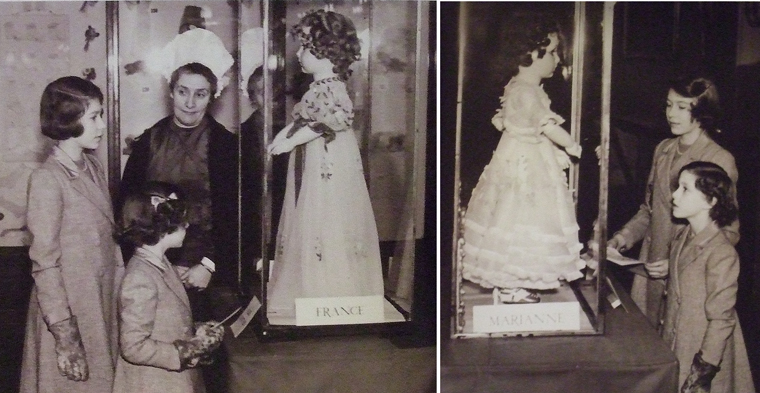
Today Willem and I went to Windsor Castle (following our trip to Buckingham Palace yesterday). A very different royal residence, with a much more masculine feeling.Princesses Elizabeth and Margaret admiring the two dolls, France and Marianne, in 1938.Princesses Elizabeth and Margaret admiring the two dolls, France and Marianne, in 1938. We were able to see Queen Mary's Dolls' House, with its miniature furniture, including textiles and embroideries. The next gallery we saw in the Palace will appeal to followers of French fashion, because it includes the garments made for two, large dolls presented in the name of the children of France to Princesses Elizabeth and Margaret, during a state visit to France by their parents, George VI and Queen Elizabeth, in 1938. The metre high dolls are called France and Marianne. The outfits and accessories were made by various Parisian haute couture ateliers, including dresses by Lanvin, Rochas and Worth; Cartier jewellery; cases by Vuitton and handbags by Hermès; as well as Lancôme and Guerlain perfume. The garments range from underwear to day dresses, evening gowns, coats, gloves and hats, shoes and so forth. All hand made and many embroidered. There are a total of 360 items.

Scattered around the state rooms that were open to the public were embroidered regimental flags and military uniforms decorated with fine passementerie. In the rooms assocatied with the Order of the Garter, there was an embroidered garter band with the motto honi soit qui mal y pense, and a beautiful example of the garter emblem worked in gold thread. Tucked in one corner of another room was a large, seventeenth century embroidered box, but unfortunately it was not possible to get close up to it to see how it was made.

The afternoon was spent walking around the town of Windsor and the road to Eaton School. There are various tailors along the road who clearly show that 'dress and identity' is alive and well at Eaton. In particular the waistcoats worn by some of the senior students are simply gorgeous.

Gillian Vogelsang-Eastwood, 31 July 2016

Fashioning a Reign: 90 Years of Style from the Queen's Wardrobe. Buckingham Palace, April 2016 -January 2017.Fashioning a Reign: 90 Years of Style from the Queen's Wardrobe. Buckingham Palace, April 2016 -January 2017.Yesterday (30 July 2016), Willem, Keireine Canavan (a fellow textile lover from the Cardiff School of Art and Design) and myself went to Buckingham Palace (where else) to see their latest exhibition about the garments worn by Princess, and later Queen, Elizabeth of Great Britain. The garments spanned a period of ninety years, from her christening robe to outfits worn with the opening of the 2012 Olympic Games in London (with James Bond in the helicopter). The highlights included her wedding dress and coronation robe. In addition, there were outfits worn as a child to the coronation of her father, George VI, on 12 May 1937; uniforms worn while she was in the army during World War II, and many of the garments worn during state visits to other countries and state events celebrating various visits of leaders to Britain. In many cases there were photographs of her wearing the outfits with accessories, such as hats. Speaking of which, there was a gallery dedicated to five decades of hats and hat designers. One thing that was missing was jewellery, that all important accessory that makes and finishes an outfit, but as she wore the same pearl necklace on various occassions, it is likely there was not enough jewellery to go around, let alone the security problems associated with their display.

One thing that struck both Keireine and myself was how badly some of these specially designed garments were made, with varying hem lengths on coats, poorly finished cuffs, even poor tensioning of the sewing machine, which left numerous ripples in the cloth (which should have been flat). It has nothing to do with age, as a photograph of the Queen wearing a particular garment clearly showed the ripples. Very curious.

In addition to seeing the exhibition (which was incredibly crowded), the ticket also included a visit to various state rooms inside the palace. What an amazing place to live and work, surrounded by paintings of the ancestors, as well as the odd Van Dyke, Rubens, Canaletto, and one particular Rembrandt that got to all of us, namely the portrait of Agatha Bas (1641). One of the most intriguing, wonderful paintings ever, with Agatha dressed in some of her finest garments and lace.

A coffee/tea, plus a walk around part of the palace grounds finished the visit. The exhibition of garments runs until 8 January 2017 and is well worth seeing, although the hefty price of the ticket was initially a bit of a shock, more than twenty pounds, until we realised it also included the chance of seeing the staterooms and all the paintings, sculptures and so forth (although with a noticeable lack of tapestries and embroideries).

Part of the afternoon was spent at The Foundling Museum, to see the tokens, especially pieces of cloth, that were attached to children's records when they entered the Foundling Hospital, an eighteenth century charitable institute. These now provide the largest sample of dateable eighteenth century textiles from the lower ends of London society. A sad reminder of a very different and hard way of life. These textiles have been published by Prof. John Styles in a book called Threads of Feeling (2010). A book that is well worth reading, both for the textiles and the social history surrounding them.

Gillian Vogelsang-Eastwood, 31 July 2016

British Museum, LondonBritish Museum, LondonThanks to an invitation by the British Foundation for the Study of Arabia I was able to attend the 50th Seminar for Arabian Studies, which was held at the British Museum from 29th -31st July 2016. I presented a paper about embroidery from the Arabian Peninsula. This was one of several papers about textiles, dress and accessories presented and discussed yesterday morning. The directly relevant papers included those by Aude Mongiatti, about the technical analysis of Omani silver jewellery; Lezley George, about the fashionable aspects of wearing an abayeh in the UAE; Martin Ledstrup, on men and the wearing of national dress in Ras al-Khaimah; Keireine Canavan about hand weaving among the el-Sadu in Kuwait, and finally Neil Richardson about weaving in Oman and its survival in the modern world (especially how camel racing has promoted the production of hand woven animal trappings).

What I really enjoyed during the meeting was how the various speakers often referred to the lectures by the other contributors. This created a strong feeling of cohesion, and the various lectures clearly complemented each other. The diversity of styles of lecturing was very noticeable, but all were interesting. Well done to everyone who was involved in the organisation of the conference!

In the afternoon a group of us travelled across London to Blythe House, an old and massive Post Office building where various museums, including the British Museum and the Victoria and Albert Museum, have storage depots. Here we were treated to a special viewing of Arabian Peninsular garments and textiles, including some magnificent Saudi and Yemeni embroidered dresses. Walking around the depot was an eye opener for some, as regards the problems of dealing with such a vast and diverse collection. We were allowed to see (but not touch) an eighteenth century bark garment from the Pacific region, which is associated with Capt. Cook and is one of the first items in the British Museum's collection. A reminder of just how impressive, varied and important the BM's textile and dress collection actually is.

Gillian Vogelsang-Eastwood, London, 30 July 2016

Zoek in TRC website

Contact

Boerhaavelaan 6
2334 EN Leiden.
Tel. +31 (0)71 5134144 (kantooruren)  
office@trcleiden.org

Het TRC is elke dag geopend tussen 10.00 en 15.00 uur.

facebook 2015 logo detail


instagram vernieuwt uiterlijk en logo


Bankrekening

NL39 INGB 0002 9823 59, t.a.v. Stichting Textile Research Centre.

Financiële giften

Het TRC is afhankelijk van project-financiering en privé-donaties. Al ons werk wordt verricht door vrijwilligers. Ter ondersteuning van de vele activiteiten van het TRC vragen wij U daarom om financiële steun:

Giften kunt U overmaken op bankrekeningnummer (IBAN) NL39 INGB 000 298 2359, t.n.v. Stichting Textile Research Centre. BIC code is: INGBNL2A

U kunt ook, heel simpel, indien u een iDEAL app heeft, de iDEAL-knop hieronder gebruiken en door een bepaald bedrag in te vullen: 


Omdat het TRC officieel is erkend als een Algemeen Nut Beogende Instelling (ANBI), en daarbij ook nog als een Culturele Instelling, zijn particuliere giften voor 125% aftrekbaar van de belasting, en voor bedrijven zelfs voor 150%. Voor meer informatie, klik hier