• F1
  • F3
  • F4
  • F2

I have just got back from Egypt where I attended a conference about science and archaeology (organised by the German Archaeological Institute, Cairo), as well as giving a lecture about the textiles and garments of Tutankhamun at the Grand Egyptian Museum, Giza. The conference was held in Cairo and Aswan, which made the logistics difficult, but on the other hand we were able to talk with many more people.Man from Cairo, Egypt, working goldthread embroidery. Photograph by Gillian Vogelsang-Eastwood, December 2014.Man from Cairo, Egypt, working goldthread embroidery. Photograph by Gillian Vogelsang-Eastwood, December 2014.

During my stay in Cairo and Aswan I had several textile moments and I thought you might like to see/hear about them. Firstly in Aswan I came across a hand weaver working on the island of Elephantine. His family comes from Naqada (you can see that with some of the striped and triangular designs he produces), but his loom was unusual. It was very short and tension was provided by a system of winches, with the warp thread going vertically. The weight under the loom was a statue of an ancient Egyptian goddess! (a modern version I should add). The man makes lovely cotton shawls of various sizes.

Then back in Cairo, near the Street of Tentmakers, we went into the last of the tarbush makers (fezzes, a form of headgear) from that area. How long they will be able to continue working is another question. Tourist numbers have dropped by 80% and many craftsmen, including the tarbush makers, are really struggling. A little further on there was a man producing gold thread embroidery – I have never seen anyone doing this in public – the results yes, but not the craftsmen. His work was tensioned by a small, rectangular frame and he used card templates for the designs, which were covered with a cotton thread and then crinkly purl (a form of metal thread). His young son was helping him!

And finally onto the Street of the Tentmakers, where, once again, I bought too much. But these will form an important element in the TRC’s new exhibition that opens on the 4th of January (that is my excuse and I am keeping to it). Some of the pieces are exquisite and I have never seen such fine appliqué work before. Amazing. You can see these and many other pieces at the TRC Gallery from January until the end of April 2015.

Gillian Vogelsang-Eastwood, 14 December 2014

Early 19th century embroidery. TRC CollectionEarly 19th century embroidery. TRC CollectionWe have just had a little 'wow' moment at the TRC. As so often happens here, someone has popped in with some potential donations for the collection. We love these moments as we are never sure what will appear. Well, this time it was a small embroidered box, with four embroidered ovals inside. One of the ovals had the word bruid ('bride') and another bruidegom ('bridegroom') embroidered on to them. It turns out they were used in a marriage in 1827! And then re-used for a wedding in 1903.

What exactly they were used for is not certain, but the size of the ovals does suggest that they might have been used for wedding rings. The embroidery is worked in floss silk and silk chemille thread, with applied, 3-dimensional flowers in very fine silk; all stitched onto a satin silk ground. The box lid is also decorated in the same manner, although sadly it is now in a much poorer condition. What memories and stories are stored in these pieces!

Gillian Vogelsang, 11 November 2014


This weekend Mariet Portheine and I went to see the European Art Quilt VIII exhibition at the Twentsewelle Museum, Enschede, and especially to admire the display of appliqué panels made by various craftsmen from the Street of the Tentmakers, Cairo. The colours and techniques of these Egyptian panels are very seductive, and I said I would not buy anymore but….. There were a few more designs that fit into the TRC’s ‘Street’ exhibition that opens on 4th January (2015) and they will look amazing. The European Art Quilt exhibition was thought provoking, as again it raised the question as to where is the line between a quilt (two or more layers of cloth sewn together, traditionally used for clothing and bed covers, etc) and textile art? Most of the pieces on display were definitely leaning towards Art rather than Quilt. There were some (quilt) pieces that personally I found really attractive, such as one depicting the night sky and another entitled 'snowflakes on a bed'. Many of the items, however, have travelled very far from the concept of quilt. Worth while seeing because it was so thought provoking. The quilt exhibition opened on the 27th September and will run until the 4th January 2015, when the TRC will open its 'own' exhibition of Egyptian panels. For more information, please click here.

Gillian Vogelsang-Eastwood, 29 October 2014

Cairo can be a dangerous place, and I am not just talking about the cars, pavements and pollution! I am in Cairo for a few days to attend various meetings (more about that later), but I could not miss the chance yesterday for a 'quick' visit to the Street of the Tentmakers and to see more of the beautiful appliqué panels they make there. Everytime I go there I think now we have enough for the special exhibition that opens at the TRC in January about the Cairo appliqués, and then someone says, we have a new design..... Fatal.

Gillian at al-Farouk in the Street of the Tentmakers, Cairo.Gillian at al-Farouk in the Street of the Tentmakers, Cairo.

I was there to pick up a few panels that had been previously ordered and, all being well, I shall be going back to Cairo in December (for another meeting, but in Aswan, life can be so hard sometimes). Then I shall be doing the big shop for thimbles, scissors, thread, cloth and more panels of various sizes. Many of these will be for sale in the TRC shop during the period of the exhibition. The Street needs help as there are less and less tourists going to Egypt, but this is one way we can help them, while being inspired to greater and more colourful things at home!

Gillian Vogelsang-Eastwood, 3 October 2014

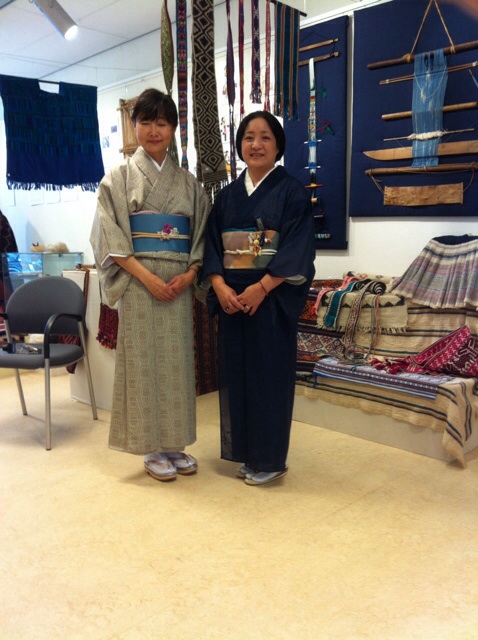
Today, we had one of those moments at the TRC. Two Japanese ladies in kimono came to see our weaving exhibition. One of the ladies had been before, and this time she brought a friend. They live in the Leiden region, and love any excuse to wearing their unique garments. Coming to the TRC was a special moment for them, and a Textile Moment for us. They looked wonderful ! I learned a lot about kimonos from them, especially the difference between the kimono's crest (at the kimono's back) of the husband's family, and that of the wife's.

Gillian Vogelsang-Eastwood, 9 September 2014

 Two Japanese ladies in kimono at the TRC, September 9th 2014Two Japanese ladies in kimono at the TRC, September 9th 2014

The Amarbayasgalant monastery, northern Mongolia. Photograph: Willem Vogelsang, August 2014The Amarbayasgalant monastery, northern Mongolia. Photograph: Willem Vogelsang, August 2014Well, I am back in Holland, but only a few days ago I had the chance to visit a Buddhist monastery in the north of Mongolia. It is the Amarbayasgalantkhiid (monastery), in Selenge Province. It was founded in the early 18th century, and to some degree survived the destruction of almost all Buddhist centres in the Stalinist era.

What I particularly liked were the many prayer flags hung along ropes between the various pinnacles of the buildings, a very Tibetan spectacle! And then there were the blue khatags, or prayer scarves, that were attached everywhere.

The Tibetan prayer scarves are generally white, and seem to be used differently. Here in Mongolia they are attached to trees, cairns, stakes, stupas, etc. You see them everywhere. In fact, I was graciously presented with one at the end of the conference we had organised (now of course being absorbed into the TRC collection). They are generally blue, and are of course very reminiscent of comparable pieces of textiles that pilgrims in many countries leave behind.

I know the custom so well from Iran, Afghanistan, Pakistan and northern India, but there they are used to confirm certain wishes, as for instance by women who pray for children. In Mongolia the blue khatags represent heaven and the blue skies of Mongolia (see the photograph), and thus seem to reflect the old shamanistic belief system of Tengri ('heaven'). Perhaps a new research area for the TRC: the use of textiles in religious rituals?

Willem Vogelsang, 16 August 2014

Blue prayer scarves attached to the Amarbayasgalant Khiid (Buddhist monastery), northern Mongolia. Photograph: Willem Vogelsang, August 2014.Blue prayer scarves attached to the Amarbayasgalant Khiid (Buddhist monastery), northern Mongolia. Photograph: Willem Vogelsang, August 2014.

Dress exhibit at the National Museum of Mongolia. Photograph: Willem VogelsangDress exhibit at the National Museum of Mongolia. Photograph: Willem VogelsangLast week, while in Ulaanbaatar, I had the chance to visit the beautiful National Museum of Mongolia, which not only has a fascinating display of archaeological finds from the area, but also an exquisite gallery showing the richness of sartorial traditions in the country. Well represented, with texts in English and Mongolian, the exhibition gives an idea of the enormous variety of local dress traditions, for both men and women. Really worth seeing is also the showcase with headdresses and others with other accessories.

To date I did not have the chance to see another dress museum, namely the Museum of Mongolian Costumes, which is located nearby, and which I hope to visit in the near future. I do include the web address though (click here), in case any of the visitors of the TRC site ever visits Mongolia. The director of the Museum however is now in (digital) contact with the TRC, after my meeting a relative of hers at a conference here in the city. It is a small world. The next few days I will be visiting some friends in the north of the country, and I will keep my eyes open for any remarkable garments !

Willem Vogelsang, 10 August 2014

TRC volunteer Shelley Anderson's Textile Moment was in Paris, France, at the Musée de Cluny: One of the six Lady and the Unicorn tapestries, Musée de Cluny, ParisOne of the six Lady and the Unicorn tapestries, Musée de Cluny, Paris"There are so many beautiful objects in this museum of medieval art. But nothing can compare with the six The Lady and the Unicorn tapestries. Woven around 1500, the colours are vibrant and the 'millefleur' background stunning. There are over 30 shades and colours in the tapestries - some of the tiny pansies include five shades alone. The tapestries are mainly dyed wool, with silk used to highlight the ladies' hair and elaborate gowns. There are many other interesting textiles in the museum, including shrouds, altar cloth and other tapestries. But The Lady and the Unicorn tapestries really take you into another world."

14 July 2014

Zoek in TRC website

Contact

Boerhaavelaan 6
2334 EN Leiden.
Tel. +31 (0)71 5134144 (kantooruren)  
office@trcleiden.org

Het TRC is elke dag geopend tussen 10.00 en 15.00 uur.

facebook 2015 logo detail


instagram vernieuwt uiterlijk en logo


Bankrekening

NL39 INGB 0002 9823 59, t.a.v. Stichting Textile Research Centre.

Financiële giften

Het TRC is afhankelijk van project-financiering en privé-donaties. Al ons werk wordt verricht door vrijwilligers. Ter ondersteuning van de vele activiteiten van het TRC vragen wij U daarom om financiële steun:

Giften kunt U overmaken op bankrekeningnummer (IBAN) NL39 INGB 000 298 2359, t.n.v. Stichting Textile Research Centre. BIC code is: INGBNL2A

U kunt ook, heel simpel, indien u een iDEAL app heeft, de iDEAL-knop hieronder gebruiken en door een bepaald bedrag in te vullen: 


Omdat het TRC officieel is erkend als een Algemeen Nut Beogende Instelling (ANBI), en daarbij ook nog als een Culturele Instelling, zijn particuliere giften voor 125% aftrekbaar van de belasting, en voor bedrijven zelfs voor 150%. Voor meer informatie, klik hier