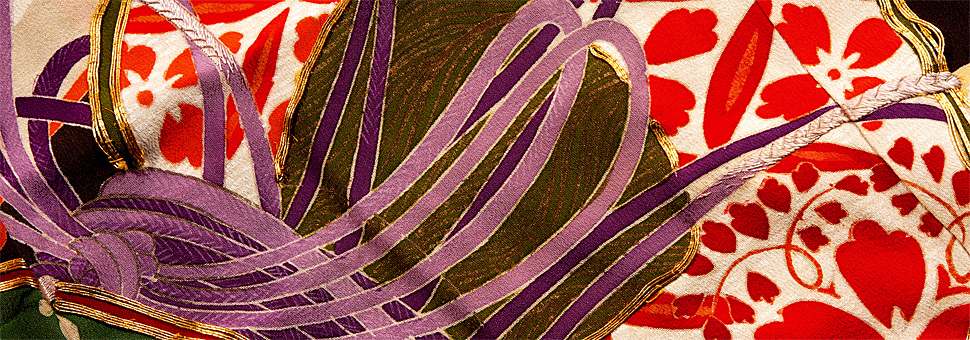
• F1
  • F4
  • F2
  • F3

We visited the Greek Folk Art Museum, Athens, this morning and spent a pleasant few hours looking at their exhibitions relating to the production of textiles (spinning equipment, including spindles and distaffs), metal work (with an emphasis on jewellery and swords), as well as their extensive collection of regional costumes and embroideries.

Throughout the museum great care has been taken in the presentation of the objects and in providing adequate information (in Greek and English). There are numerous photographs illustrating how the garments and jewellery were worn. Interesting details are being explained, such as the role in society of the first borns on the island of Karpathos. Both the first male and female children had a very different life, with different clothing, jewellery and expectations than their younger siblings.

The embroidery gallery is divided according to region rather than, for example, technique, and the main styles are clearly indicated. In addition, the use of embroidery for household furnishings, including beds, curtains, cushions and so forth are described and illustrated with some amazing examples. There was no information about the specific techniques used for the various styles, but there are books (all in Greek) on sale in the small shop that cover these aspects.

The museum is in the old quarter near the Acropolis and it is not easy to find, especially as it has been divided into various buildings in the same neighbourhood - so, the Greek pottery museum is housed in a nearby buliding that was originally a mosque. But it is well worth the effort to find the costume and embroidery museum and enjoy the display and friendliness of the staff.

Gillian Vogelsang-Eastwood, 13 July 2014

Detail of an embroidered bridal sheet from Skyros, Greece. Benaki Museum, Athens.Detail of an embroidered bridal sheet from Skyros, Greece. Benaki Museum, Athens.The last few days of our travels through South and Southeastern Europe have been spent wandering around Athens, Greece, looking at the monuments, especially the Acropolis, and, more importantly as the subject of a Textile Moment, the Benaki Museum. This museum, located just behind the Parliament Building at Syntakhma Square, was established in 1930 by Antonis Benaki in memory of his father, the collector Emmanuel Benaki. The museum houses over 44,000 items relating to Greek history and culture.

The collection includes a wide range of objects dating from prehistoric times to the 20th century: ceramics, glass, jewellery, metal work, paintings, and of course, Greek traditional costumes (mainly 19th and 20th century examples) and accessories, as well as woven textiles and embroideries. The costumes and other textiles date from the 13th century onwards and include medieval examples of metal thread work, as well as various early examples of embroidered net and needlelace. The collection on show does indeed include substantial, and top quality upholstery and costume pieces in a wide range of techniques. Some of the most spectacular pieces come from marriage beds, which were the focus of embroidery in a traditional Greek home.

The Benaki Museum also has a bookshop with a range of books and postcards in English and Greek about regional dress and embroidery. The books purchased during this visit will be described in the next group of book recommendations that will appear on the TRC website at the end of July.

Gillian Vogelsang-Eastwood, 13 July 2014
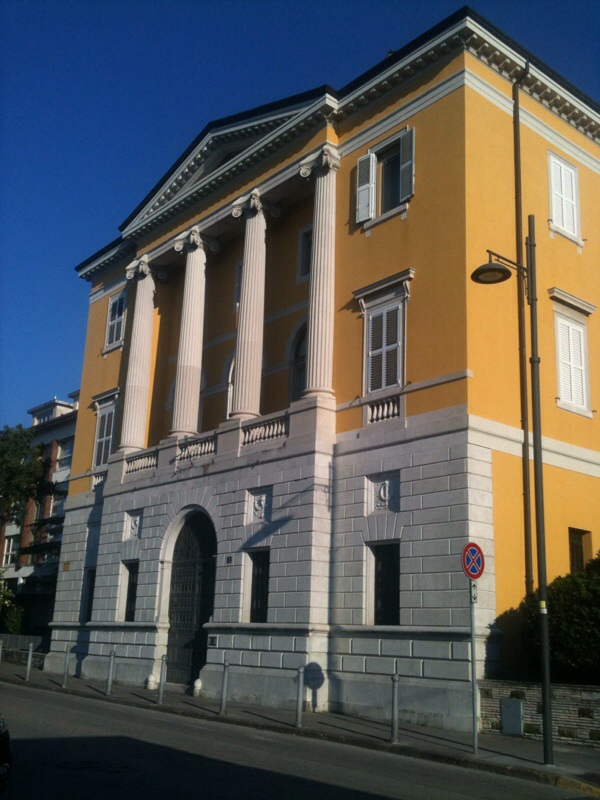
Sir Richard Francis Burton (1821-1890), the British Arabist and explorer (not the actor) wrote The house of Richard Francis Burton in Trieste, Italy, where he died on 20 October, 1890. Photograph: Willem Vogelsang, July 2014.The house of Richard Francis Burton in Trieste, Italy, where he died on 20 October, 1890. Photograph: Willem Vogelsang, July 2014.numerous books about life in Egypt and the Middle East during the latter half of the 19th century. Among his various exploits, for example, he disguised himself as an Arab sheikh and went on a pilgrimage to Mecca. In the memoires of this trip he describes in detail the garments worn by the people he met and the types of dress worn by, for example, the local Arabs, the Egyptians, the Indians, and the Turks, in Medina and Mecca. This information is invaluable for people working on the history of Western Arabian Peninsular dress and dress forms in India and the Middle East in the second half of the nineteenth century.

At the end of his career, he and his wife Isabella lived in Trieste, northern Italy, where Burton was the British consul. The house where they lived and in fact, where Burton died, is still there. It was here, in the garden at the back of the house, that soon after Burton's death his wife burnt all his papers and documents. The house is now called the Villa Gosleth, after one of its early nineteenth century occupants, and is situated along the Via Franca. On the web various houses are illustrated, so it can be a little confusing when searching different areas of the city (as we did!) for the building. But the search was worthwhile.

Gillian Vogelsang-Eastwood, 8 July 2014

We arrived in Vienna early this afternoon and went straight to the Kaiserliche Schatzkammer (Imperial Treasury). This is a must for people interested in medieval and later Western and Central European embroidery. There are numerous examples of ecclesiastical embroidery, especially copes, from the 14th century, as well as an impressive collection of heraldic garments (tabards in particular) ranging in date from the 16th to the early 18th centuries.

Personally, the most impressive group of embroideries was that from Sicily. The mantle of King Rogier II of Sicily alone is worth visiting the museum. With a maximum width of 345 cm, it is worked in gold and pearls on a crimson ground and has the motifs of a striped lion attacking a camel, with an inscription in Arabic underneath. It dates to c. 1134. In the same room as the mantle is a medieval royal gown made from Chinese silk and embroidered in the West with gold and pearls, as well as silk hoses, gloves, shoes and various other gowns, all embroidered using a variety of techniques.

Gillian Vogelsang-Eastwood, 3 July 2014

We are having a few days in Budapest, Hungary. The Museum of Ethnology, just by the Parliament building, has a permanent display of Hungarian life. The display includes a wide range of amazing costumes for men and women, from all the main parts of Hungary, mainly dating from the 19th and early 20th centuries. The many forms reflect Hungary's diverse and complicated history. The exhibition also includes many different decorative techniques, as for instance felt applique, laces of various types, pulled thread work, as well as decorative stitch forms. To the uninitiated eye some of the men's outfits could be taken as elaborate women's attire. This is quite a revelation to someone used to more sober (and boring) West European men's clothing. The embroidery and woven textiles are well worth seeing and studying in further detail.

Lots of embroidery for sale in the city, but most of it is made in China for the Hungarian market (sounds familiar?). However, we found a small shop called Vali-Folkart. It is full of 'good'  embroidery and the shopkeeper, Bálint Ács, knows what he is talking about. certainly a place to visit! More details about Vali-Folkart can be found at their website www.valifolkart.hu

Gillian Vogelsang-Eastwood, 3 July 2014

Last May I was one of the happy few to follow the Intensive Textile Course at TRC Leiden. Since that course my outlook on the world has been (further) textilized. Meaning, that what I see is filtered through a textile filter.

This filter pops up at unexpected moments and this weekend it manifested itself again when I was looking through the NRC Newspaper. There was a large picture of the uniform worn by Arch Duke Franz Ferdinand on the day of his assassination 28 June 1914. I expect most people would associate this with the wearer, and with the act that changed the course of history.

The first thing I noticed: blue fabric, twill weave. The red collar has gold embroidery in a geometric pattern, with three silver stars on either side in raised embroidery, decorated with what looks like sequins, but are probably spangles. I regret the photo was not clearer, so I might have been able to tell what thread was used for the gold embroidery.

Those details I would not have noticed before the course, and it is great fun to see them since. I will have more of these moments, and look forward to them. Thanks to the teaching of Gillian Vogelsang-Eastwood at TRC Leiden.

Felicia Kruger-de Bats, 24 June 2014

I have just returned from a holiday in Holland, in early June, where I went to several wonderful exhibitions for West Weeft and I also had the pleasure of meeting Gillian Vogelsang-Eastwood, the director of the Textile Research Centre in Leiden.

We chatted enthusiastically about our different interests in textiles, and how the centre relied on the help of volunteers and that recently they had set up a section on their website for textile wow moments, so I hope my small contribution will be accepted. Here goes, firstly the exhibition at the TRC was a WOW moment. Walking in to find displayed 7000 years of textile history is amazing. To be able to look closely and even try using some replica looms similar to those used by early mankind was fascinating and very humbling. The generosity of people donating textile artefacts, clothing, books and more to their ever increasing collections adding to the accessibility of knowledge for everyone is incredibly important.

None of this would be possible without the dedication of the staff and the volunteers, so a big thank you for the privilege of visiting. Several days later we had another WOW moment, the www.weverijmuseum.nl/ at Geldrop, a very welcoming museum converted from a former textile factory that holds a superb collection of wooden floor looms and ancillary equipment from 18th century to large Jacquard, ribbon, double beam looms and all sorts of other equipment I knew nothing about but had fun looking at. There was a double sided sheet of paper written in English, but most of the descriptions were in Dutch and the centre was run by volunteers so I really need to return to Holland again and again and learn Dutch too!

Carolyn Griffiths, 18 June 2014
www.frometextileworkshop.com

The afternoon of the 15th of June was dedicated to a film screening and a presentation of a new book by the anthropologist, Sandra Niessen, about theA Batak afternoon at the TRC. 15 June 2014A Batak afternoon at the TRC. 15 June 2014 weaving traditions of the Batak in North Sumatra, Indonesia. Some forty people attended the afternoon and enjoyed, not only watching the film, but also discussing the Bataks and their culture with the author. And above all, they visited the new exhibition on weaving products and weaving techniques from all over the world. The photograph shows Sandra Niessen talking with some of the visitors. The orange coloured lady in the foreground is a mannequin with an orange coloured burqa from Afghanistan..........

15 June 2015

Zoek in TRC website

Contact

Boerhaavelaan 6
2334 EN Leiden.
Tel. +31 (0)71 5134144 (kantooruren)  
office@trcleiden.org

Het TRC is elke dag geopend tussen 10.00 en 15.00 uur.

facebook 2015 logo detail


instagram vernieuwt uiterlijk en logo


Bankrekening

NL39 INGB 0002 9823 59, t.a.v. Stichting Textile Research Centre.

Financiële giften

Het TRC is afhankelijk van project-financiering en privé-donaties. Al ons werk wordt verricht door vrijwilligers. Ter ondersteuning van de vele activiteiten van het TRC vragen wij U daarom om financiële steun:

Giften kunt U overmaken op bankrekeningnummer (IBAN) NL39 INGB 000 298 2359, t.n.v. Stichting Textile Research Centre. BIC code is: INGBNL2A

U kunt ook, heel simpel, indien u een iDEAL app heeft, de iDEAL-knop hieronder gebruiken en door een bepaald bedrag in te vullen: 


Omdat het TRC officieel is erkend als een Algemeen Nut Beogende Instelling (ANBI), en daarbij ook nog als een Culturele Instelling, zijn particuliere giften voor 125% aftrekbaar van de belasting, en voor bedrijven zelfs voor 150%. Voor meer informatie, klik hier