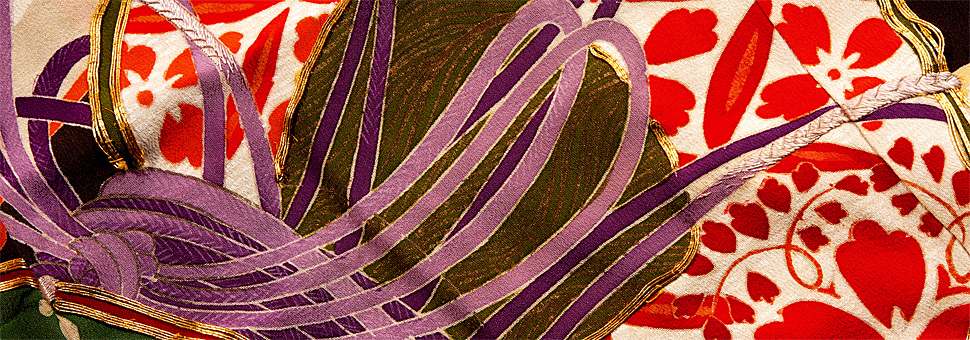


Many people may think of kimono and obi as very Japanese garments. That is true in some way, of course, but not always so in terms of their decoration. Rather, kimono/obi designers have for centuries applied many foreign motifs to decorate kimono and obi, to attract customers who want to wear ‘something different’.
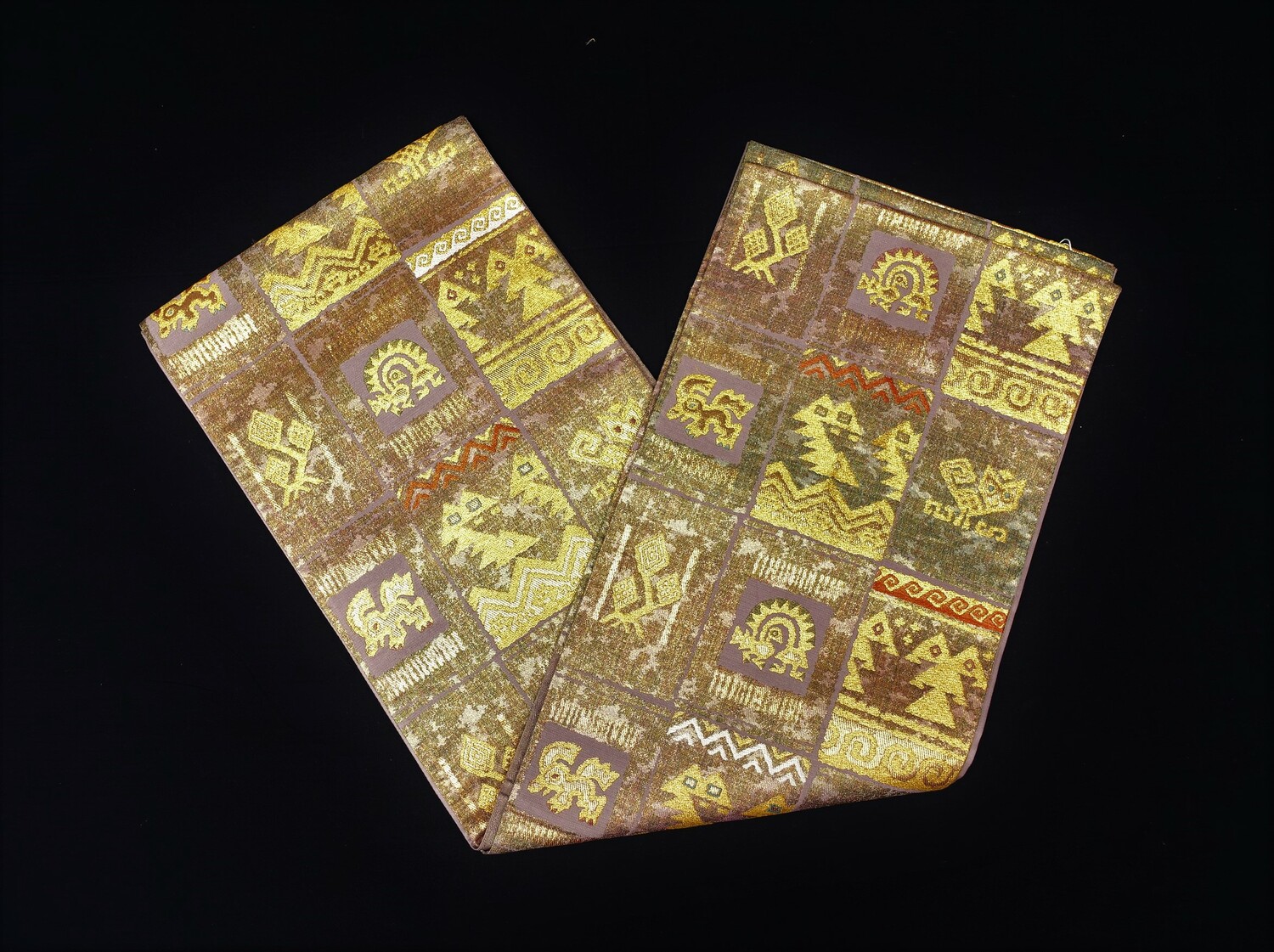 Japanese obi (sash), with Andean (pre-Hispanic South American) motifs, c. 2000 (TRC 2022.0233).
While looking for kimono and obi with foreign decorative patterns, I came across a gorgeous obi with ancient Andean patterns (subsequently added to the TRC Collection, TRC 2022-0233). It is beautifully woven with colourful and metallic threads to create designs such as that of a jaguar, a bird and a fish.
These highly stylised motifs, so I found out, were developed in South America, many centuries ago. They are said to have religious meanings. While Japanese designers were attracted to these motifs, so were Western artists. Some of the patterns, I want to add, may be compared with the paintings of Paul Klee (1879-1940).
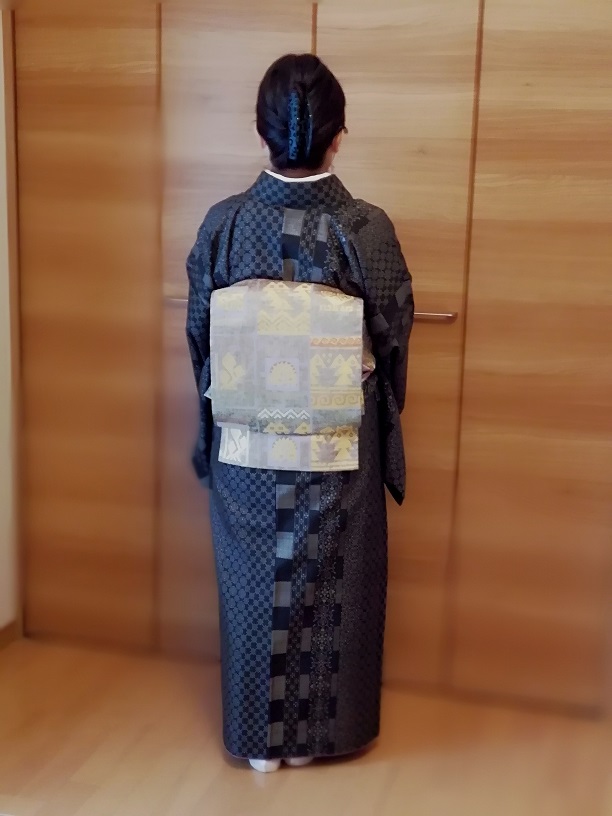 A friend of the author wearing a Japanese obi (sash), with Andean (pre-Hispanic South American) motifs, c. 2000 (TRC 2022.0233).Actually, this particular obi was bought at a second hand market with a tag identifying the garment as being decorated with ‘Egyptian patterns’. But I recognised instantly that it was Andean, as it has exactly the same patterns as the ancient Andean fragments that I had shortly before seen at the exhibition ”Moyo-wo kiru: Enveloping patterns," which was set up at the Nagoya City Museum in the autumn of 2020.
The exhibition featured many designs that were used in Japan to decorate kimono and obi. The exhibition also included some of their design sources, taken from the Matsuzakaya collection, with textiles from the ancient Chancay culture in Peru, from between ca. 1000-1400.
Matsuzukaya
The Matsuzakaya Collection is linked to a Nagoya-based department store with the same name, which grew out of a kimono shop that was established in 1611. In fact, many department stores in Japan have their origins in kimono outlets and kimono fabric wholesalers, and have been fashion trend makers for centuries.
Since the Meiji Restoration in 1868, Japanese dress gradually became more Western, and with it the market for traditional kimono started to decline. To keep attracting customers, kimono designers sought design sources from historic kimono owned by former feudal lords, but also from textiles from all over the world, including Andean textiles from South America.
The Matsuzakaya chain set up a textile reference library in 1931 and commisioned a library building in Kyoto in 1957. The number of its collection reached ca. 4,900 items. Due to the decline of demand for kimono, the library was closed in 2011, and about 70 percent of its collection was donated to the Nagoya City Museum.
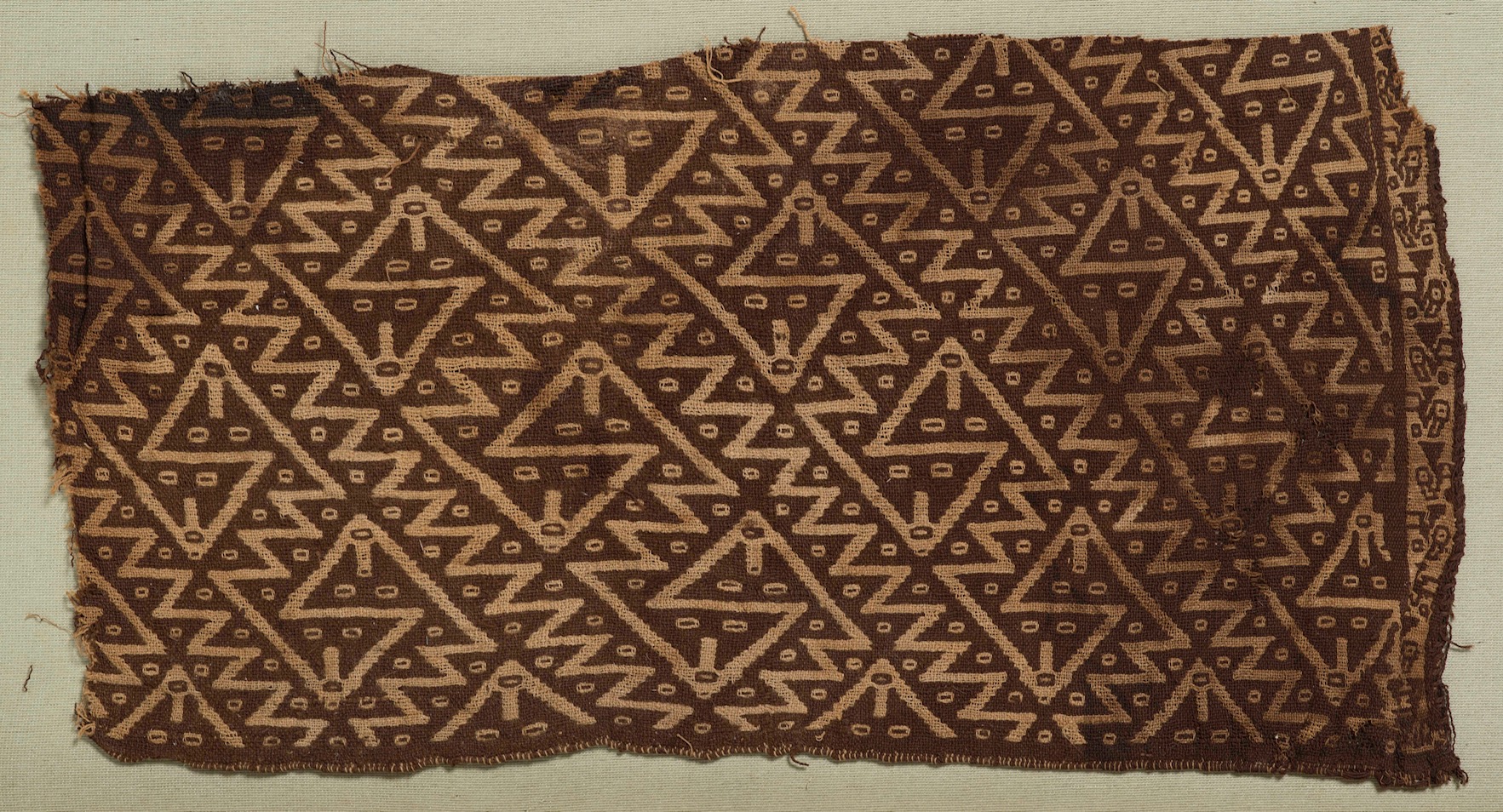 Textile fragment with fish design, Chancay culture, ca..1000 1400. The Matsuzakaya Collection, courtesy of the Nagoya City Museum.
It is said that kimono and obi with Andean patterns from South America and even Coptic designs from ancient Egypt first became popular in the late 1920s - 1930s. However, the obi which I bought recently is relatively new. I heard that the first owner purchased it some ten to twenty years ago.
One of the former Matsuzakaya kimono designers, aged 75, has said that he designed an obi with Andean patterns just before he retired. As I couldn’t interview him directly, I cannot say the obi now in the TRC Collection was his design.
Foreign elements
Still, I can guess that this type of exotic ornamentation became popular again around 2000. I spotted another obi with exactly the same motifs, but with a black background. This one was once owned by a professional dancer of traditional Japanese dance. With such patterns she definitely wanted to be different!
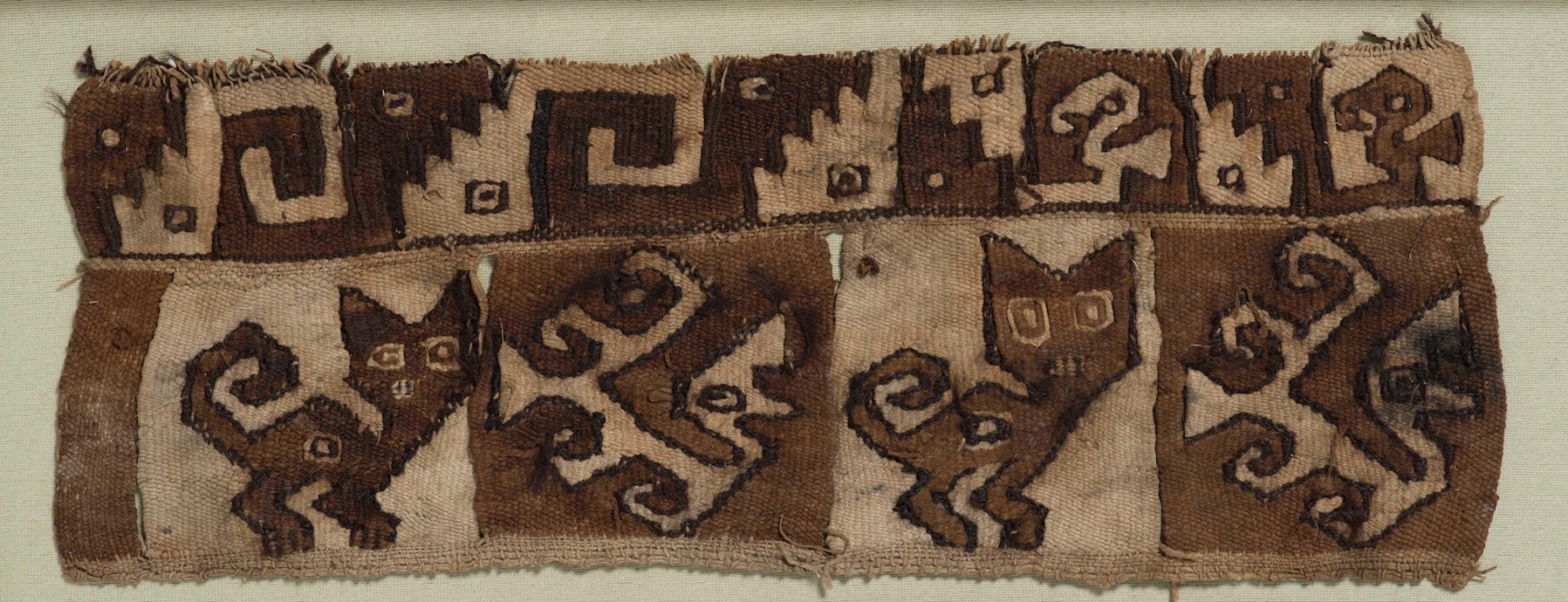 Textile fragment with jaguar and bird motifs, Chancay culture. The Matsuzakaya Collection, courtesy of the Nagoya City Museum.
There are many other kimono and obi with foreign patterns often called in Japan 'Sarasa', including chintz designs and buteh (paisley) motifs. Another foreign design is the Java saw-tooth. The word Sarasa may have originated in the Portuguese word for ‘cotton’ or in the name 'Saracen' (a general medieval European word for a Muslim). Sarasa textiles became popular in Japan from the 16th century. Furthermore, the stripe and check patterns called ‘shima’ and ‘kanto’ were introduced from China in the 15th - 16th centuries. Much later, in the early 20th century, kimono/obi designers even applied Art Nouveau and Art Déco patterns and ‘exotic’ objects from Europe.
The foreign elements can still be seen today. There are kimono and obi with Western characters, such as Mickey Mouse (see our earlier blog of 18 February) and designs based on the work of world-renowed artists. I heard that the TRC plans to have a mini exhibition on kimono and obi with Western influences later this year. Something to look forward to!
Naoko Kikuchi, TRC volunteer living in Japan, 3 March 2022