

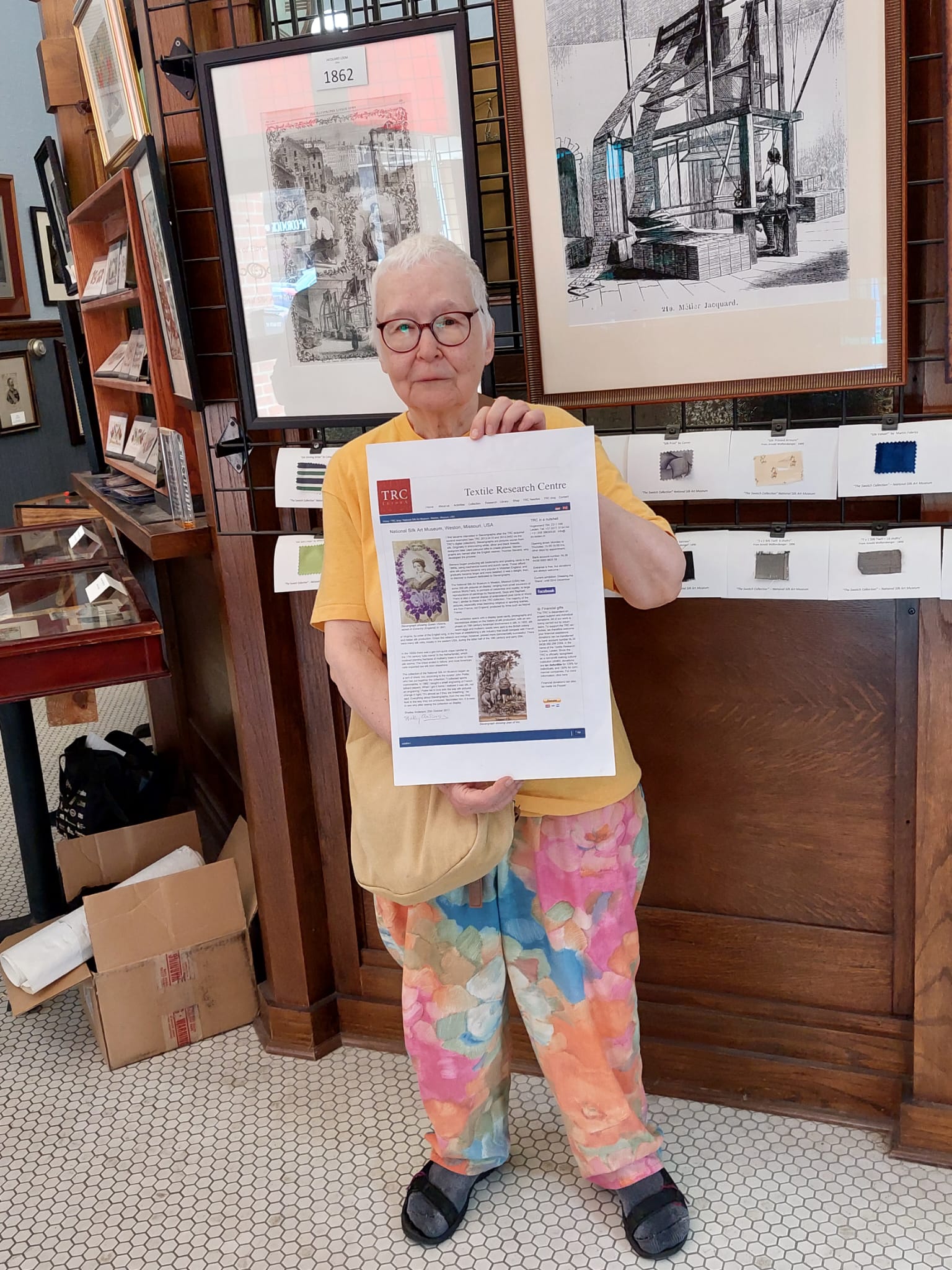
 Photo: TRC volunteer Shelley Anderson holding a copy of the TRC blog inside the National Silk Museum, USA. Photo by Francoise Pottier.It was a very pleasant surprise to learn recently just how far the TRC’s blogs can reach. I was at the National Silk Art Museum in Weston, Missouri (US). I had first visited the Museum in 2017, and written about the visit in a TRC (see 25 October 2017). It was a pleasant surprise to see, at the end of this second visit, a large copy of that TRC blog on the Museum’s wall.
When I told the Museum’s director, John Pottie, that I was a TRC volunteer and had written the blog, he thanked the TRC and said the blog piece had been “a real turning point for the Museum.” “Some upscale European magazine read the TRC’s blog and listed the Museum in its ‘Ten Museums to See in America’” Pettie said, which resulted in an upsurge of visitors and revenue.
A third of the Museum’s visitors now come from Europe. “We’ve been able to increase our collection to over 800 pieces, and double the objects we have on display to 400,“ he added. And all because of the TRC’s blog!
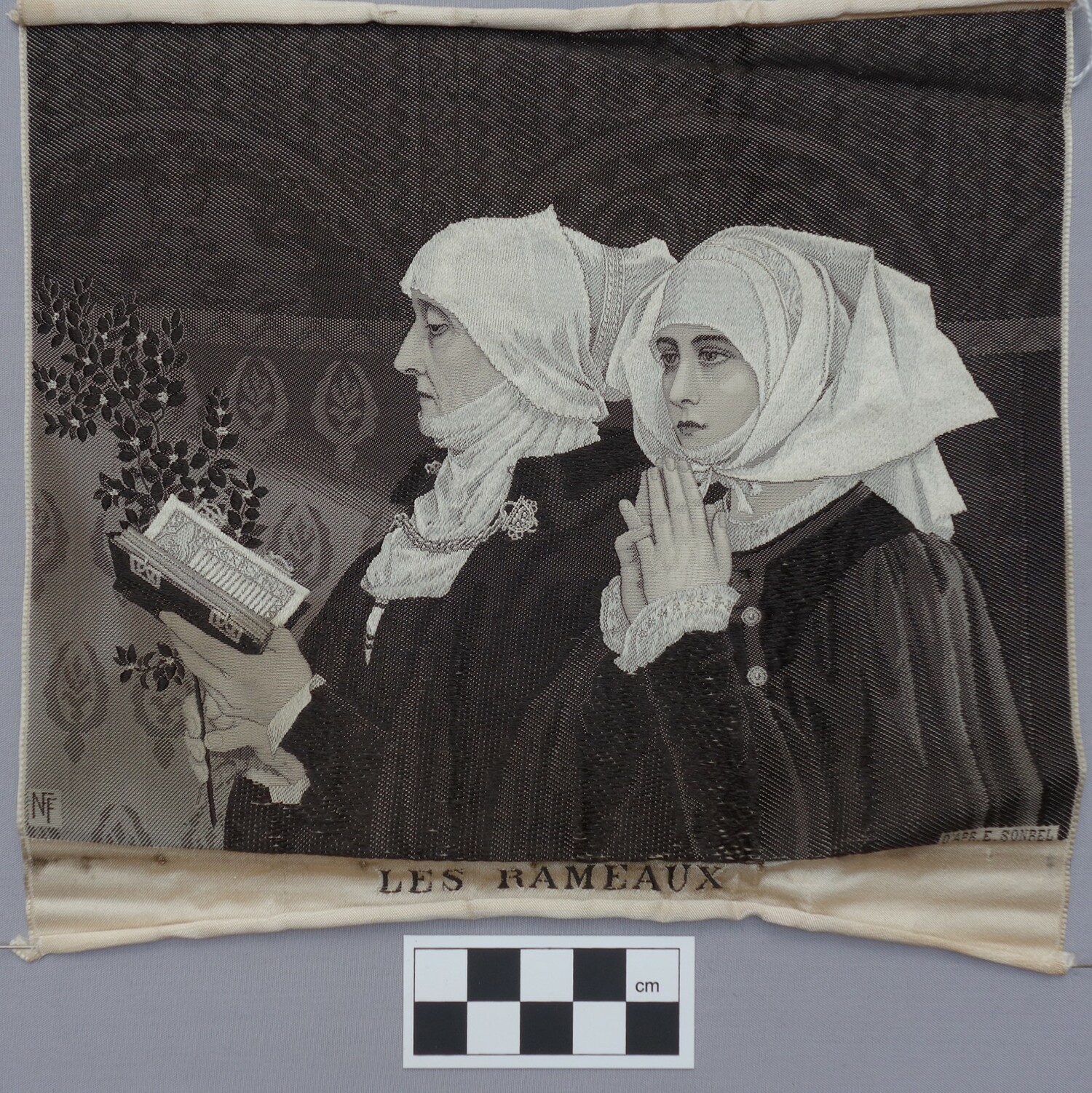 Silk Stevengraph picture, France, 1916 (TRC 2013.0419).The TRC has its own small collection of machine-woven silk paintings, which are also known as Stevengraphs. Two of these paintings depict religious scenes. TRC 2013.0419 shows two veiled women, presumably nuns, at prayer. A larger panel, TRC 2013.0462, shows the Crucifixion.
My favourite object, however, is a dance card holder from the 1920s, TRC 2015.0212. One side of this rectangular wallet is worked in glass and metal beads, in an art deco design.
The other side is a small silk painting of two women fencing. All three objects have the initials ‘NF’ in their lower left hand corners. ‘NF’ refers to ‘Neyret Frères’, the French company that produced them.
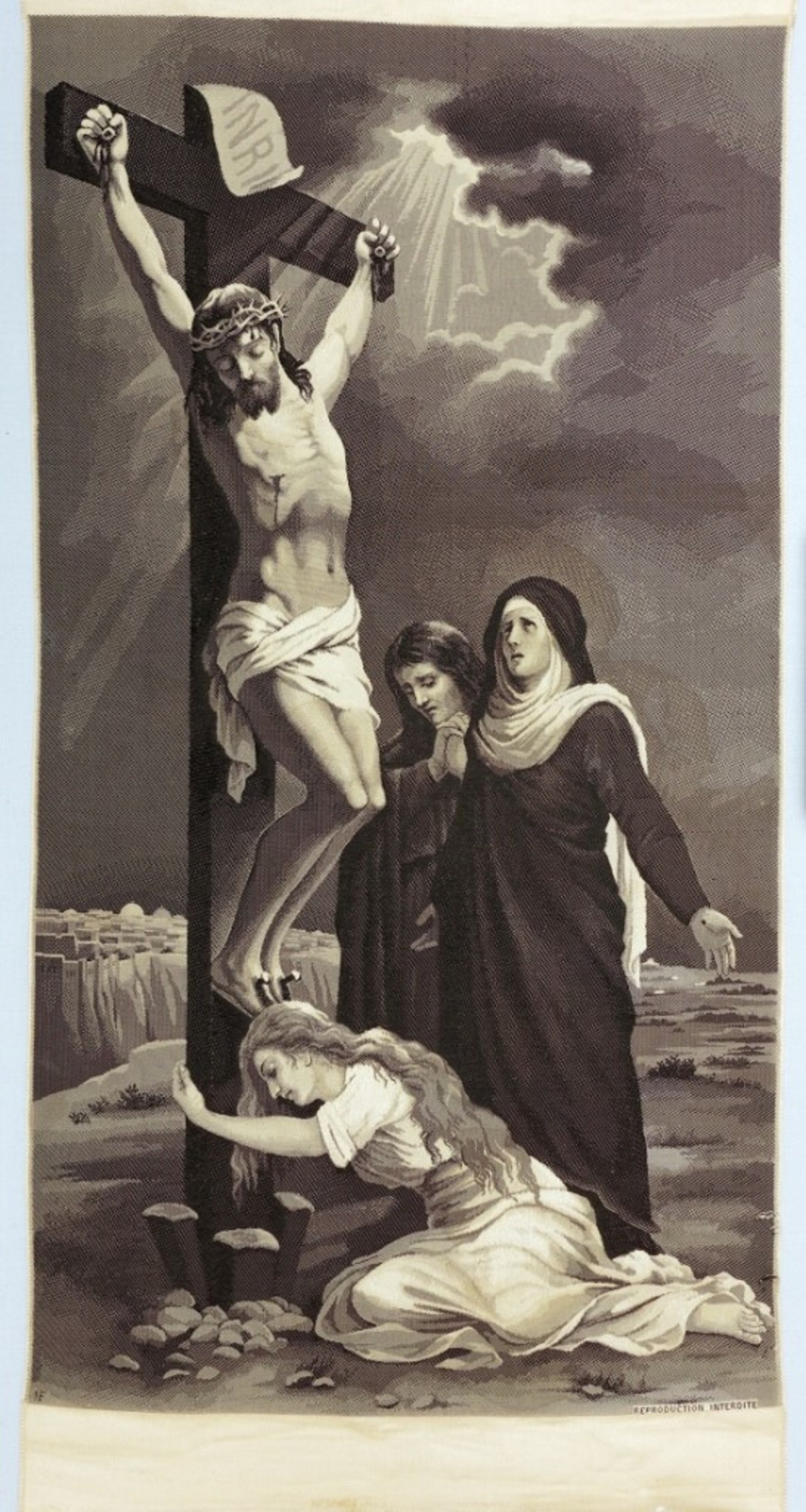 Silk Stevengraph picture, France. c. 1916 (TRC 2013.0462).I had noticed a larger silk painting of this fencing scene on display at the National Silk Museum. Curious, I did some research. The design is called “Le lecon d’escrime” and is based on a painting by a Spanish painter named Alonzo Perez (1881-1914).
This silk painting was also produced by Neyret Freres (Neyret Brothers). Perez had left his native Spain and moved to Paris by the turn of the 20th century. His work was exhibited in Parisian salons (and at least one of his paintings ended up in the Louvre). Interestingly, Perez also worked as a designer for Neyret Freres.
Neyret Frères was founded in 1823 and originally produced special ribbons for medals and for haute couture. The popularity of silk paintings in the early part of the 20th century was a profitable side line for the business. Silk paintings, at a time when photocopying did not exist and photography demanded expensive equipment, was a way of reproducing art work at an affordable price for a broader public.
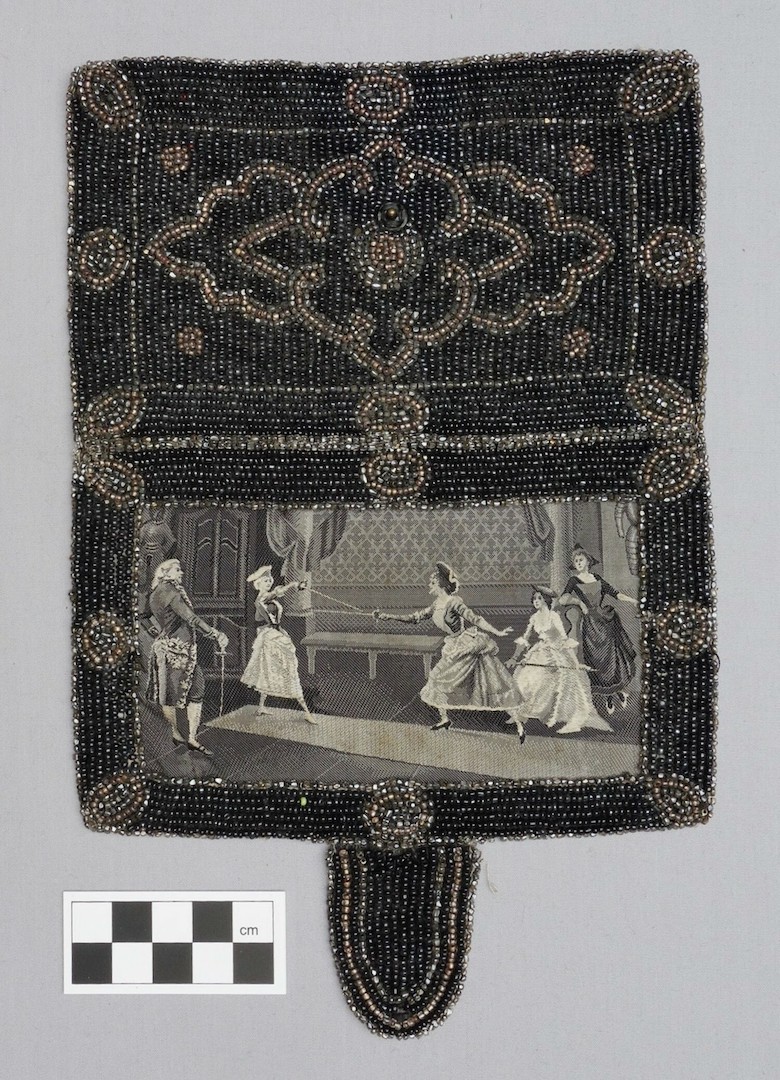 Small dance card holder, Stevengraph, France, c. 1920 (TRC 2015.0212).The company used high quality Chinese silk for its paintings, and up to twelve different shades of grey. I was delighted to learn that Neyret Frères is still in business, producing ribbons for medals, sashes for ceremonial events, and labels and textile packaging for luxury brands. You never know where reading the TRC blog will take you!
By Shelley Anderson, 21 October 2023