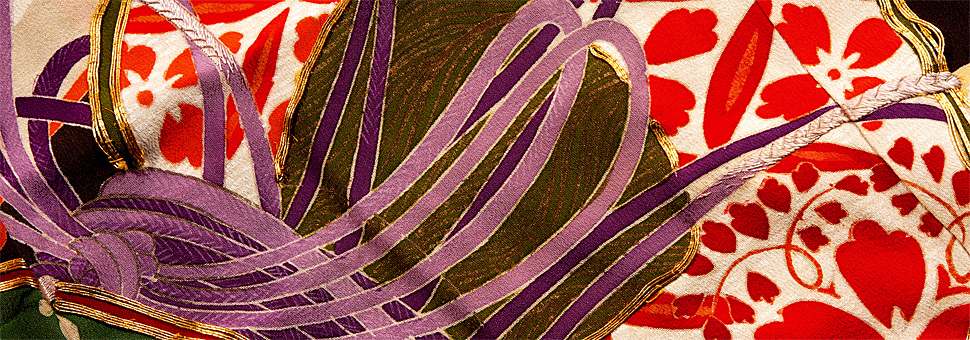


 A modern steam punk corset in a paisley (buteh) material (TRC 2020.3832).We are getting more and more ‘textile’ questions being directed at the TRC via social media and emails. They range from what is wrong with Dutch sheep and their wool (there was a recent newspaper article stating that the wool was too coarse for general use) to when did manufacturers start adding shoe sizes to the soles of their knitted socks (that question really floored me, I have no idea!).
We recently had another question from someone working on a school project about corsets and the different types. We could point her to various useful books and to the Victoria and Albert Museum’s amazing collection of corsets (the great advantage of having such collections online!).
 French fashion plate, c. 1900, showing a woman wth an impossibly small, narrow waist created by a corset (TRC 2023.1488).We don’t actually have many corsets at the TRC (although we have a wonderful 'steam punk' corset in the collection) and I know Augustade Gunzbourg, who deals with our fashion section, would really like to have a collection that illustrates the history of this garment and the changing role of women within society.
But that is not really why I am writing this blog. I am currently slowly sorting and cataloguing the samples and samplers that form part of a large donation of objects recently given to the TRC by the former Naaldkunst Museum, Winschoten (more about this in another blog)!
 Sampler dedicated to elements of corset making including pleats, boning, ties, lacings, hooks and eyes, buttons, gathers, etc. Belgium or the Netherlands, c. 1900. (TRC 2023.2780).One of the samplers (TRC 2023.2780) was probably made by someone following a seamstress (coupeuse) training, as it is based on many of the elements needed to make a real corset. We think this particular sampler dates to about 1900 and is Dutch or Belgian in origin
The corset sampler is 71 x 20 cm in size and made of a very fine wool cloth, lined with a plain weave linen material. It has a ‘valance’ decorated with an indented pattern edged with line of indented pendants edged with yellow silk in buttonhole stitch. These would have been placed along the lower edge of the corset.
There are also the initials M G, which are worked in yellow silk using satin stitch outlined in back stitch. These are followed (from left to right) by three different types of white buttons set into small, handmade buttonholes, as well as rows of hooks and eyes, loops and rings, all fastened with the same yellow thread used for the initials.
There is then an opening that is fastened with corset laces (like shoe laces, but wider) ending in metal points (aglets).
The lacing is followed by a series of pleats, two of which are channels (casings) and enclose flat bones of some kind, as well as part of a waist tie in a thick band, which has hook and eye fastenings and decorative ‘flossing’, the embroidered elements at the top and bottom of a boning channel.
 Detail of the corset sample with the initials M G, buttons, hooks and eyes, lacing, boning. (TRC 2023.2780).Flossing was developed in the second half of the 19th century, both to make the corset more decorative and to strengthen the ends of the channels. After the bones there is another opening, this time fastened with a line of hooks and round eyes.
The structural elements of the corset sampler are followed by an abstract pattern in passementerie, using a narrow, white, silk braid.
The final element is a broad row of ruffles of the type that could have decorated the upper edge of the corset. And last but by no means least, on the back of the sampler, one of the short edges is finished with a band with a short, hard fringe.
This type of band is often found on the hems of late 19th and early 20th century long skirts and is intended to protect the material from damage when walking.
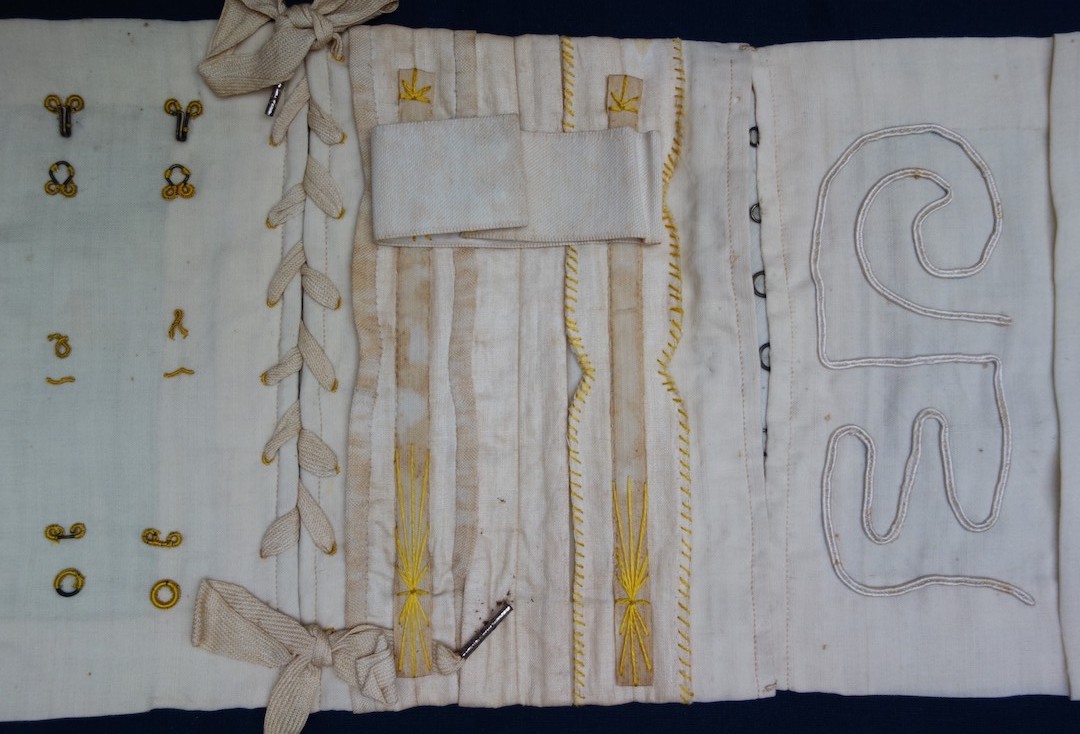 Detail of the corset sample with lacing, boning, flossing and hooks and eyes (TRC 2023.2780).
All in all, a very interesting sampler that has provided many technical details as well as opening the TRC door onto a much bigger and intriguing story!
Gillian Vogelsang-Eastwood, 23 December 2023