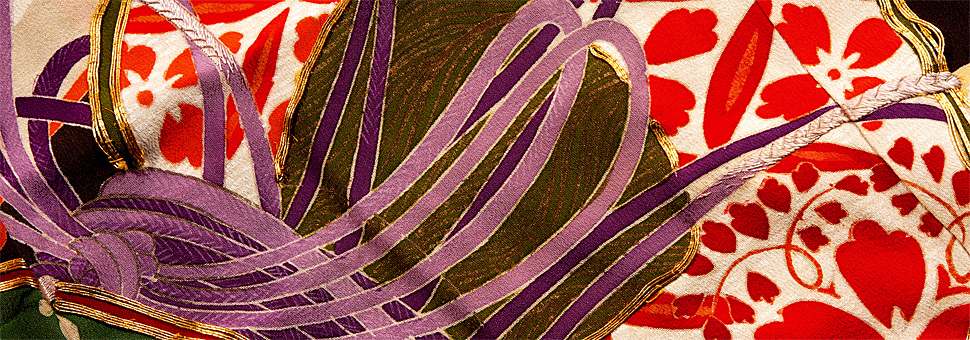

Little is written and known about traditional Jordanian dress and embroidery. Very often it is confused with Palestinian textiles and its predominant cross stitch work, Traditional Jordanian dress and ornamentation is rapidly disappearing, and may soon only be seen in musea.
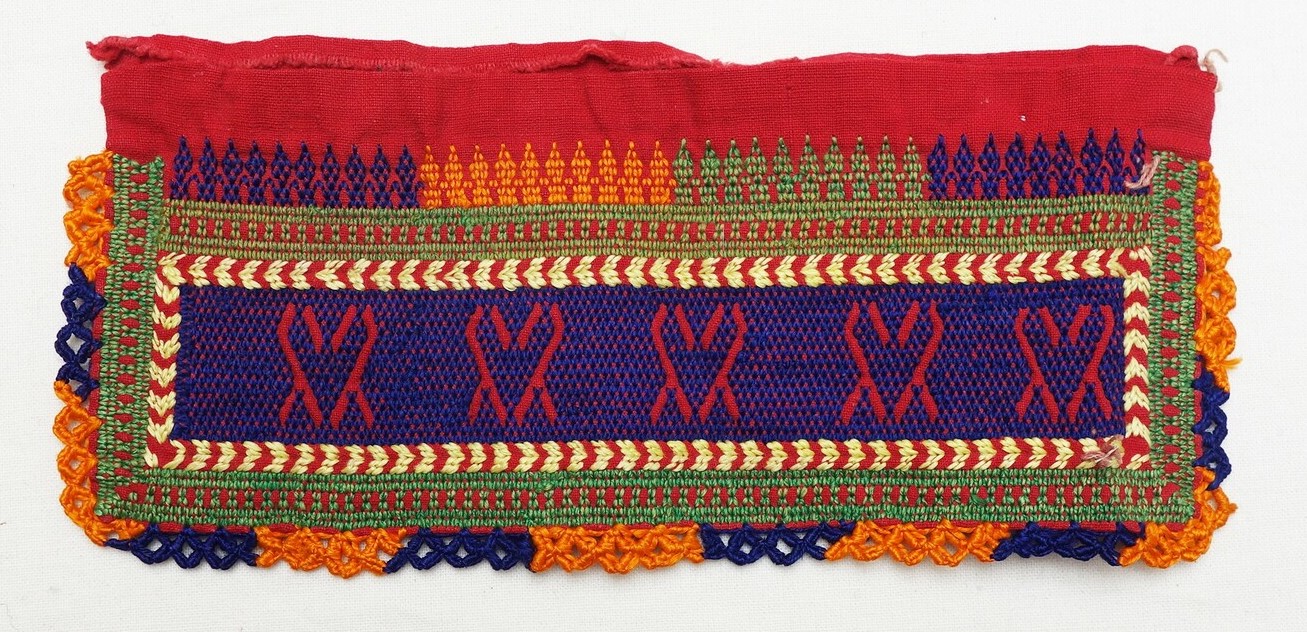 Detail of an embroidered panel from Jordan, with a negative design set within a purple ground, 20th century (TRC 2019.1715).
Traditional Jordanian women's dress and embroidery are unique in their style and shape. They can be divided into a number of regional styles, such as those of Irbid in the north, Al–Salt in the centre, Al Karak and Ma’ an in the south. There are also differences in dress and ornament among the various Bedouin groups, such as those of the Bani Sakr, Bani Hasan, ‘Adwan, ‘Abbadi or the Bedul of Petra.
Most traditional dress includes loose fitting gowns, but they vary in size and shape. For example, they may range from a normal-size dress to a gigantic three-metre double folded dress, or from garments with narrow sleeves to those with long huge sleeves that used to be placed over the head.
During the workshop we are going through the fascinating history of Jordanian dress, its embroidery and its distinctive forms divided per region. Subsequently, the participants will learn the basics of particular stitches from Jordan, including the Al Raqme stitch (a diagonal filling stitch). All materials will be provided by the TRC
- Date: Wednesday, 28 October 2026.
- Time: 10.00 - 13.00.
- Venue: TRC Leiden, Boerhaavelaan 6, 2334 EN, Leiden.
- Teacher: Fatima Abbadi.
- Language: English.
- Costs: 45 euros. Coffee, tea and materials are provided.
- Maximum number of participants: 8. Minimum: 4. If the minimum number of participants is reached, confirmation and invoices shall be sent.
Please register in advance: This email address is being protected from spambots. You need JavaScript enabled to view it.