• F2
  • F1
  • F3
  • F4

Woman's outfit from the Kalocsa region, Hungary, mid-20th century, TRC pop-up exhibition, from 24 April until the end of May 2022.Woman's outfit from the Kalocsa region, Hungary, mid-20th century, TRC pop-up exhibition, from 24 April until the end of May 2022.After the successful opening of the TRC pop-up exhibition on Sunday, April 24th, it was clear that one particular outfit was catching a lot of attention, due to its brilliant colours and floral patterns. This was one of the women’s outfits from the Kalocsa region in Hungary, which greeted visitors to the TRC as they came in. Several of the items from the Amsel Collection, which arrived at the TRC earlier this year, build up this outfit, which was so incredibly popular both in-person and online.

Both men and women from Kalocsa wear clothing adorned with a characteristic floral pattern, which can be seen both in the outfit on display as well as in several other pieces in the collection (e.g. the man's shirt, TRC 2022.0798). For the women it is most common that a white blouse with short sleeves was worn underneath a waistcoat with significantly more embroidery. The heavily pleated skirts, such as the red one pictured, could be layered over up to a dozen underskirts for added volume and flair, which would look incredible while dancing.

The aprons also often include a lace cutwork known as Richelieu and would have coloured ribbons woven throughout the lace. Most often the ribbon would be blue, although I have found that examples of other colours do exist. It was even common for ribbons to be woven through cutwork in the blouses and caps as well!

What makes the floral pattern of Kalocsa, just south of Budapest, so iconic is not only its use for clothing, but also for many other aspects of daily life. Florals can be found on everything, from dinnerware, to wallpaper, bedding, tablecloths, as well as decorated eggshells! Designs are also known to include the famous Kalocsa paprika that I look forward to spotting on a garment some day. It’s no wonder this outfit was catching everyone’s eye. This is part of what makes exhibitions at the TRC so unique, namely that visitors are able to view the embroidery very closely in order to fully appreciate the detailed patterns (see detail of TRC 2022.0450).
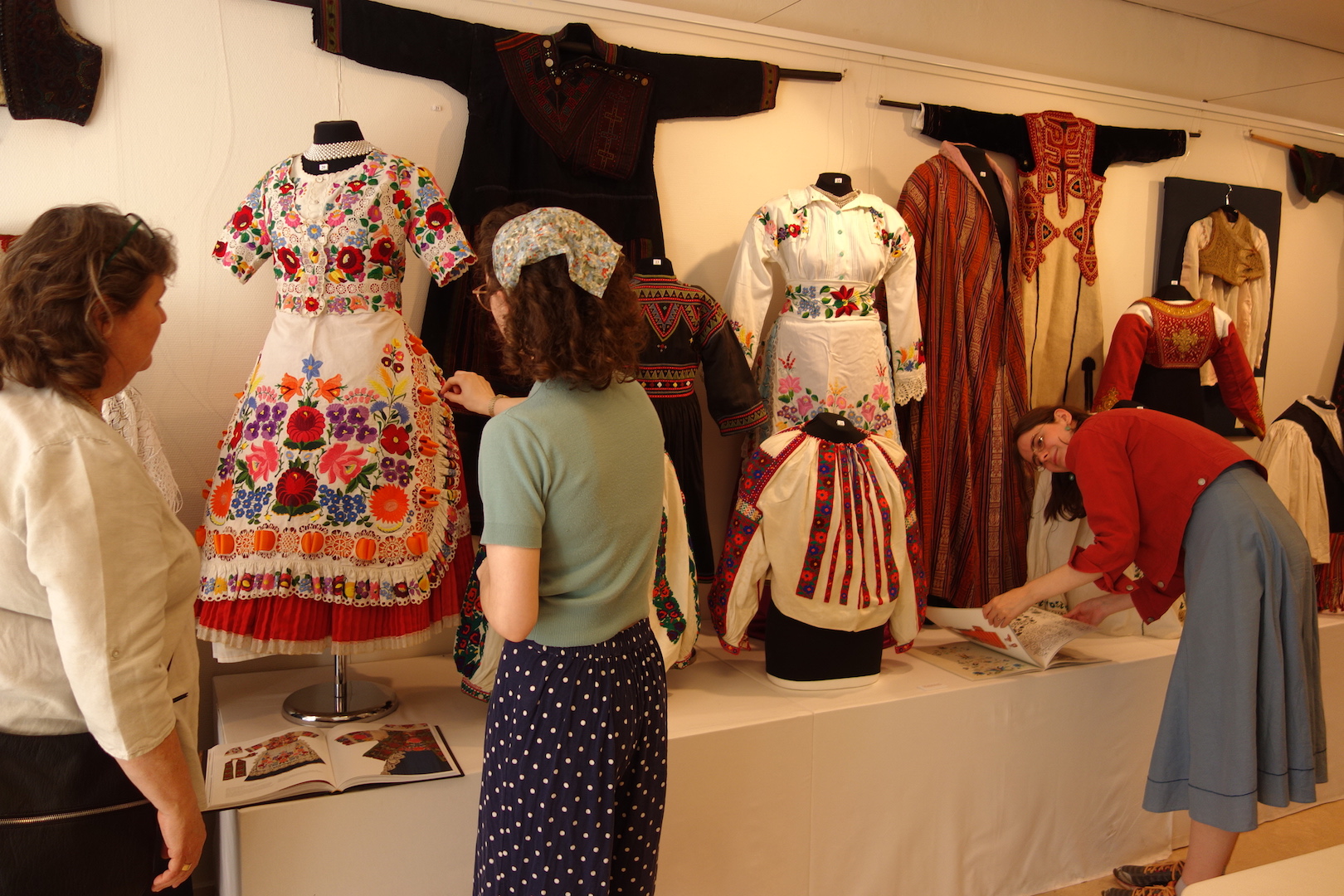
Sunday afternoon, 24 April, between 13.00 and 16.30, the TRC will open its doors to show a pop-up exhibition that includes a number of items that were included in two collections, from Paris and Arizona respectively, that were recently received by th TRC. The majority of the Arizona items come from Albania. Most of the Paris items come from Hungary and Romania. Entrance is free, and coffee/tea/biscuits will be served.

TRC volunteer preparing the pop-up exhibition of East European traditional clothing, for Sunday afternoon 24 April.TRC volunteer preparing the pop-up exhibition of East European traditional clothing, for Sunday afternoon 24 April.

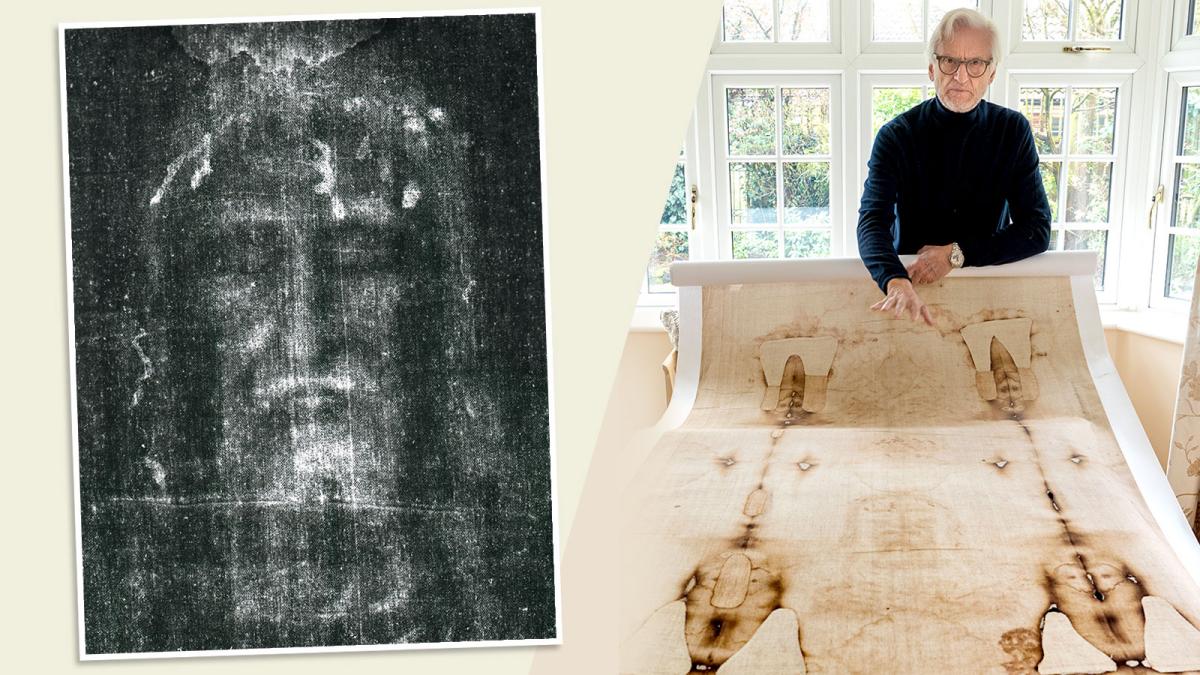
An article in The Times of today, 18 April, again draws attention to the Turin Shroud, allegedly the shroud in which Jesus was buried. The film director David Rolfe offers one million dollar to the British Museum when it can present evidence that the Shroud is a 'fake'.

David Rolfe, alongside a scan of the shroud, believes the fact the face is clearer in photo negatives raises questions about when it was created. Jeff Moore.David Rolfe, alongside a scan of the shroud, believes the fact the face is clearer in photo negatives raises questions about when it was created. Jeff Moore.

Many years ago I was asked by Ian Wilson, author of The Turin Shroud: The Burial Cloth of Jesus Christ?, a 1979 bestseller, to become a member of the British Turin Shroud Committee (BTSC) on the recommendation of Elisabeth Crowfoot, a renowned textile archaeologist.

Over the years the TRC in Leiden has acquired a large collection of textiles and dress from Afghanistan. Most of it was obtained during my frequent visits to the country between 1978 and 2011. Attention in the West is currently, and understandably, directed towards the Russian invasion of the Ukraine, but the situation in Afghanistan, after some forty years of civil war, is equally horrific. The TRC hopes that its Afghanistan holdings will continue to testify to the rich culture of the country, and to the perseverance of its people in trying to build a peaceful society, free from outside interference.

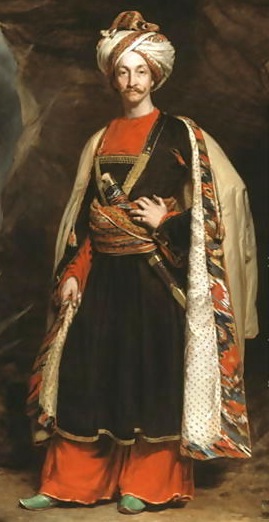
Colin Mackenzie in his Afghan dress, after 1843. by James Sant. Courtesy National Army Museum, London, NAM. 1961-10-61-1. Colin Mackenzie in his Afghan dress, after 1843. by James Sant. Courtesy National Army Museum, London, NAM. 1961-10-61-1.

In 2010 the TRC mounted a special exhibition about Afghan dress, which is now available to other suitable venues (This email address is being protected from spambots. You need JavaScript enabled to view it.). There is also an online exhibition, which can be enjoyed by clicking here. Many of the textiles were used for, and incorporated in Vol. 2 of the World Encyclopedia of Embroidery: Embroidery rom Central Asia, the Iranian Plateau and the Indian Subcontinent, which was published in 2021.

Looking at Afghan dress, and going through Afghan history, I frequently come across weird ‘occurrences’, which the reader may regard as trivial, but which I find fascinating and reflecting directly on the fascinating world of dress.

One of these ‘occurrences’ started with a shower curtain which you can buy for some fifty dollars from Fine Art America. It carries the depiction of a stern looking, obviously European gentleman in Afghan dress. I don’t remember why I came to look at this curtain, but when I did I immediately recognised the gentleman: It is Colin Mackenzie, one of those indomitable British warriors that strode the world in the 19th century, convinced of British superiority and British obligations towards civilizing the rest of the world.

He was one of the captives that survived the disastrous Retreat from Kabul in the winter of 1842 when at the end of the First Anglo-Afghan War the British suffered a disastrous defeat. Some 16,000 soldiers and camp followers were killed, died of their wounds or the cold, or were enslaved. Many of the officers and their family, some 80 in total, were taken hostage, among whom Colin Mackenzie.

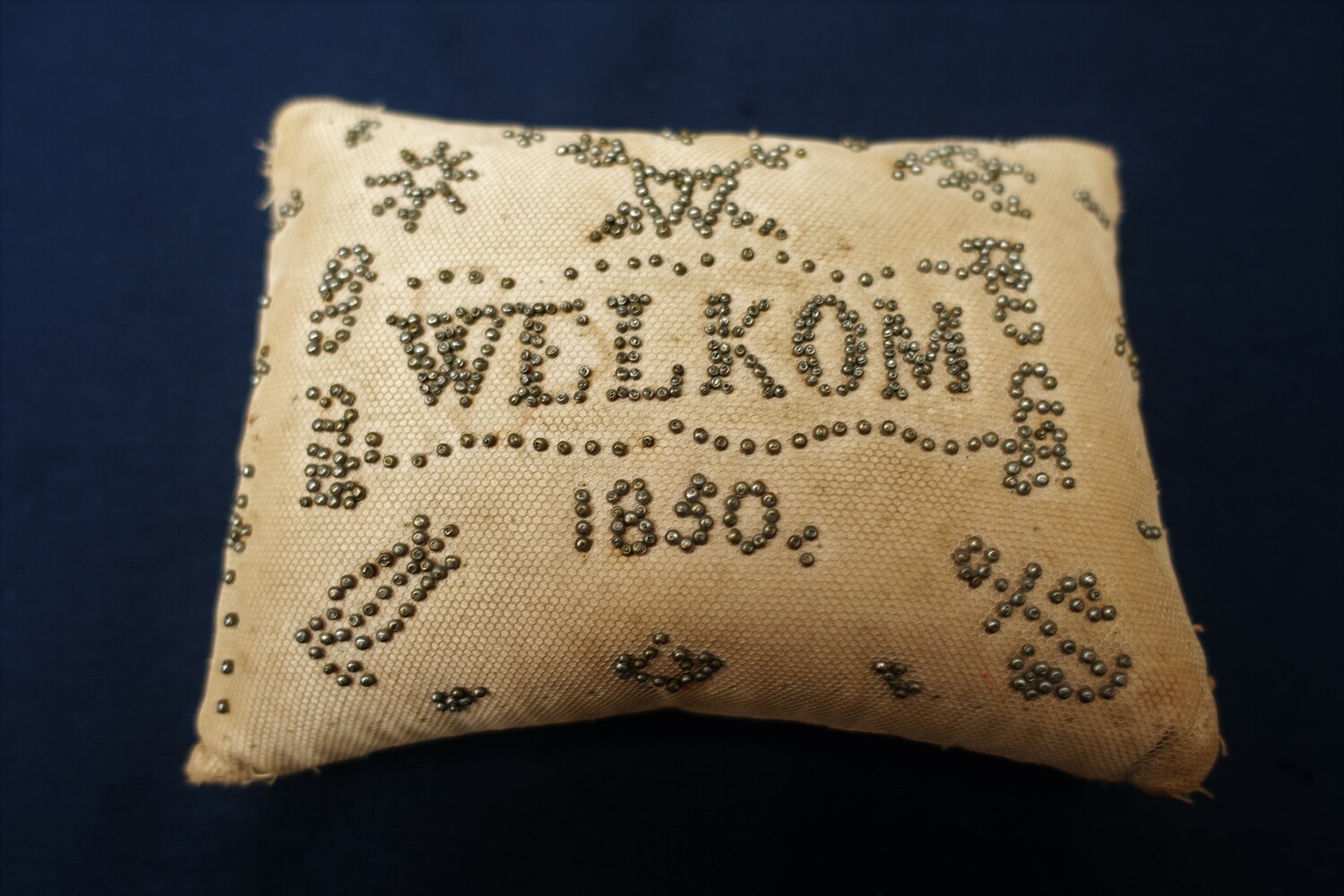
Thrift shops sometimes house real treasures among a lot of rubbish. Recently the TRC acquired a pin cushion from one of these places in Leiden (TRC 2022.0320), which dates from 1850. Pins are inserted into the cushion and they spell the word welkom and the date, among hearts, flowers and other ornaments.

Pin cushion with the dates of 1850 (front) and 1890 (back), the Netherlands (TRC 2022.0320).Pin cushion with the dates of 1850 (front) and 1890 (back), the Netherlands (TRC 2022.0320).

Over the last few days the initial sorting, tagging and numbering of the Arizona collection has been taking place! The larger boxes with complete Albanian outfits have been opened and these marvelous items hung up on racks. The American quilts, part of the same donation, have brought forth cooing noises from Beverley Bennett, who is in charge of the TRC’s collection of quilts. Although one item did confuse some volunteers (including myself): a patchwork skirt in Christmas materials with a narrow waist. It turned out to be a Christmas tree skirt, i.e. a covering for around the lower part of a Christmas tree to hide the trunk and stand. Of course, what else…..?

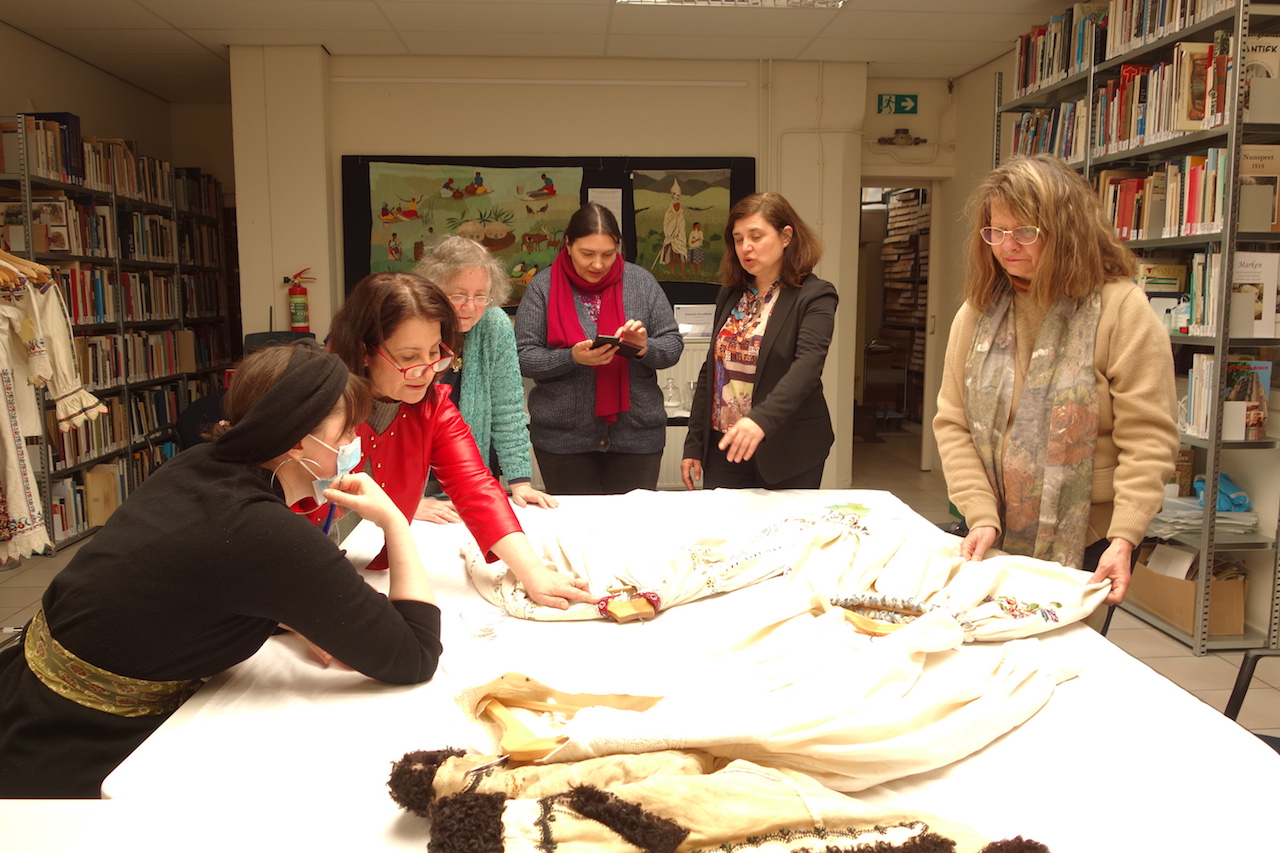
Saturday saw another important step in building up the TRC’s European collection. When the Amsel Collection from Paris, with many Hungarian and Romanian garments, was first unpacked at the TRC a few weeks ago we had several ‘walk-in‘ visitors, one a Romanian Dutch couple, and a few hours later a Hungarian couple. We discussed with both of them our need for further information about objects, confirmation of provenance, and the need for the stories behind. And on Saturday (2 April) there was the first of several meetings.

Discussing Romanian emboideries with a group of specialists, 2 April 2022 (photograph Maria Linkogle).Discussing Romanian emboideries with a group of specialists, 2 April 2022 (photograph Maria Linkogle).

Japanese fine glass beads are highly valued by fashion designers, artists and crafts enthusiasts worldwide. These minute beads are generally called ‘seed beads’ and were an important feature of 20th century Japanese fashion, being used for beaded bags made from the seed beads in a wide variety of colours.

The first Japanese company to produce beaded bags was Lumy Hashimoto in Osaka. Around 1920 their quality bags became popular among young women in high society who dressed in Western clothes - they were called ‘modern girls’ (moga). Beaded bags were also exported to the US and other countries. The older examples of Hashimoto bags were made using imported beads and decorated with patterns in the Art Deco style. This company kept producing beaded bags to go with both Western clothes and kimono until 2016, when they closed their business.

Art Deco style bag by Lumy Hashimoto, Osaka. 1960s-1970s (TRC 2021.0632).Art Deco style bag by Lumy Hashimoto, Osaka. 1960s-1970s (TRC 2021.0632).

Search in the TRC website

Contact

Boerhaavelaan 6
2334 EN Leiden.
Tel. +31 (0)6 28830428  
office@trcleiden.org 

facebook 2015 logo detail 

instagram vernieuwt uiterlijk en logo


Bank account number

NL39 INGB 0002 9823 59, in the name of the Stichting Textile Research Centre.

TRC closed until 4 May 2026

The TRC is closed to the public until Monday, 4 May 2026, due to our move to the Boerhaavelaan. The TRC remains in contact via the web, telephone and email. For direct contact and personal visits, please contact the TRC at office@trcleiden.org, or by mobile, 06-28830428.

Donations

The TRC is dependent on project support and individual donations. All of our work is being carried out by volunteers. To support the TRC activities, we therefore welcome your financial assistance: donations can be transferred to bank account number (IBAN) NL39 INGB 000 298 2359, in the name of the Stichting Textile Research Centre. BIC code is: INGBNL2A.

 You can also, very simply, if you have an iDEAL app, use the iDEAL button and fill in the amount of support you want to donate: 


Since the TRC is officially recognised as a non-profit making cultural institution (ANBI), donations are tax deductible for 125% for individuals, and 150% for commercial companies. For more information, click here