• F3
  • F1
  • F4
  • F2

It has been a while since we have published some embroidery charts via the TRC Blog, so I have been looking for some suitable items.

As we are working on the volume about Sub-Saharan African embroidery for the Bloomsbury World Encyclopedia of Embroidery series, it seemed appropriate to include some African embroidery patterns. These particular examples are based on the darned embroidered bands from a series of men's caps now in the British Museum, London. The caps come from Senegal and were acquired by the Museum in 1934.

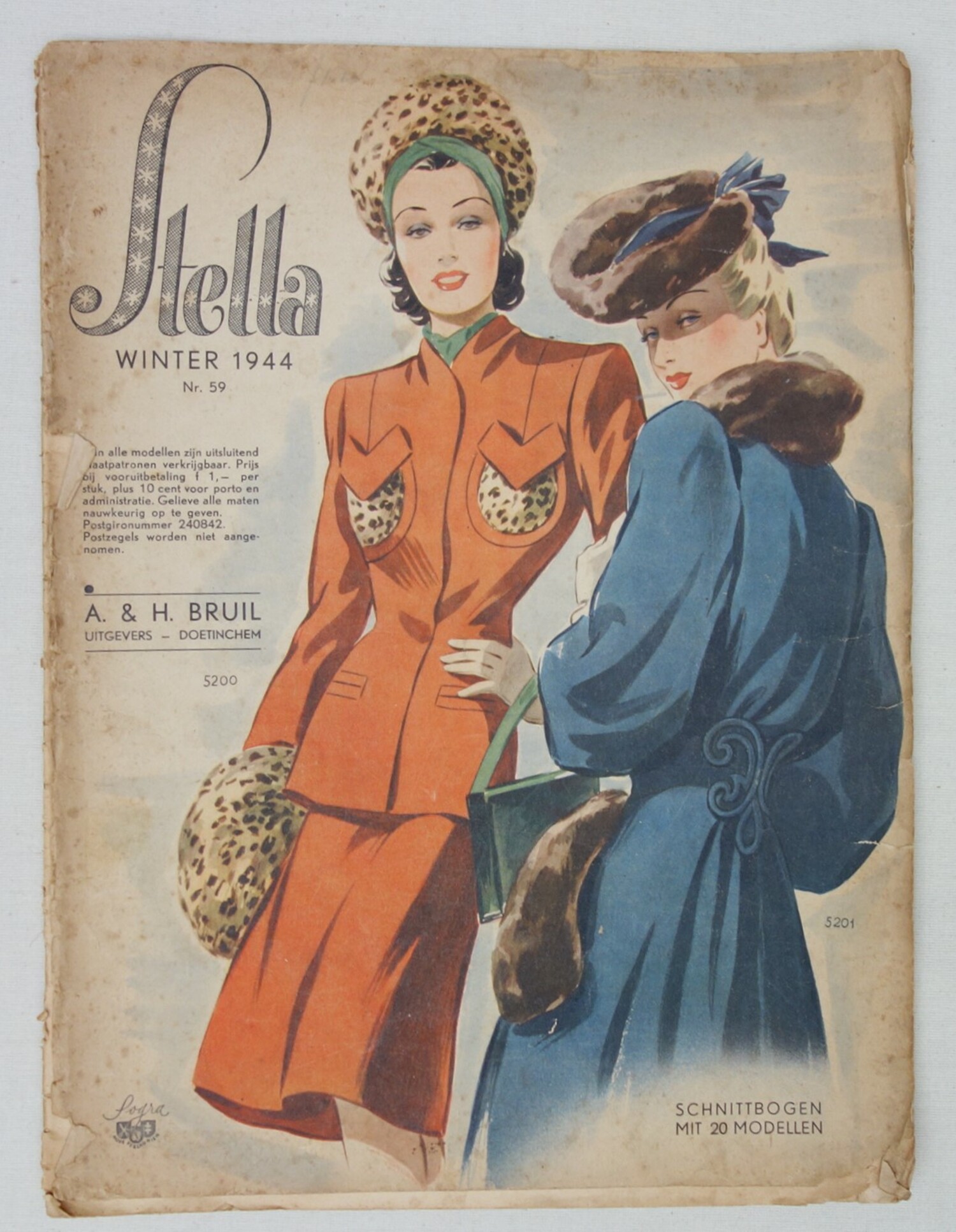
Cover of a 1944 women's magazine, called Stella, published in Doetinchem (TRC 2020.5174).Cover of a 1944 women's magazine, called Stella, published in Doetinchem (TRC 2020.5174).Last week the COVID-19 crisis led to a semi-lockdown of the Netherlands, at least until 19th January. This means that we have had to shut the TRC for visitors for much of the rest of December and early January. It does not mean that we stop with our work. The TRC staff and its many volunteers and student interns will continue with a plethora of activities, as we partially also discussed in a blog of yesterday. In the days and weeks to come, we would like to keep you informed about what we are doing:

The TRC Leiden has just extended its exhibition called Textile Tales from the Second World War until Thursday, the 4th February 2021. This means, despite the TRC being currently shut due to the lockdown, that you still have a chance to see the exhibition from the 20th January to the 4th February 2021. But please be aware, as it stands now you probably will have to announce your visit in advance!

In the meantime, we have recently received several donations that are related to the theme of the war, textiles and dress. Some of these pieces will be added to the actual and to the online exhibition on the same theme. We have been given, for example, by Esther van der Valk, some rare examples of women's fashion magazines from the period. These include one from the summer of 1940 that was in Dutch (TRC 2020.5173), one from the summer of 1944, in Dutch and German (TRC 2020.5174) and two from just after the war (1946/7 and 1948, TRC 2020.5171 and TRC 2020.5172 respectively), which were both in Dutch and French and produced in Belgium and the Netherlands..

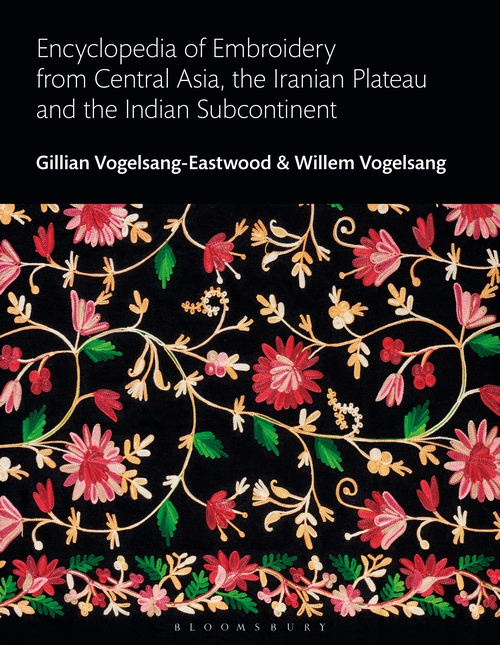
Volume 2 of the Bloomsbury World Encyclopedia of Embroidery will be published in January 2021.Volume 2 of the Bloomsbury World Encyclopedia of Embroidery will be published in January 2021.In early January 2021 the second volume of the Bloomsbury World Encyclopedia of Embroidery will become available. It is about hand embroidery from Central Asia, the Iranian plateau and the Indian Sub-Continent. More details can be found here.

In the meantime the TRC in Leiden is working on two more volumes, namely, embroidery from Scandinavia and Western Europe, and hand embroidery from Sub-Saharan Africa. We were just wondering if anyone has examples of African embroidery they would be willing to donate to the TRC Collection? Or could you send photographs?

Any 'stories' behind the suitable embroideries and textiles are also needed. Who made the pieces, what materials, threads and techniques did the makers use, and were the designs symbolic? What did the piece mean to the makers and users?

Last Wednesday (9th December) I took part in the TRC workshop on pre-industrial sewing stitches, given by by Dorothee Olthof. I’m interested in archaeology and in all sorts of hand stitching, and I was not disappointed.

Dorothee focussed on early medieval styles of hand stitching for garments. She introduced the subject with a PowerPoint presentation and showed us some modern replicas of early medieval garments, especially head coverings from various museum and archaeological collections.

Photograph of the TRC workshop on pre-industrial sewing techniques, 9 December 2020.Photograph of the TRC workshop on pre-industrial sewing techniques, 9 December 2020.

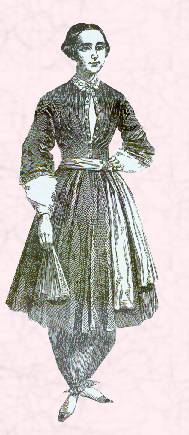
Amelia Bloomer (1818-1894), American dress reformer and suffragist, in the costume named after her.Amelia Bloomer (1818-1894), American dress reformer and suffragist, in the costume named after her.The weather is becoming cold and grey here in the Netherlands. But there’s a 1920s white summer dress (TRC 2007.0710) in the TRC collection here in Leiden that reminds me of warmer days, and tennis and tea parties in the garden. This dress looks simple and light-weight, but there is a long history of controversy and social change behind it.

Women won the right to vote in the Netherlands in 1919, and in 1920 in the US. Alongside decades of struggle for the vote was a fight for dress reform in women’s clothing. In 1850s America, the suffragist Amelia Bloomer scandalized society by throwing away her whale bone corsets, petticoats, tight long sleeved bodices and long heavy skirts. Instead she wore a more comfortable short dress over loose trousers (sometimes called Turkish trousers). This costume may have been based on the loose dress and leggings of some Native American women. Though Amelia did not invent the costume it was immediately dubbed the ‘Bloomer’, as she wore it publicly and popularized it through her newspaper, including publishing a pattern of how to sew the dress.

Women who wore the costume were called ‘Bloomers’. They were ridiculed and accused of mannishness and subversion. Yet they also found friends among health reformers and those in the medical profession who criticized tight corsets and restrictive clothing as dangerous to women’s health. In the Netherlands, too, there was a Vereeninging voor Verbetering van Vrouwen (-en kinder) Kleding (Union for the Reform of Women’s and Children’s Clothing), which published a monthly magazine from 1899 to 1909.

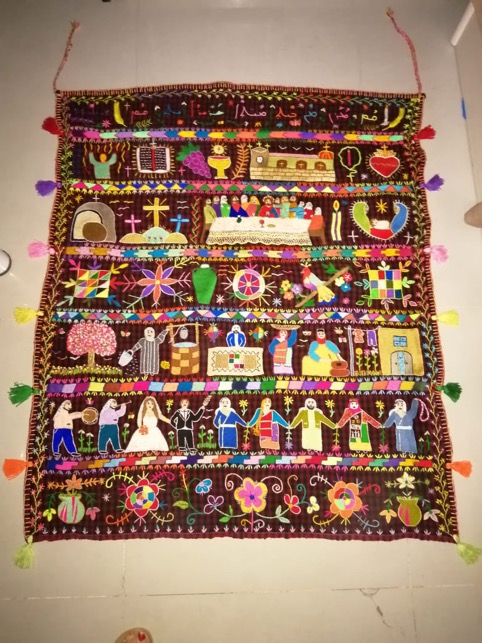
At the end of May of this year, Fatima Abbadi wrote a blog (click here) about the charuga, which is a mantle-like garment knotted at the shoulder and worn at festive occasions among the Christian community in northern Iraq. The TRC commissioned the sewing and embroidering of a charuga, by a local embroideress, called Suzan Sukari. A few days ago we were informed that the garment has been completed (see the attached photograph), and we soon hope to show it in our TRC Gallery in Leiden.

Fatima Abbadi sent us the following blog, which is based on her recent conversations with the embroiderer.

Suzan Sukari is one of the last embroiderers from the Iraqi town of Qaraqosh who still embroiders the traditional charuga, with much love and devotion. She is doing so despite all the struggles that she faces every day, including the difficulty in finding textiles and threads, the lack of demand due to the economical crisis and the decline in the willingness of the younger generation to wear this traditional garment.

A charuga being made in northern Iraq by Suzan Sukari for the TRC in Leiden.A charuga being made in northern Iraq by Suzan Sukari for the TRC in Leiden.

What do a Chinese imperial embroidered cloud collar – vibrant in colours and highly detailed-  and a Communist worker suit - monochromatic blue, adorned with a bright red Mao pin - have in common?

Not only are they part of the Chinese collection of the TRC in Leiden, they also give a contrasting reflection of the changes that took place in China over a hundred years, from imperial times to the People’s Republic of China. In addition to their apparent esthetic differences, the two pieces however reveal different political and personal orientations in very graphic manners.

Early 20th century 'Cloud Collar' from imperial China. TRC 2004.0108).Early 20th century 'Cloud Collar' from imperial China. TRC 2004.0108).

Native American, Ojibwe (Minnesota) shirt, 2019 (TRC 2019.1605).Native American, Ojibwe (Minnesota) shirt, 2019 (TRC 2019.1605).November is Native American Heritage month in the US. Its aim is to highlight the traditions and modern cultures of Native Americans, including indigenous textile traditions.

A ribbon shirt (TRC 2019.1605), made in 2019 expressly for the TRC collection by Ojibwe textile artist Jenny Kappenman, also illustrates this connection between tradition and modernity. This traditional garment features coloured ribbons representing the Four Directions. But it is made from a non-traditional synthetic fabric that sports a floral motif, imitating traditional Ojibwe beadwork.

Search in the TRC website

Contact

Boerhaavelaan 6
2334 EN Leiden.
Tel. +31 (0)6 28830428  
office@trcleiden.org 

facebook 2015 logo detail 

instagram vernieuwt uiterlijk en logo


Bank account number

NL39 INGB 0002 9823 59, in the name of the Stichting Textile Research Centre.

TRC closed until 4 May 2026

The TRC is closed to the public until Monday, 4 May 2026, due to our move to the Boerhaavelaan. The TRC remains in contact via the web, telephone and email. For direct contact and personal visits, please contact the TRC at office@trcleiden.org, or by mobile, 06-28830428.

Donations

The TRC is dependent on project support and individual donations. All of our work is being carried out by volunteers. To support the TRC activities, we therefore welcome your financial assistance: donations can be transferred to bank account number (IBAN) NL39 INGB 000 298 2359, in the name of the Stichting Textile Research Centre. BIC code is: INGBNL2A.

 You can also, very simply, if you have an iDEAL app, use the iDEAL button and fill in the amount of support you want to donate: 


Since the TRC is officially recognised as a non-profit making cultural institution (ANBI), donations are tax deductible for 125% for individuals, and 150% for commercial companies. For more information, click here