• F2
  • F1
  • F3
  • F4

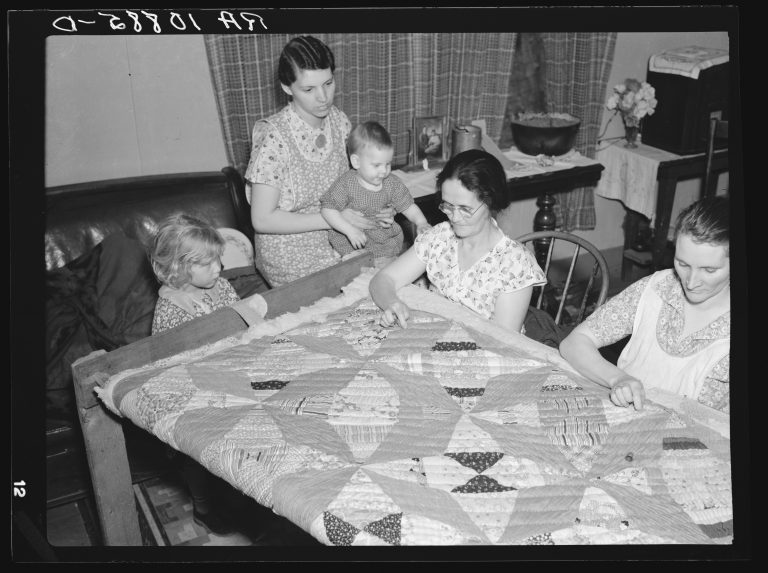
Women working a quilt under the 1930s WPA Sewing Room Project (Lee LC USF34 010885 D 768x573).Women working a quilt under the 1930s WPA Sewing Room Project (Lee LC USF34 010885 D 768x573).Last week the TRC took down its exhibition on American quilts. What became clear when organising and displaying the exhibition, is the importance that quilts have played in American history. A remarkable story is recounted by textile historian, Kyra Hicks, who tells about an Afro-American woman called Estella Weaver Nukes. She made a postage stamp quilt and presented it to President Roosevelt. TRC volunteer, Shelley Anderson, retells this fascinating story.

Before the US entered World War II, the country was struggling with massive unemployment and poverty. In an effort to provide jobs for millions of destitute Americans, President Franklin Delano Roosevelt (1882-1945) established the Works Projects Administration (WPA). The WPA hired jobless men to build roads, dams, schools and libraries.

Today is a day of mixed feelings! It is the last day of the American Quilt exhibition. We will take everything down tomorrow. The Gallery will be cleaned and we will then start putting up the next exhibition. A sad, yet exciting phase, as we say good-bye to a popular display, and build up something new.

Preparing the exhibition Textile Tales of the Second World War, TRC Leiden. Photograph by author.Preparing the exhibition Textile Tales of the Second World War, TRC Leiden. Photograph by author.

It is also a time to ponder on the 'fate' of the quilt exhibition, since it was closely linked to the spread of the corona virus. The exhibition was opened on 5th February by Marja Verloop, the depuy Chief-of-Mission of the American Embassy in The Hague. Lots of activities were planned, including lectures, workshops, quilt identification days, even a quilting week in May as part of the large Textile Festival held every five years in Leiden.

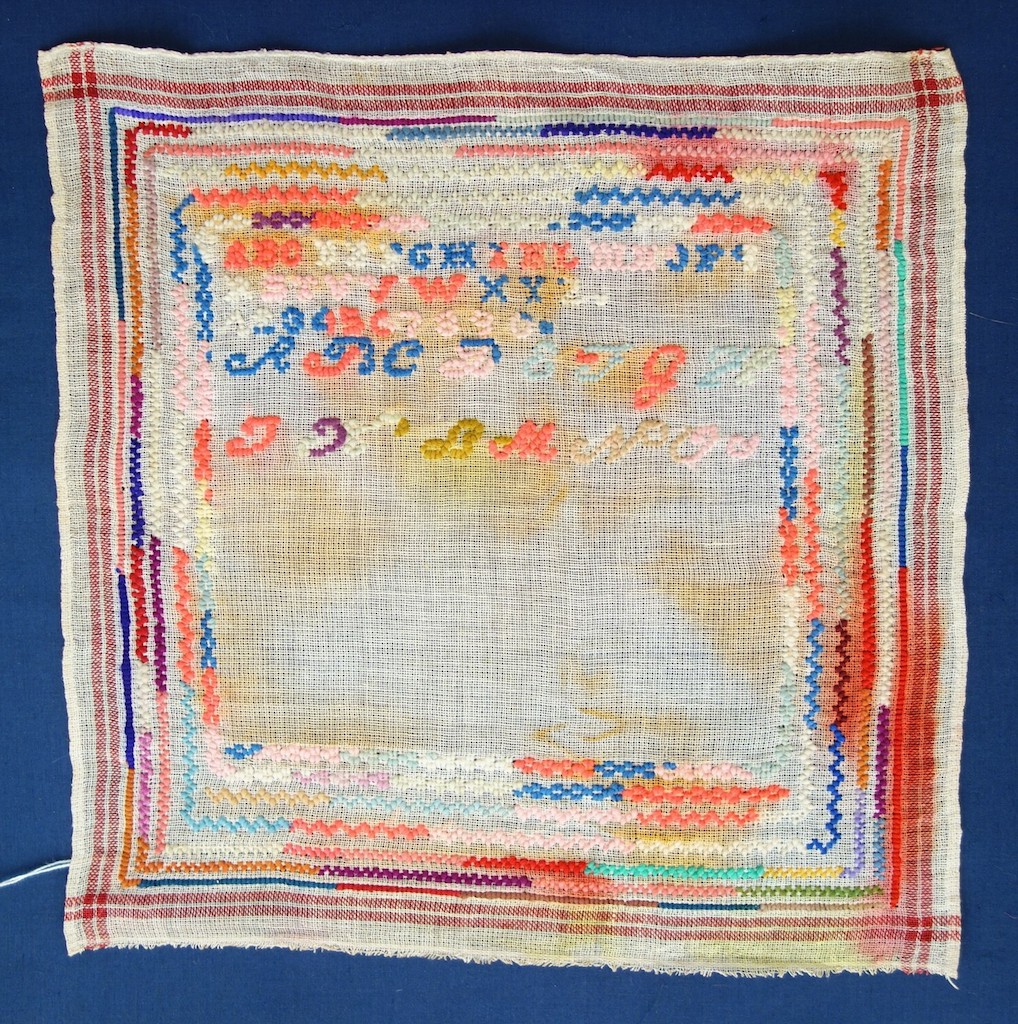
Unfinished sampler from the late 19th century, with aniline dyed embroidery threads (TRC 2020.2396).Unfinished sampler from the late 19th century, with aniline dyed embroidery threads (TRC 2020.2396).Some objects you do not keep just because they are attractive, but because they have a story to tell. One particular sampler in the TRC collection (TRC 2020.2396) is unfinished, the colours are garish and they have bled. If there was ever anything beautiful about it, it has completely disappeared. But we can really be glad that it has not been thrown away, because there is quite a lot to see.

Samplers were often left unfinished. Sometimes the girl was taken from school because her parents could no longer pay the fees, or because she had to work, or because she had to come home to help. Some girls died before they could complete their samplers. That would be a reason for the family to keep the cloth. It was a reminder of the deceased.

The TRC in Leiden has just finished a 1-day study day on the theme of ‘What is embroidery’ (29 July 2020) and a 5-day intensive textile course (17-21 August), which also included a session about the basic nature of embroidery. What is actually required to make a piece of embroidery? What tools are needed? Which stitches are used? When is this form of decoration actually carried out? And what is it used for, and how?

The general consensus was that (technically) embroidery is worked on a finished piece of material (whether it is woven, non-woven, leather, etc), using some form of yarn, with one or more stitches, worked with a needle, a hook or a similar tool.

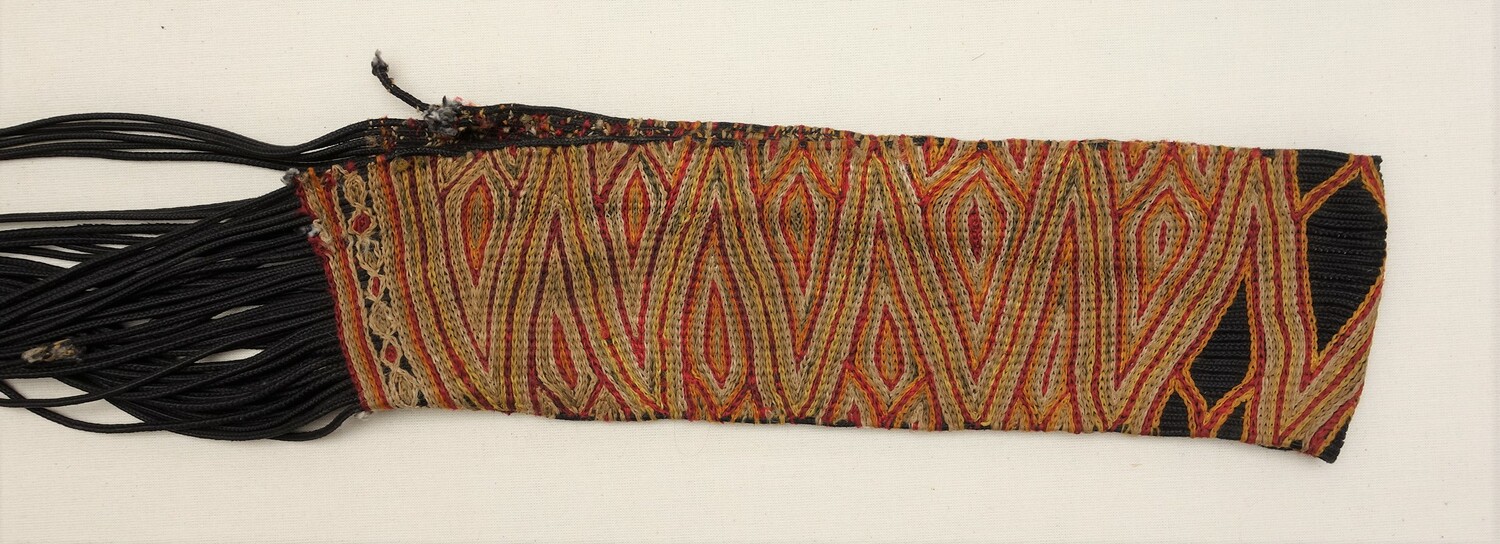
Embroidered part of a woman's headdress from late 20th century Yemen (TRC 2015.0610).Embroidered part of a woman's headdress from late 20th century Yemen (TRC 2015.0610).

But there are always exceptions!

On Sunday, 23rd August 2020, Gillian Vogelsang wrote:

As part of the work being carried out at the TRC in Leiden, on volume 3 of Bloomsbury's Encyclopedia of Embroidery (Scandinavia and Western Europe), I came across a fascinating sample book now in the Metropolitan Museum of Art, New York (MMA 25.92).

The book dates from the early 17th century and comes from Portugal. It is filled with numerous small pieces of actual embroidery worked on a linen ground using silk yarns in various colours. The samples were stitched together and then made into the booklet that is loosely bound.

Who did this is unknown, but he or she created a fascinating compendium of stitches and designs used in early 17th century Portugal. A variety of stitches are represented in the book, including cross stitch, satin stitch, bullion stitch, double running stitch (Holbein stitch), various types of knots, as well as reticello and drawn thread work.

Some examples of geometric patterns, which were worked in cross stitch, are given below:

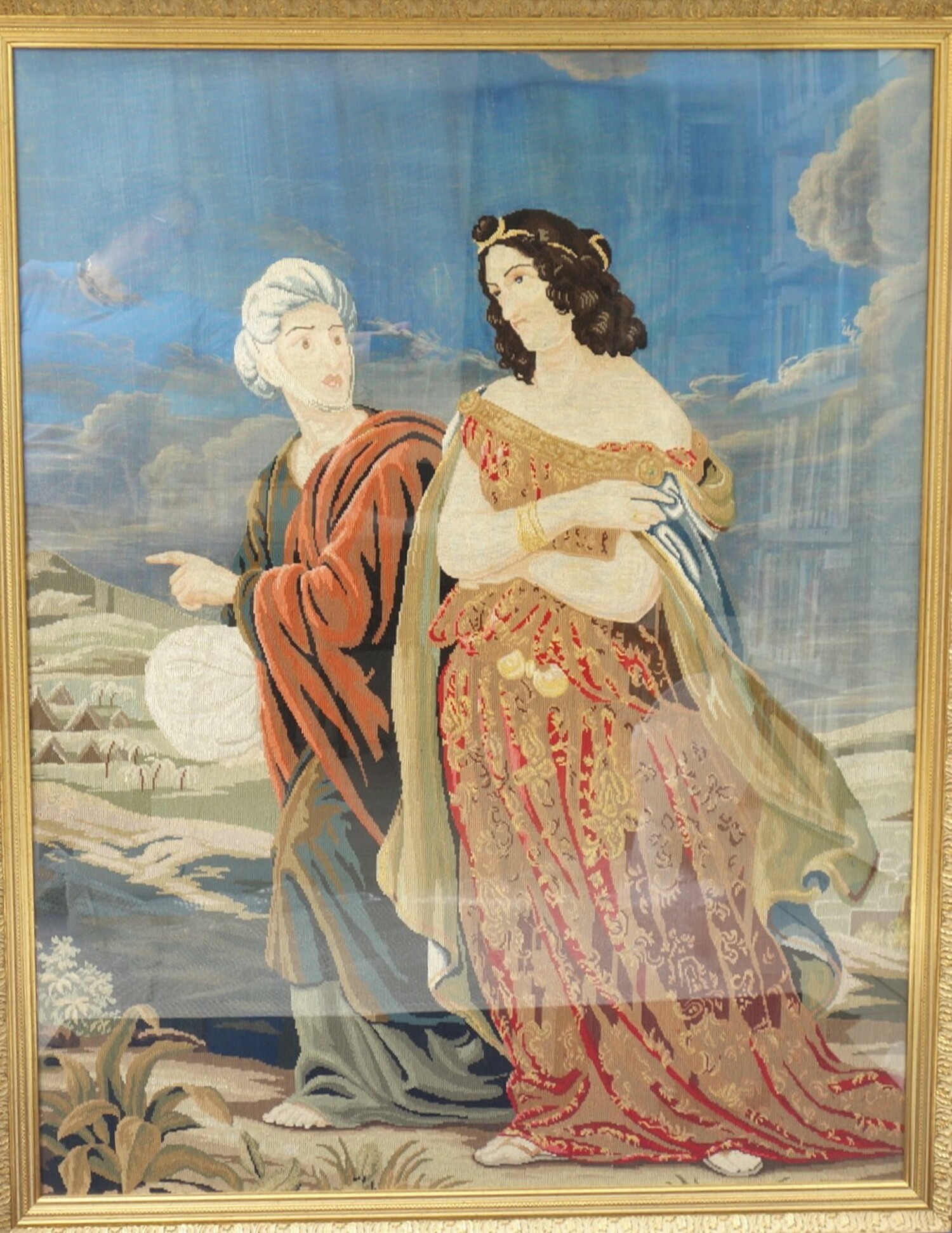
Embroidered picture from the mid-nineteenth century, showing Judith and her servant; The Netherlands (?) (TRC 2020.3320).Embroidered picture from the mid-nineteenth century, showing Judith and her servant; The Netherlands (?) (TRC 2020.3320).The TRC Leiden has recently been given a number of embroidered pictures by the Bijbels Museum, Amsterdam. We wrote a separate blog about this donation. One panel is especially large (135 x 105 cm) and depicts a lady in a low cut, ornate dress with an elderly woman carrying a white bag (TRC 2020.3320). The woman is pointing to a city on a hill top and a series of tents just below the city walls.

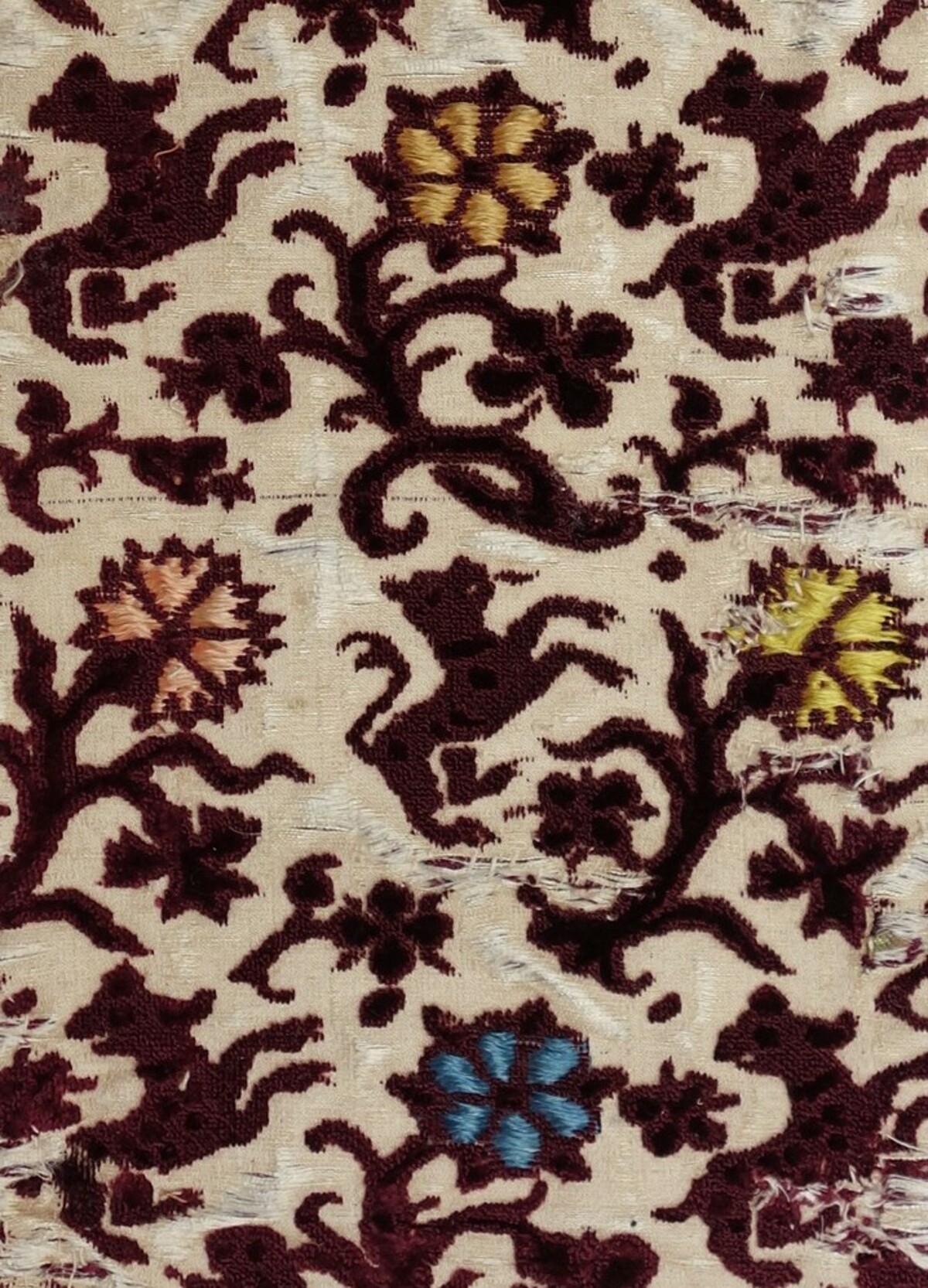
Mid-17th century ciselé velvet sample with huinting dogs, from Italy (TRC 2011.0385).Mid-17th century ciselé velvet sample with huinting dogs, from Italy (TRC 2011.0385).In 2011 the TRC Leiden was given a collection of early European velvets by Ms. Van Gerwen. They came from her father's private museum of medieval art. These pieces have intrigued me ever since. Although I specialise in hand embroidery, I have long wanted to go deeper into the history of velvets and to gain a better understanding of the various different types. Not so much as how exactly each form was made and the (many) technical and mechanical intricacies that were involved, but in more general terms to try and follow the history of the designs associated with them as well as the function of these luxury textiles.

The Van Gerwen collection includes thirty examples of early velvets that probably date back to at least the fourteenth century with most of the pieces dating to the seventeenth and the eighteenth centuries (with a few nineteenth century copies of earlier forms). There are also examples of plain, chiselé (cut and uncut), and voided textiles, and some that include silver and gold threads in the main designs and in the backgrounds.

Search in the TRC website

Contact

Boerhaavelaan 6
2334 EN Leiden.
Tel. +31 (0)6 28830428  
office@trcleiden.org 

facebook 2015 logo detail 

instagram vernieuwt uiterlijk en logo


Bank account number

NL39 INGB 0002 9823 59, in the name of the Stichting Textile Research Centre.

TRC closed until 4 May 2026

The TRC is closed to the public until Monday, 4 May 2026, due to our move to the Boerhaavelaan. The TRC remains in contact via the web, telephone and email. For direct contact and personal visits, please contact the TRC at office@trcleiden.org, or by mobile, 06-28830428.

Donations

The TRC is dependent on project support and individual donations. All of our work is being carried out by volunteers. To support the TRC activities, we therefore welcome your financial assistance: donations can be transferred to bank account number (IBAN) NL39 INGB 000 298 2359, in the name of the Stichting Textile Research Centre. BIC code is: INGBNL2A.

 You can also, very simply, if you have an iDEAL app, use the iDEAL button and fill in the amount of support you want to donate: 


Since the TRC is officially recognised as a non-profit making cultural institution (ANBI), donations are tax deductible for 125% for individuals, and 150% for commercial companies. For more information, click here