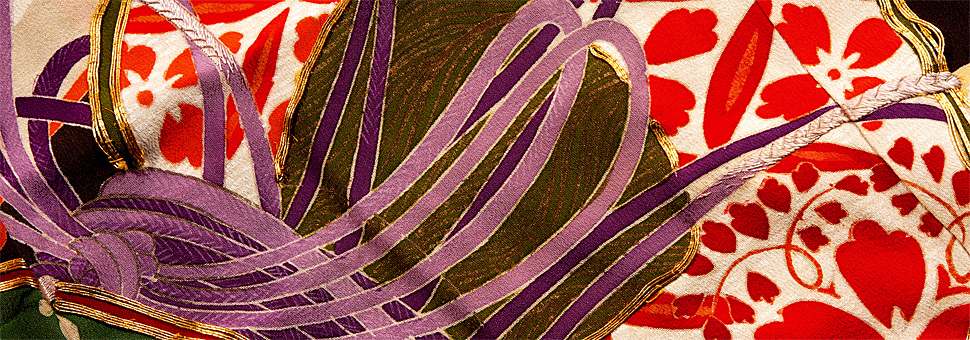

Japanese paste-resist dyeing stencils (katagami) for textiles
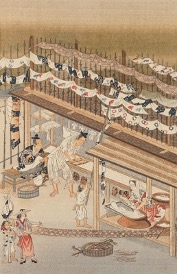 A Japanese woodcut by Kano Yoshinobu (1552-1640) depicting a stencil dyeing workshop with a range of textiles drying in the sun Kita’in temple, (20th century reproduction, private collection).Gillian Vogelsang-Eastwood, Director TRC, 28 July 2024
In 2023, Sytske Wijnsma donated a group of 28 Japanese textile stencils (katagami; TRC 2023.0197 - TRC 2023.0225) to the TRC. A few weeks ago she gave another 40 examples (TRC 2024.2008 – TRC 2024.2048). Most of the stencils have been used, but some are pristine. They represent various forms of stencils used for paste-resist dyeing (katazome), which was and still is used to create intricate patterns and motifs for a range of garments and soft furnishings.
A brief history
It is not clear when the use of paper stencils for paste-resist dyeing was first used in Japan, but it is likely that they were in use by the end of the Murimachi (period 1336-1573). More details are available from the Edo period (1603-1868), which is regarded as a golden age for stencil dyeing. It would appear that by that time the technique was applied in various Japanese towns and cities, as well as temples.


 By Shelley Anderson, TRC volunteer, 8 June 2024