• F2
  • F3
  • F4
  • F1

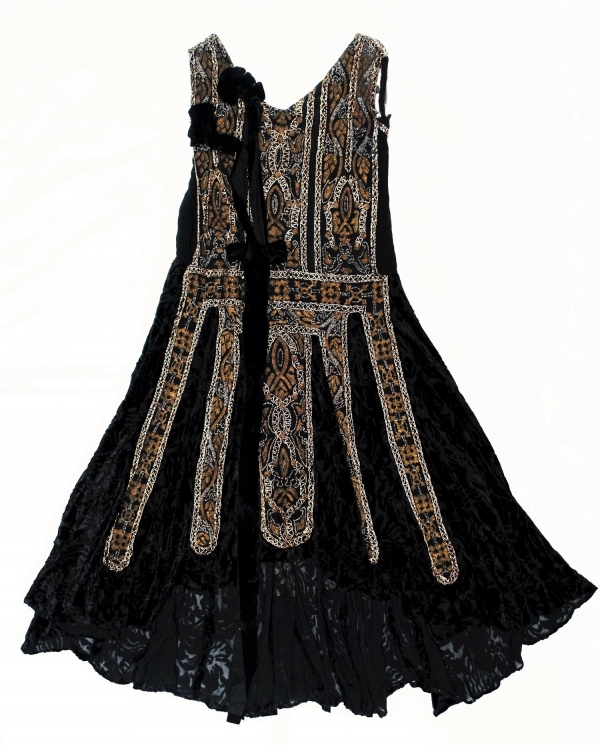
Long, black velvet dress, The Netherlands, 1920sLong, black velvet dress, The Netherlands, 1920sAfter World War One, a feeling of freedom, wealth and liberation changed how women dressed themselves. Women were becoming an increasingly larger segment of the workforce in the Western world and their clothing reflected the need for practicality and use, but also a desire to be fashionable and have fun.

The 1920s were an important period in dress history for women. They became more liberated in how they dressed. Designers like Coco Channel made their debut during this time and became popular fashion icons. Beauty ideals changed and femininity expressed itself differently: you had to look modern and boyish, practise sports, emulate film stars and look very fancy at evening parties with elaborate dresses and headwear that catched the eye and light.

This lecture will be given by Augusta de Gunzbourg. She has previously curated an exhibition about 1920's fashion and written our online exhibition on the subject. See also a series of blogs about the physical exhibition:

All participants will also be able to visit the TRC's first exhibition in our new building about Khayamiya and our mini-exhibition about card-weaving.

Augusta de Gunzbourg is head of exhibitions and education at the TRC, and has been studying the TRC collection closely for the past five years, working on telling its many stories. She has a  Master’s degree of Leiden University and her research focuses on historical fashion and Asian textiles. 

  • Date: Sunday, 21 June 2026.
  • Time: 14.00 - 15.00 pm (the TRC will remain open for participants until 16.00).
  • Venue: TRC Leiden, Boerhaavelaan 6, 2334 EN, Leiden.
  • Lecturer: Augusta de Gunzbourg.
  • Language: English.
  • Costs: 7.50 euros (to be paid on the day itself). Coffee/tea are provided. 

Please register in advance: This email address is being protected from spambots. You need JavaScript enabled to view it.

Fashion magazine, published in Dutch and German, The Netherlands 1944 (TRC 2020.5174).Fashion magazine, published in Dutch and German, The Netherlands 1944 (TRC 2020.5174).Making Something from Nothing – Dutch clothes and textiles during World War II.

Upcycling, sourcing local materials, mending and preserving clothing are all modern topics of conversation when thinking about sustainability in fashion. These concepts, however, have an extensive past and were at the heart of people’s daily life in a time of material shortages like World War II in the Netherlands.

How did people make clothing and still feel fashionable when there was nothing? The lecture will look at a series of objects from the Netherlands, illustrating war time inventiveness - ranging from dresses made from old maps and parachutes, a fancy coat made out of mouse fur or even clothing made out of mattress material. The lecture will look at each piece, give an opportunity to interact with them and talk about the context in which these items were made and worn.

Augusta de Gunzbourg is head of exhibitions and education at the TRC, and has been studying the TRC collection closely for the past five years, working on telling its many stories. She has a  Master’s degree of Leiden University and her research focuses on historical fashion and Asian textiles. 

  • Date: Sunday, 8 March 2026. Moved to: Sunday 3 May 2026.
  • Time: 14.00 - 15.00 pm (the TRC will remain open for participants until 16.00).
  • Venue: TRC Leiden, Boerhaavelaan 6, 2334 EN, Leiden.
  • Lecturer: Augusta de Gunzbourg.
  • Language: English.
  • Costs: 7.50 euros (to be paid on the day itself). Coffee/tea are provided. 

Please register in advance: This email address is being protected from spambots. You need JavaScript enabled to view it.

Khayamiya appliqué panel from the Street of the Tentmakers, Cairo, Egypt, 2012 (TRC.2013.0314).Khayamiya appliqué panel from the Street of the Tentmakers, Cairo, Egypt, 2012 (TRC.2013.0314).Khayamiya is a textile that is omnipresent in Egypt. The word itself is derived from the Arabic word for tent, namely khayma. Originally, it was an appliqué technique that was used for making hand-sewn tents. Nowadays, khayamiya can also be made with other techniques, such as machine-sewing or (digital) printing. Especially before and during Ramadan, khayamiya tents and decorations are ubiquitous in the Egyptian streets.

Khayamiya is embedded in Egyptian Islamic culture. Khayamiya is used as an atmosphere maker that creates an Islamic setting, but can also be used by other (non) religious groups. Since khayamiya is not seen as sacred itself, it can be used for many purposes.

The lecture touches upon three themes, namely material culture and Islam, popular culture and piety, and living heritage. 

This lecture is given by visual artist and textile researcher Christina de Korte. She learned how to make khayamiya in the Street of the Tentmakers in Cairo while carrying out research on the technique and the contemporary khayamiya usages before and during Ramadan.

  • Date: Sunday, 22 March 2026.  Moved to: Sunday, 19th of July 2026
  • Time: 14.00 - 15.00 pm. Participants can visit the Khayamiya exhibition until 16.00.
  • Venue: TRC Leiden, Boerhaavelaan 6, 2334 EN, Leiden.
  • Lecturer: Christina de Korte.
  • Language: Dutch
  • Costs: 7.50 euros (to be paid on the day itself).
  • Coffee/tea are provided.

Please register in advance: This email address is being protected from spambots. You need JavaScript enabled to view it.


Replica of a beaded tunic with discs, reconstructed with the help of Jolanda Bos. The original was discovered in the tomb of Tutankhamun. Part of TRC-led project on the study of Tutankhamun's wardrobe. Photograph courtesy Textile Museum of Sweden.Replica of a beaded tunic with discs, reconstructed with the help of Jolanda Bos. The original was discovered in the tomb of Tutankhamun. Part of TRC-led project on the study of Tutankhamun's wardrobe. Photograph courtesy Textile Museum of Sweden.The textiles and garments from the tomb of the Egyptian pharaoh, Tutankhamun, who died ca. 1323 BC, have to date received scant attention, although they constitute the largest group of items from the tomb, and they certainly will provide a wealth of information about the state-of-the-craft of Egyptian and Middle Eastern textile production in the second half of the second millennium BC. The rooms of the tomb, when opened 100 years ago, contained more than 400 garments and textiles, many of them embroidered.

The textiles have been studied extensively by Dr Gillian Vogelsang-Eastwood, director TRC, and during this lecture she will give a general introduction and discuss the garments that were placed in the tomb to be worn by the pharaoh in his after-life. Some of these dated to the time that he was still a young boy, others were made for him when he had grown up. Many of these, if not all, were worn by Tutankhamun himself.

During this Sunday afternoon lecture, Dr Gillian Vogelsang-Eastwood, director TRC and the author of various books on ancient Egyptian clothing, will discuss the textiles found in the 1920s in the tomb of the Egyptian pharaoh, Tutankhamun. The lecture will focus on some of the most spectacular of the garments, namely the embroidered clothes, such as the imitation leopard skin fto be worn by a priest and various decorated garments that have a clearly non-Egyptian origin. Gillian Vogelsang will also show relevant replicas of the various garments.

  • Date: Sunday, 31 May 2026.
  • Time: 14.00 - 16.00 pm. 
  • Venue: TRC Leiden, Boerhaavelaan 6, 2334 EN, Leiden.
  • Lecturer: Dr. Gillian Vogelsang-Eastwood.
  • Language: English
  • Costs: 7.50 euros (to be paid on the day itself).
  • Coffee/tea are provided.

Please register in advance: This email address is being protected from spambots. You need JavaScript enabled to view it. 

Search in the TRC website

Contact

Boerhaavelaan 6
2334 EN Leiden.
Tel. +31 (0)6 28830428  
office@trcleiden.org 

facebook 2015 logo detail 

instagram vernieuwt uiterlijk en logo


Bank account number

NL39 INGB 0002 9823 59, in the name of the Stichting Textile Research Centre.

TRC closed until 4 May 2026

The TRC is closed to the public until Monday, 4 May 2026, due to our move to the Boerhaavelaan. The TRC remains in contact via the web, telephone and email. For direct contact and personal visits, please contact the TRC at office@trcleiden.org, or by mobile, 06-28830428.

Donations

The TRC is dependent on project support and individual donations. All of our work is being carried out by volunteers. To support the TRC activities, we therefore welcome your financial assistance: donations can be transferred to bank account number (IBAN) NL39 INGB 000 298 2359, in the name of the Stichting Textile Research Centre. BIC code is: INGBNL2A.

 You can also, very simply, if you have an iDEAL app, use the iDEAL button and fill in the amount of support you want to donate: 


Since the TRC is officially recognised as a non-profit making cultural institution (ANBI), donations are tax deductible for 125% for individuals, and 150% for commercial companies. For more information, click here