

We have just had several questions as a result of our trip to Sens Museum. One was whether I could give more information about the medieval bags we saw, and the other was about how to tell the difference between a woven and embroidered textile and can the use of a Dino-lite microscope help with this? In this blog I will have a look at the bags, the weave/stitch question will come later.
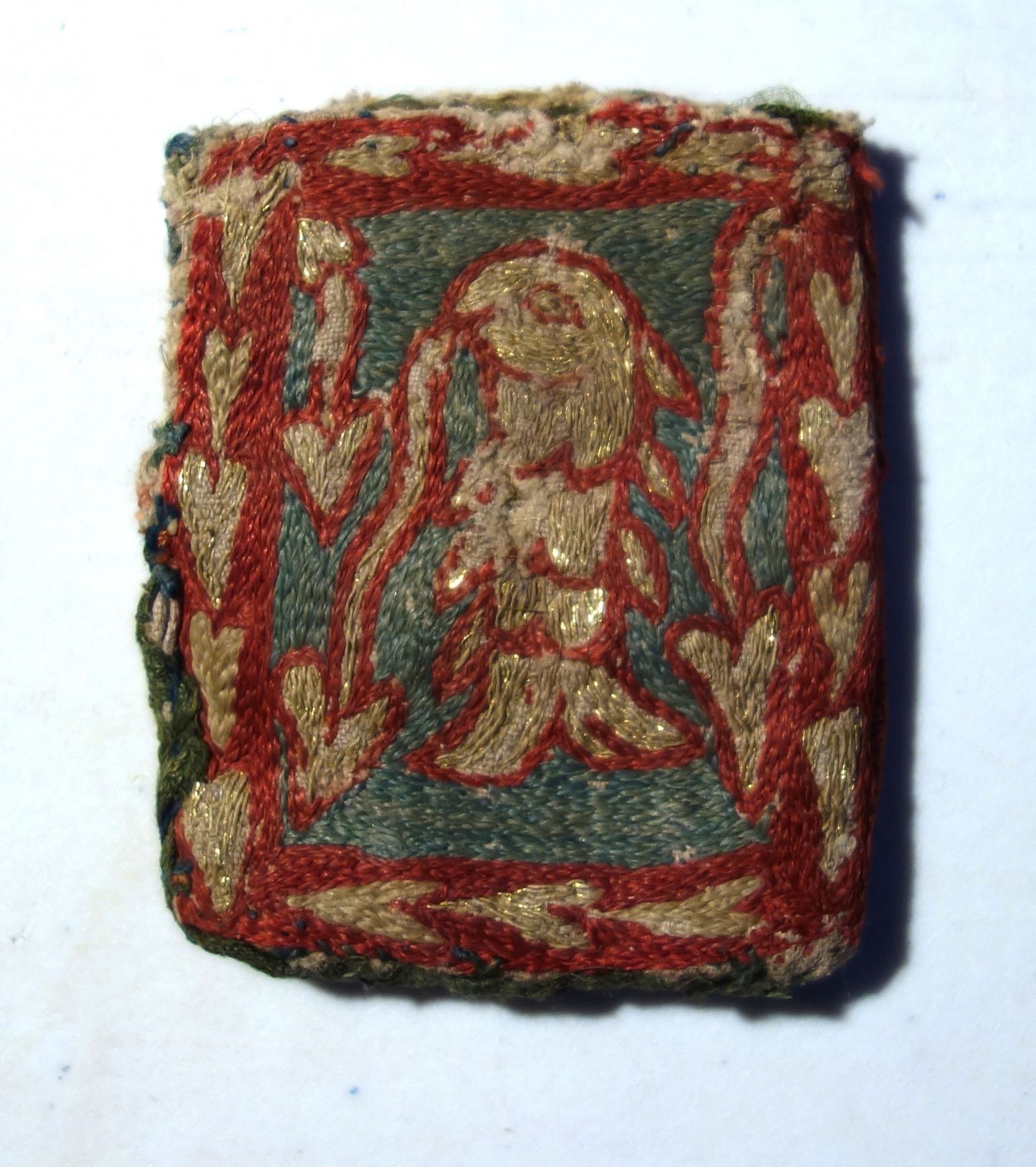 Small embroidered bag with the depiction of a fish, 13th century. Sens Museum (B321).
In the treasury room of the Sens Museum, there is an extensive collection of woven and embroidered textiles and bags, most of which came from medieval tombs and other places in the cathedral. They were collected and published in Inventaire du trésor de l'église primatiale et métropolitaine de Sens by Eugène Chartraire (1862-1935) in 1897 (available online here).
The items originate from various countries including Byzantium, Iran, Egypt, as well as France, Italy and Spain. In addition, there is one knitted back (B325) with a line in Arabic script along the top hem. Some of the textiles were used to wrap relics, while others, namely most of the bags, were used to carry or store relics. But what is a relic?
An important feature of medieval and later Catholic life was the collecting of items associated with various saints. These pieces became the focus for people’s prayers and devotions. Such relics came in various level. First class: parts of a saint’s body. Second class: the garments or other objects directly worn or used by a particular saint. Third class: an object that has touched a first-class relic.
It is no longer possible to say which category the relics associated with the Sens bags came into, but the fact that special bags made of silk were used indicates the contents were important and significant to the owner(s) of the bag.
One of the smaller, embroidered bags (B321, 6.5 x 5.5 cm) dates to the 13th century and is decorated on both sides with a fish, worked in split stitch, with some gold (passing) thread adding highlights.
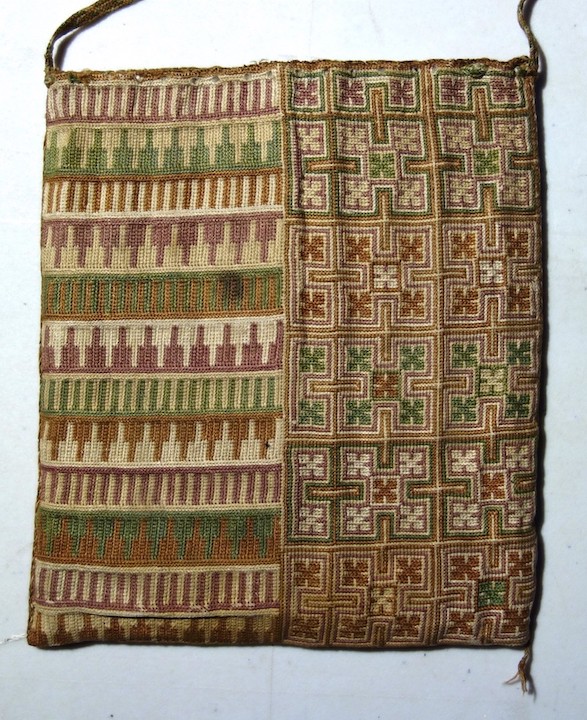 Thirteenth century bag with embroidered geometric decoration. Sens Museum (B320).
A second bag (B320, 14 x 12 cm) is decorated with precise, repeating geometric patterns worked in long-armed cross stitch and cross stitch using mainly brown, red and yellow floss silk threads. It has also been dated to the 13th century. When I get to back to Leiden I will work on a graph of the various patterns.
In addition to the smaller bags there were also several larger examples. One of them (B379, 26 x 22 cm ) has been dated to the 12th century and has the image of a knight on one side and on the other side an eagle with a rabbit or hare in its claws. The embroidery was carried out in split stitches using bright red, yellow, blue, green and pink floss silk.
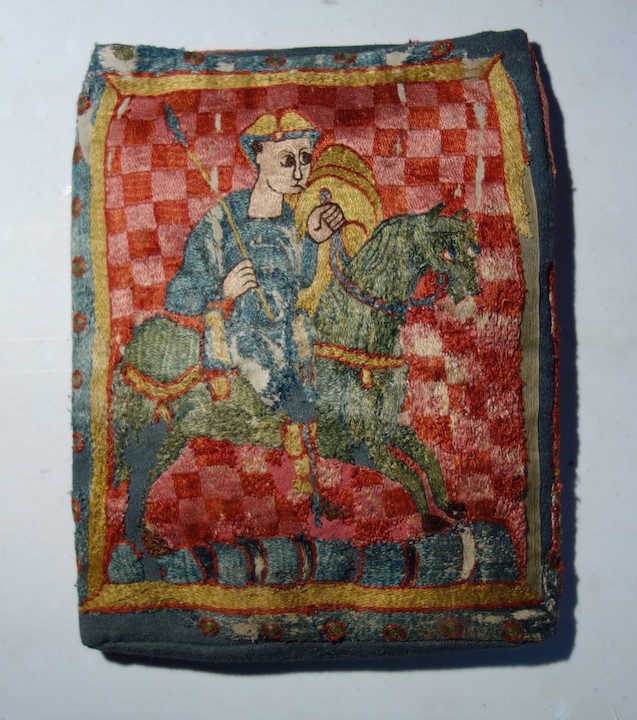 Medieval bag with the he depiction of a knight, 12th century. Sens Museum (B379).
Another type of bag (sometimes called an aumônière) was used for daily life situations and some of these bags were regarded as lover’s tokens. Various examples are in museum collections, such as the Metropolitan Museum of Art, New York, but the Sens example (B324, 20 x 18.5 cm) is one of the best, given its condition, embroidery techniques, colours and details. It has been given a 14th century date.
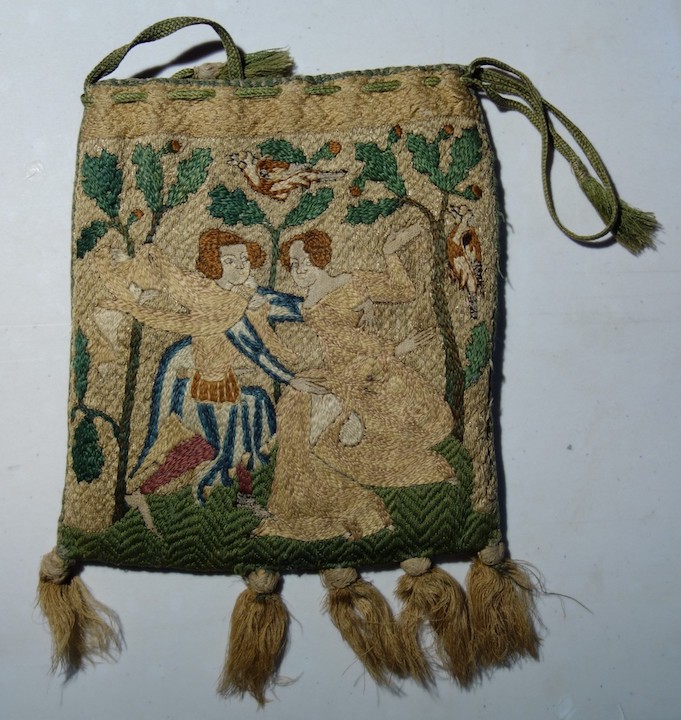 Fourteenth century embroidered bag depicting a pair of lovers. Sens Museum (B324).
On one side of the bag there are two women under a tree. One of the women is wearing a sun hat and both of them appear to be holding a small object of some kind, perhaps a ring or brooch. On the other side there is a man and a woman, and given the position of the man’s hands on her breast and legs, the indication is that they are lovers; a well-known theme from the period. A lovely detail is the woodpecker on the tree to the right! What would this symbolise?
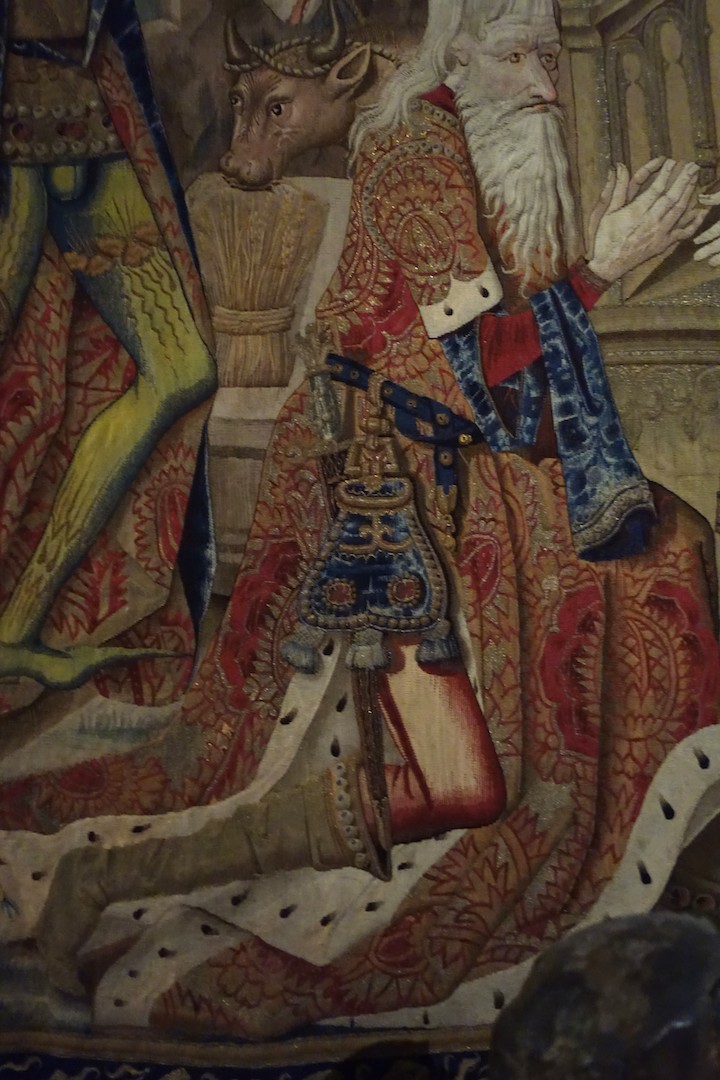 Detail of a medieval tapestry in Sens Museum, showing a man with a large bag attached to his belt.
It is worth noting that these larger types of bags are sometimes depicted in medieval tapestries, hanging from men's and women’s belts. Examples of such tapestries can be seen in the Palais du Tau in Reims as well as in the Sens Museum.
We again want to stress that our work would have been impossible without the assistance of the Museum and Museum archives staff.
Gillian Vogelsang- Eastwood, 8 July 2022