

In June we had an intense time at a special TRC study-day looking at the various basic types of velvet and how to identify them. One of the participants, Monika Gimblett, has a Polish/Dutch background and when we were talking about natural red dyes - cochineal, kermes, lac, madder - she started talking about the name for the month of June in many Central European countries, and the link with cochineal. It's a story that we thought that a lot more people would like to know. Monika sent us the following blog. More information about Polish lac or Polish cochineal can be found in the relevant Wikipedia pages.
****
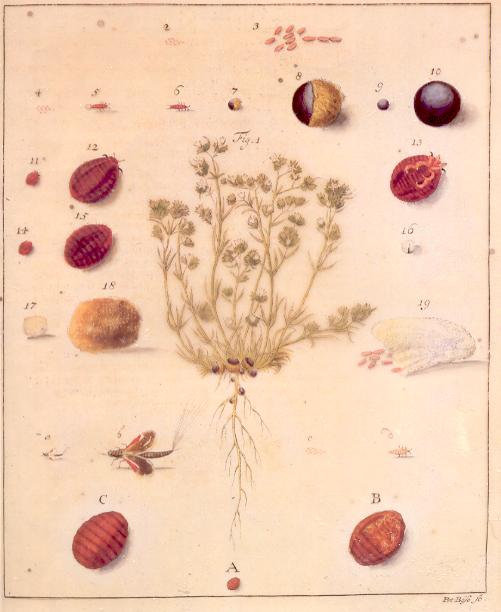 Life cycle of the Polish cochineal, as portrayed in Breyne's 'Historia naturalis Cocci Radicum...', published in 1731.Some stories are hidden deep in language, in words that we use every day but the origins of which have long been forgotten. Such is the case with Polish cochineal, also known as Polish lac or Polish grain, produced by a small insect known in Polish as Czerw.
Here is how it happened: this small bug known as Porphyrophora Polonica or Margarodes Polonicus was once common in central and eastern Europe, from Lusatia along the German border, through present-day Poland to the Baltic countries, Belarus and Ukraine to the northern borders of Romania and Moldova.
The insects (the females in their late larva state) were collected and boiled in water with vinegar, then dried in ovens or in the sun, and ground with some bread acid. The dye prepared this way could be used to dye cotton, flax, silk and wool. To dye 1 kg of silk, 15-20 gr of red powder was needed, but to dye the same amount of wool, 50 gr was used. However, to produce 1 kg of dye it was necessary to collect as much as 155 thousand of insects!
No wonder that Polish cochineal was very expensive, and only monarchs, nobility and high clergy could afford to buy cloth dyed with this substance. To some extent this explains why red was reserved for secular rulers and bishops for many centuries. Colour symbolism is another matter entirely.
It is no coincidence that Polish noblemen in their portraits wear red robes, and the first flags and banners of the Kingdom of Poland show a white-crowned eagle on a red background, and the white and red flag represents Poland to this day. Not bad for a tiny bug measuring just a few millimetres.
Incidentally, the insects were collected in June, hence its other name was Saint John’s Blood, after the Feast Day of Saint John the Baptist on 24 June.
 Polish military commander, Stefan Czarniecki (1599–1665), in a crimson costume typical of Polish magnates.Red powder was in such great demand that next to grain, salt and wood it became from the medieval period onwards one of the most important and profitable export commodities of Poland and Lithuania, from where it was sent first to the city of Gdansk, and hence to the leading textile manufacturing centres in Armenia, England, France, Germany, Tuscany and Venice, France, England, and even to the Ottoman Empire.
Poland exported it from the early Middle Ages until the eighteenth century. The scale of this trade is illustrated by numbers. In 1534 the Polish city of Poznan alone sold as much as thirty tons! But the popularity of Polish cochineal slowly began to decrease after the opening of trade routes to America and the opening up of its cochineal production, which would soon also give its name to Polish cochineal, which was originally known as Polish lac. With time also the insect itself began to disappear from Central Europe, where today it is difficult to find, but the memory of it and of the role it played in the development of trade relations between Poland and the rest of Europe and the Middle East remains in almost all Slavic languages.
It gave its Polish name to the month in which the larvae were collected (June), namely Czerwiec, and the word for 'red', namely Czerwony, and according to many, also the names of towns where the farming of the larvae was an important economic activity, such as the town of Czerwinsk in Mazovia. Compare also Ukrainian Chervonyy (red); Czech Červené (red); and Slovak Červená (red).
Monika Gimblett, 5 August 2022