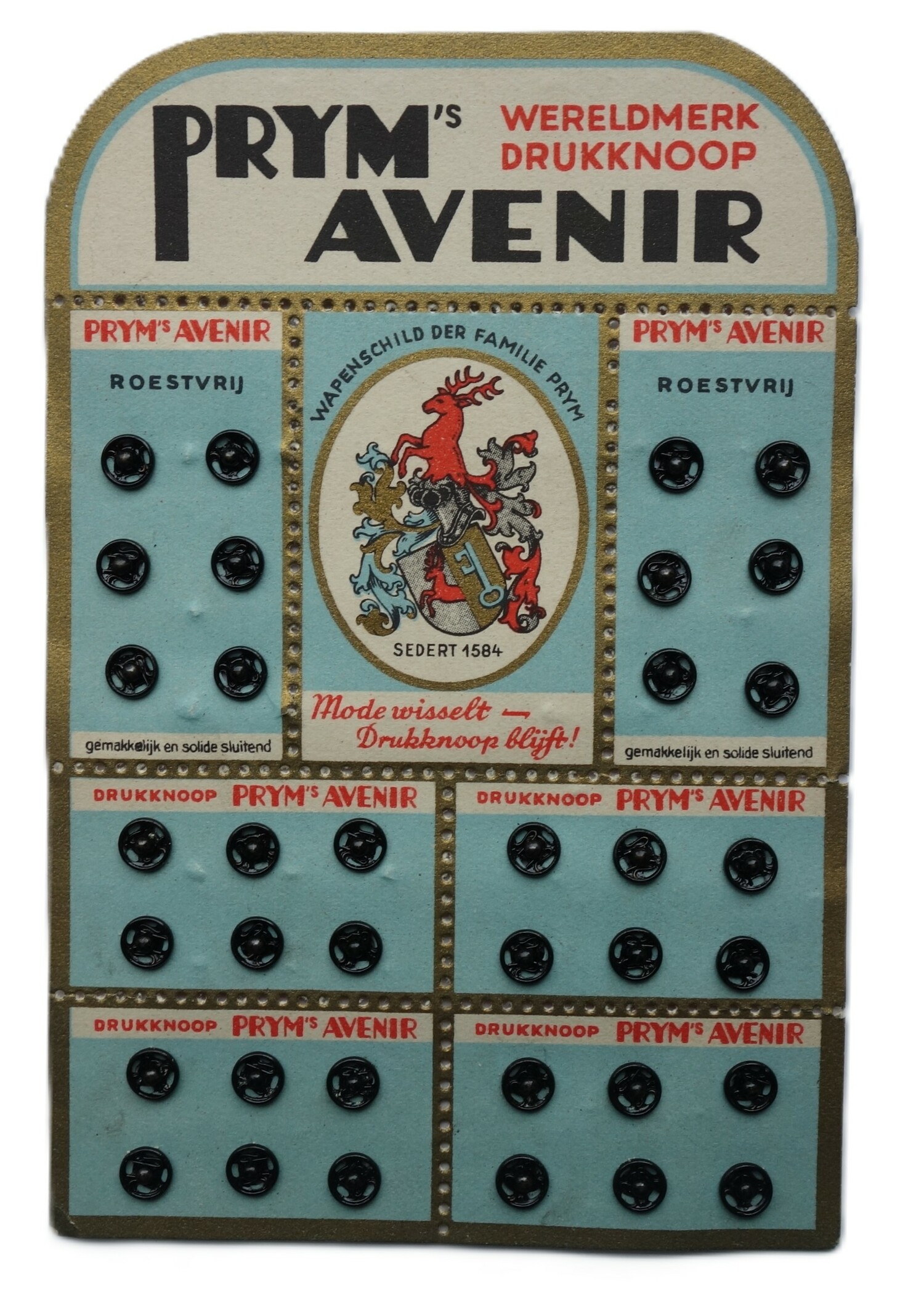
 Fig. 1. Card with 6x six black press studs. There is a printed text that states: "PRYM'S AVENIR WERELDMERK DRUKKNOOP", Germany, produced for the Dutch market, early 20th century (TRC 2026.2008).(Gillian Vogelsang, 9 Sept. 2026) Over the years I have become intrigued with some ‘strange’ items in the TRC collection, but I never expected to become interested in that everyday item, the press stud! Perhaps I was drawn to this subject when I realised that, in 2021, I wrote a blog about medieval hooks and eyes now in the TRC Colleciton.
But back to the press studs. I am currently cataloguing various forms of fastenings, not only the press studs, but also hooks and eyes, and buttons, that were given to the TRC by Hennie Stevan-Bathoorn and Sjoerd Stevan of the former Museum voor Naaldkunst, Winschoten, here in the Netherlands.
Press studs are often used instead of buttons to fasten various items, including soft furnishings, as well as a wide range of garments from underwear, to blouses, aprons, trousers, coats and skirts, headwear, gloves and footwear (Fig. 1). They are a hidden form of fastening, and easy to use. There are different grades of press studs, from those suitable for a child to military grade forms used for parachute harnesses, etc. Press studs are also sometimes used to decorate items. In the TRC Collection, for example, there is a child’s embroidered cap from Pakistan that is embellished with buttons, coins and press studs (compare TRC 2026.1897).
The donation includes a folder with various cards of press studs that were produced by different manufacturers. I have never really looked in detail at these small, but useful items before, but I started to wonder about the history of these items as well as looking again at the press studs in the collection, and at a range of garments that are fastened with such studs.
Well, to start with, the press studs (UK) have different names in the (English-speaking) world. In the US, for example, they are called snap fasteners, snaps, or snap buttons. Elsewhere they are sometimes called poppers, tich buttons or dome fasteners.