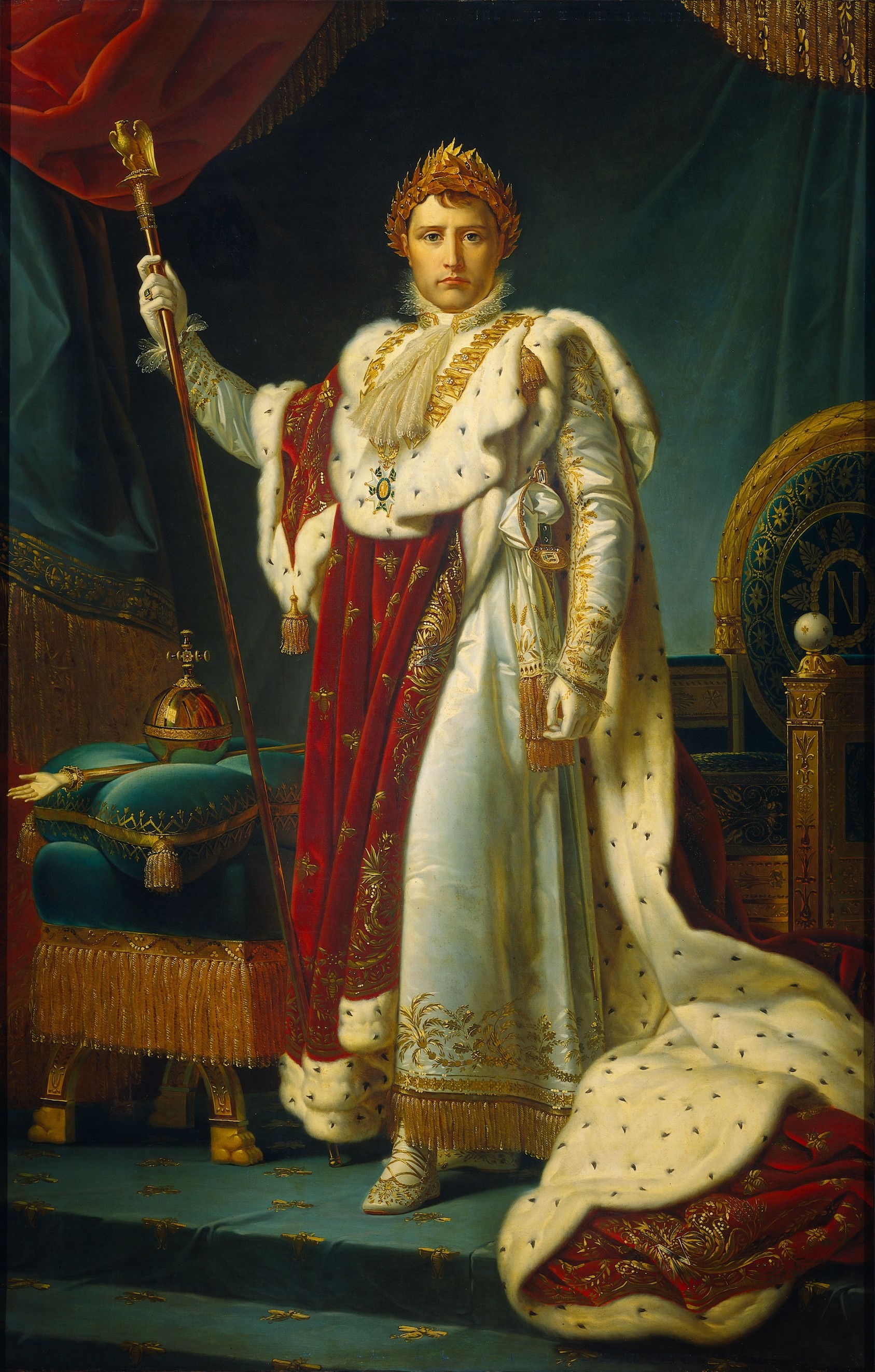
 Napoleon in his imperial clothing, at his coronation in 1804. Who says that clothing and textiles do not matter?I have just attended part of a two-day conference at Naturalis (the massive, natural history museum) here in Leiden, on the theme of indifference. The conference is part of the Brave New World Art & Science series that has been running for nearly ten years.
Each year they concentrate on different themes, such as the ‘Future of Attention' (2023), in order so see how “the worlds of culture, philosophy, science, technology and storytelling will collide”.
As noted, this year’s theme was Indifference, and it covered both theoretic, philosophical, artistic, and actual themes, from empathy, medical issues, 3-D printing of cultural artifacts, to disability and handicap accessibility (or not).
 Every man's dream of domestic bliss: Man smoking his pipe (while dozing), woman darning (his?) socks. Painting by Wybrand Hendriks (d.1831), Frans Halsmuseum, Haarlem.My talk of twenty minutes was about indifference to textiles, and concentrated on how textiles are an essential item to everyday life, yet often forgotten – in order to emphasise this point I asked the audience to remove their textiles, ie clothing, a request that got a mixed response! But I hope it brought home the simple fact that we all wear textiles and interact with textiles on a regular and daily basis. It's amazing to regard the number of people who ‘just’ wear clothing without thinking about the textiles what they have on and what it took to make those ‘simple’ pieces of cloth.
The themes in my talk ranged from Tutankhamun and textiles, Napoleon and his coronation textiles, the concept that textiles were ‘only’ a woman’s subject, and that many men are (or think they are) bored by the subject ( generations of farmers, spinners, dyers, weavers, printers and tailors, not to mention male embroiderers and knitters should give a collective sigh at this moment), and historic, international links on a commercial and trade level via textiles.
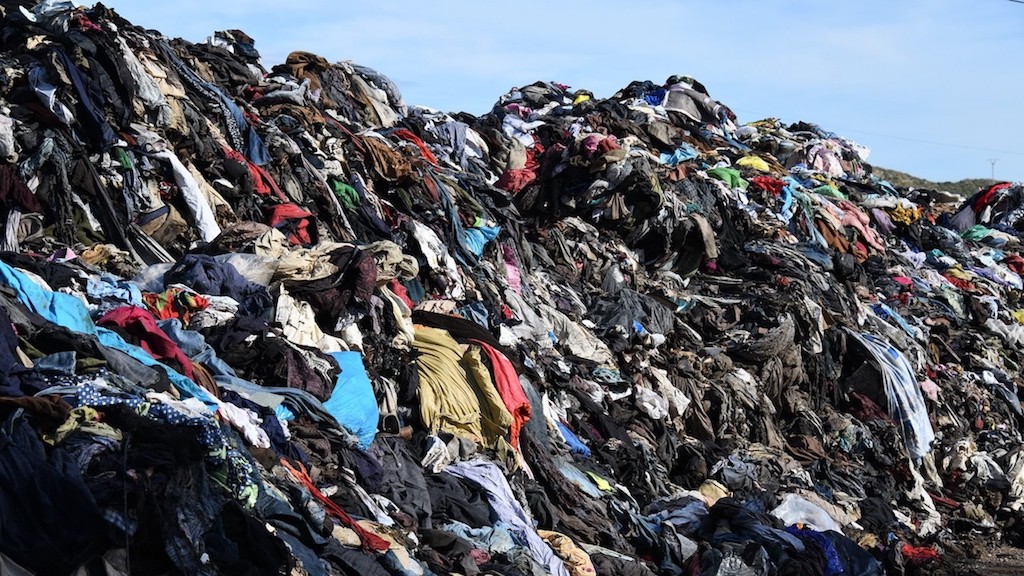 Massive landfills of discarded textiles.And finally, and sadly, most significantly and worryingly how the modern indifference of many people to textiles has led to huge mountains of discarded garments left rotting in landfills.
One of the other speakers, Norbert Peeters, talked about Indifference to plants – he is a plant philosopher (yes, there are such people) and spoke about the colour green, lions in a tree (do you see the lions or the tree), as well as the importance of plants for food.
 A textile from the TRC collection (TRC 2015.0193) with a history that causes strong emotions. It contains the hand-embroidered names of female Nazi-sympathizers interned after the war in Stadskanaal, the Netherlands.This brought to mind a conversation I had the other day with two agricultural students, recent graduates from Wageningen University, the Netherlands, who want to volunteer at the TRC. They were muttering about the course they were doing emphasizing plants for food, but nobody talked about plants for textiles.
Textiles are no longer important within the mainstream agricultural life of many countries, including the Netherlands. But the students wanted to learn about this subject and help bring back flax, nettle and natural dye production, not just on a small, horticultural scale, but as a part of mainstream agricultural life (as is happening in Latvia, Lithuania, Sweden, Belgium, etc).
I spoke with Norbert about this and the look on his face when he realized he had never seriously thought about plants and textiles, the opening up for him of a new field (sorry for the pun) of plant philosophy! He lives in Leiden and will shortly be coming to the TRC to discuss plants, textiles, life, the universe, etc.
The theme of next year’s conference has not yet been released, but as soon as it has I will let you know. It was so useful attending a conference on a more abstract and diverse theme, rather than the normal conferences I go to that are ‘simply’ about textiles. As I said, lots to think about.
 Leiden: City of Textiles. The frieze on top of the Vergulde Turk, Breestraat Leiden, showing Neptune (overseas trade), the Ottoman admiral Barbarossa, Mercury (trade), and peeping over Neptune's leg there is an angora (compare Ankara) goat (mohair!) to the right, all of it representing Leiden and its textile trade, especially in mohair, with Turkey, mid-17th century.
I would like to thank Alexander Mouret, Leiden University, and his team, for inviting me to talk at this conference. It was really interesting and stimulating.
Dr. Gillian Vogelsang-Eastwood, Director TRC, 15 September 2024