

 Man in market at Sololá, Guatemala (2007). Photograph by Caroline Stone.Guatemala is famous for its splendid textiles and for the traditional dress still worn by large numbers of indigenous women. Men adopted a version of Spanish regional costume shortly after the Conquest for a variety of reasons. More recently, they have tended to move on to modern Western dress, except in a few remote areas and for ceremonial occasions.
There are exceptions: for example, in Sololá some men wear jackets, essentially western in cut (TRC 2020.4573), and matching trousers of dark and richly coloured ikat (see the photograph of stall-holder in Sololá market). It is not clear how old this fashion is. Women’s clothing, on the other hand, still has close parallels with pre-Hispanic dress, as seen in paintings and statuettes, especially that worn for rituals connected with the cofradias or religious brotherhoods.
Women’s dress is generally untailored, based on rectangles, often woven by the woman herself on a back-strap loom and richly decorated with a number of techniques, including various types of brocading, soumak, ikat, as well as embroidery and appliqué, especially at the neck.
The “blouse” is known as a huipil and can consist of one, two or three panels and is generally sleeveless. It can be longer or shorter and is usually worn inside the skirt, in which case the area below the belt is typically left undecorated and even unfinished. Some areas, however, wear the huipil loose, over the skirt. Wide, much longer huipiles, closely resembling the pre-Hispanic style, are worn for ceremonial occasions and are often sumptuously decorated.
Until the mid-20th and the terrible internecine fighting of the ‘80s, as with most traditional folk costume, the designs on the huipiles were indicators, not only of the village but also of the status of the wearer, so that in a market, for example, a large amount of information could be deduced simply on sight. A woman normally continued to wear her village’s patterns even after marriage to a man from a different community, although customs varied.
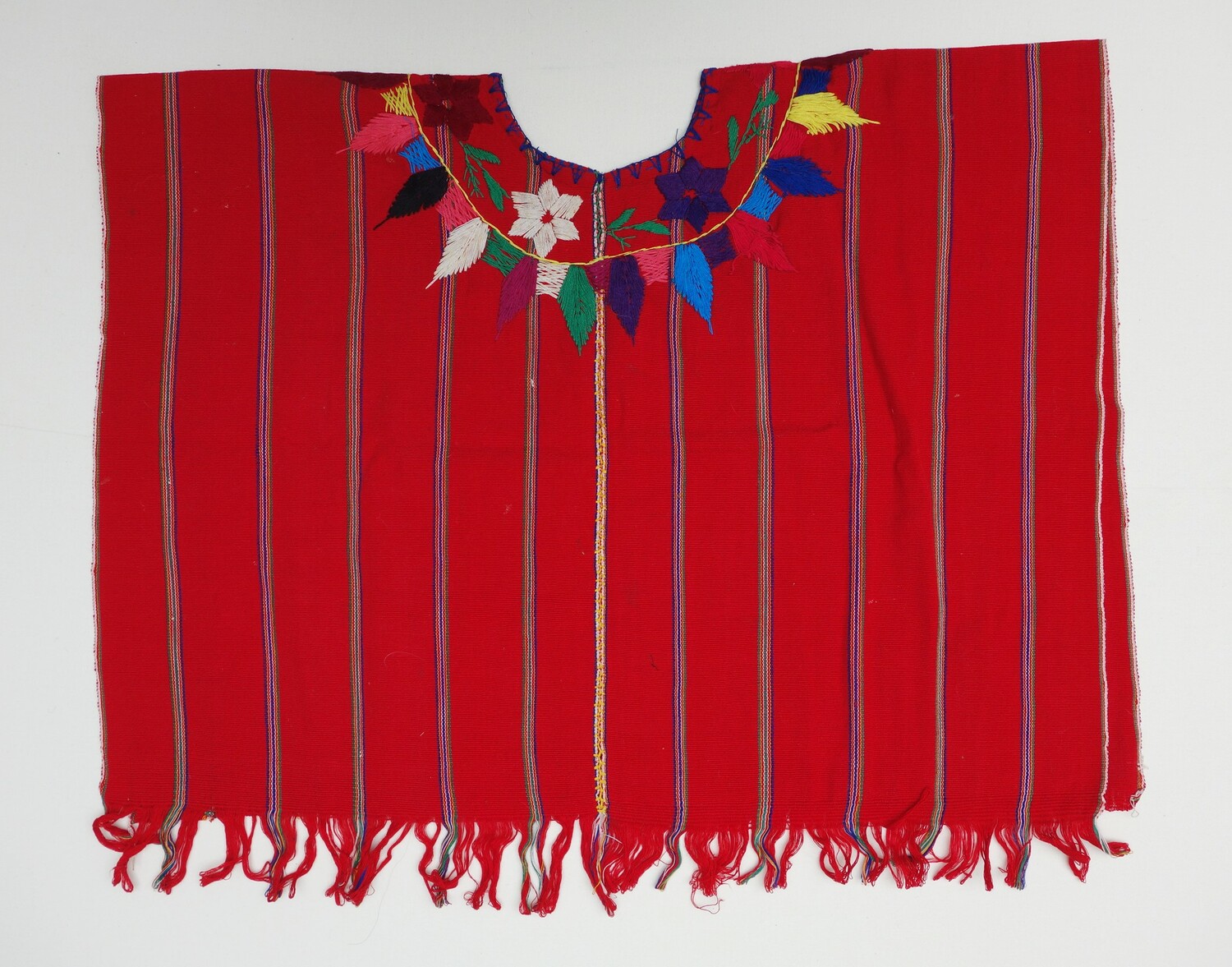 Huipil from Patzun, Guatemala, late 20th century (TRC 2016.2036).
Today, however, younger women, even if they weave themselves, are much less bound by tradition and will often simply make something that they like. They may not even be aware of symbolism, clear to their mothers and grandmothers, who would have known – for example - that the diamond shaped motifs on the neck of a Patzún huipil (TRC 2016.2036) had ritual significance, even if they were unaware that they were feathers of a sacred creature, venerated by their ancestors before the Conquest and common on clothing of that period.
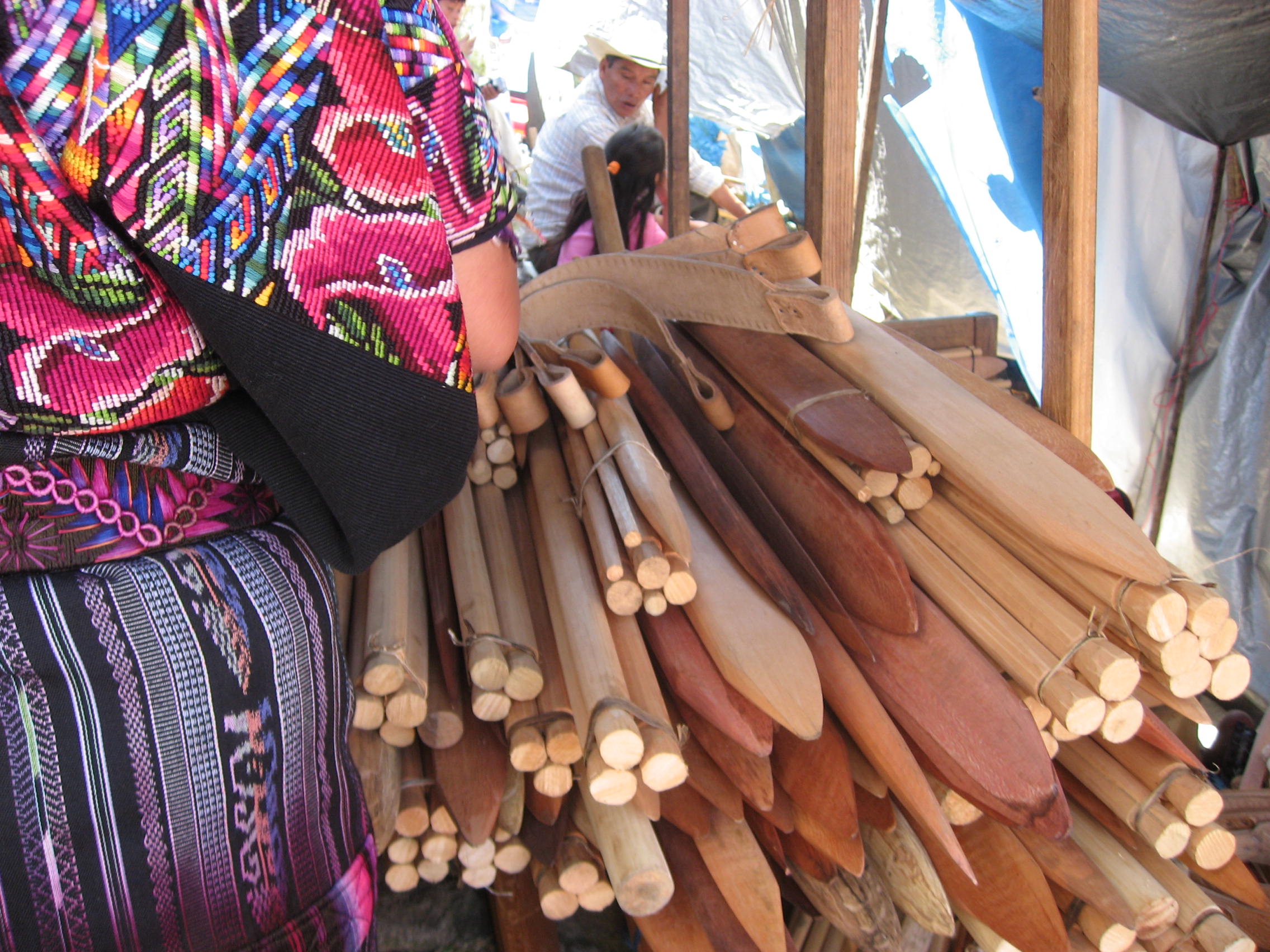 Choosing a loom, Chichicastenango, Guatemala (2007). Photograph by Caroline Stone.Cross stitch patterns have had an enormous impact, with brightly coloured flowers, naturalistic birds and even cupids being copied into weaving, especially in the Chichicastenango area – often mixed with traditional motifs (see photo of a woman choosing a new backstrap loom). This, however, is not new. Several towns, such as San Antonio Aguas Calientes, which does particularly fine weaving, apparently copied designs from European brocades, probably seen on church vestments, at an earlier date.
There is a tendency to think of traditional dress as “fixed” and “unchanging”, but in fact there can be an amazing range of variants within one basic design. Take the very striking huipiles from San Juan (also San Raimondo) Sacatépequez with their bold stripes in, predominantly, shades of purple and yellow with touches of orange, brown, green and red and, against this background, dramatic mythical beasts, perhaps “winged serpents”. Twenty huipils by different weavers will combine these elements, but each will be different.
 Huipil from San Juan, Sacatepéquez, Guatemala, 1960s (TRC 2021.0703).The examples in the TRC demonstrate another fact: designs evolve, whether through fashion – one innovative weaver, whom everyone copies – increasing wealth, or external contacts. Descriptions of huipiles from the late 19th and first half of the 20th centuries, suggest that they were very frequently white, as still today in Mexico, and lightly decorated, apart from ceremonial garments. The tendency, then, has been brighter and brighter colours and greater and greater areas of the huipil decorated. This is demonstrated by the 1960’s example [TRC 2021.0703] from San Juan Sacatepéquez, worked with a line of brocading across the shoulders, as opposed to the late 20th century example [TRC 2020.0523], which is more heavily decorated, and ones can now be found with the brocading reaching almost to the waist.
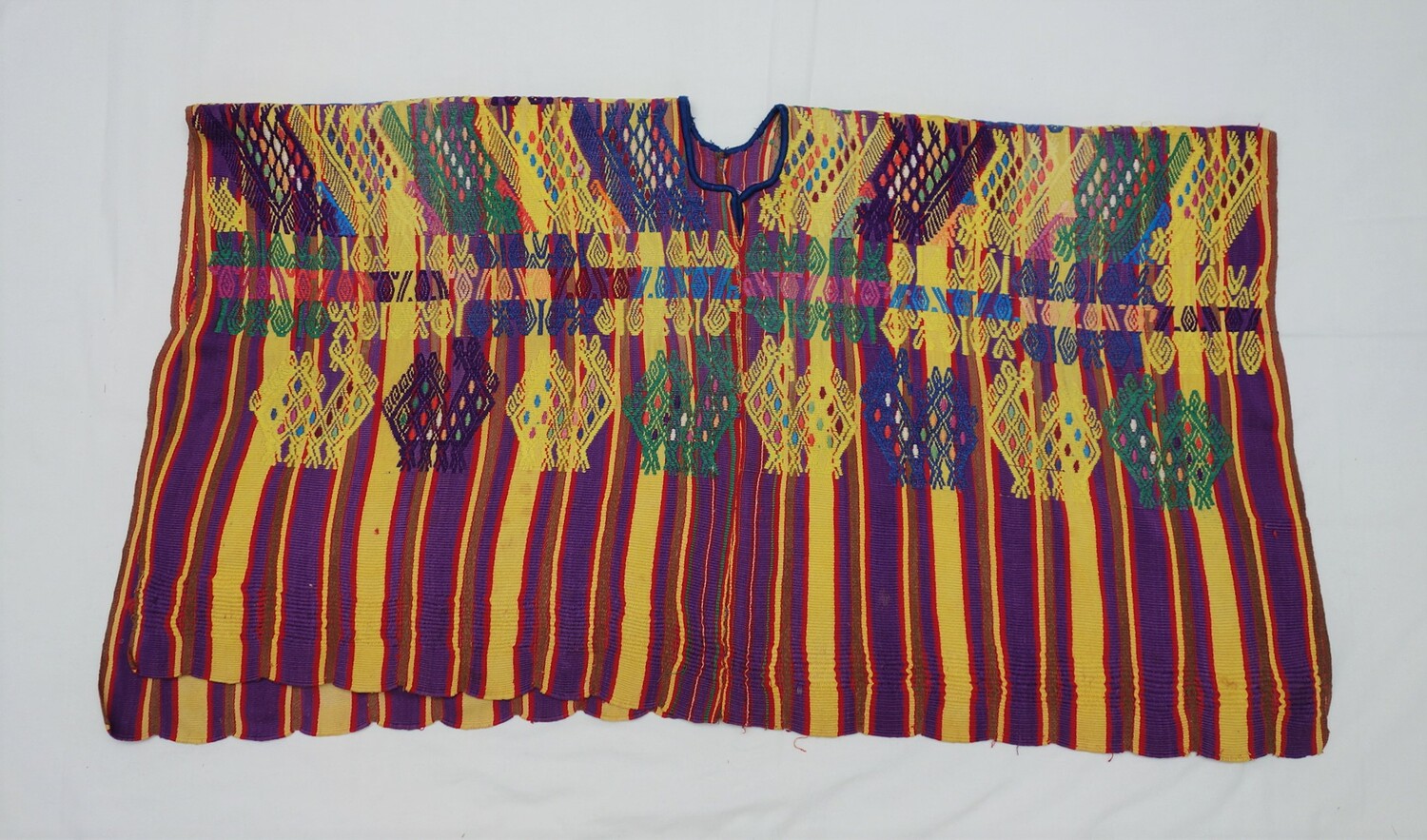 Huipil from San Juan Sacatepéquez, Guatemala, late 20th century (TRC 2020.0523).
Skirts too have changed over the decades. The most common forms now are a length of cloth – corte - worn like a sarong or sewn into a tube. These are held in place by a woven belt, which may be very long and is often elaborately decorated. Earlier, the skirts were often of morga, a heavy cloth, commonly red or blue, reflecting in part the areas where cochineal and indigo were produced. In a number of towns, for example Cobán, the skirt was gathered to a drawstring waist and the sleeved huipil echoed earlier Spanish folk dress. The examples of this shape skirt in the TRC collection have been identified, quite correctly, as being for the tourist market. Ladinas may wear full skirts but, in a country where ethnicity is an extremely sensitive subject, tend to avoid indigenous textiles.
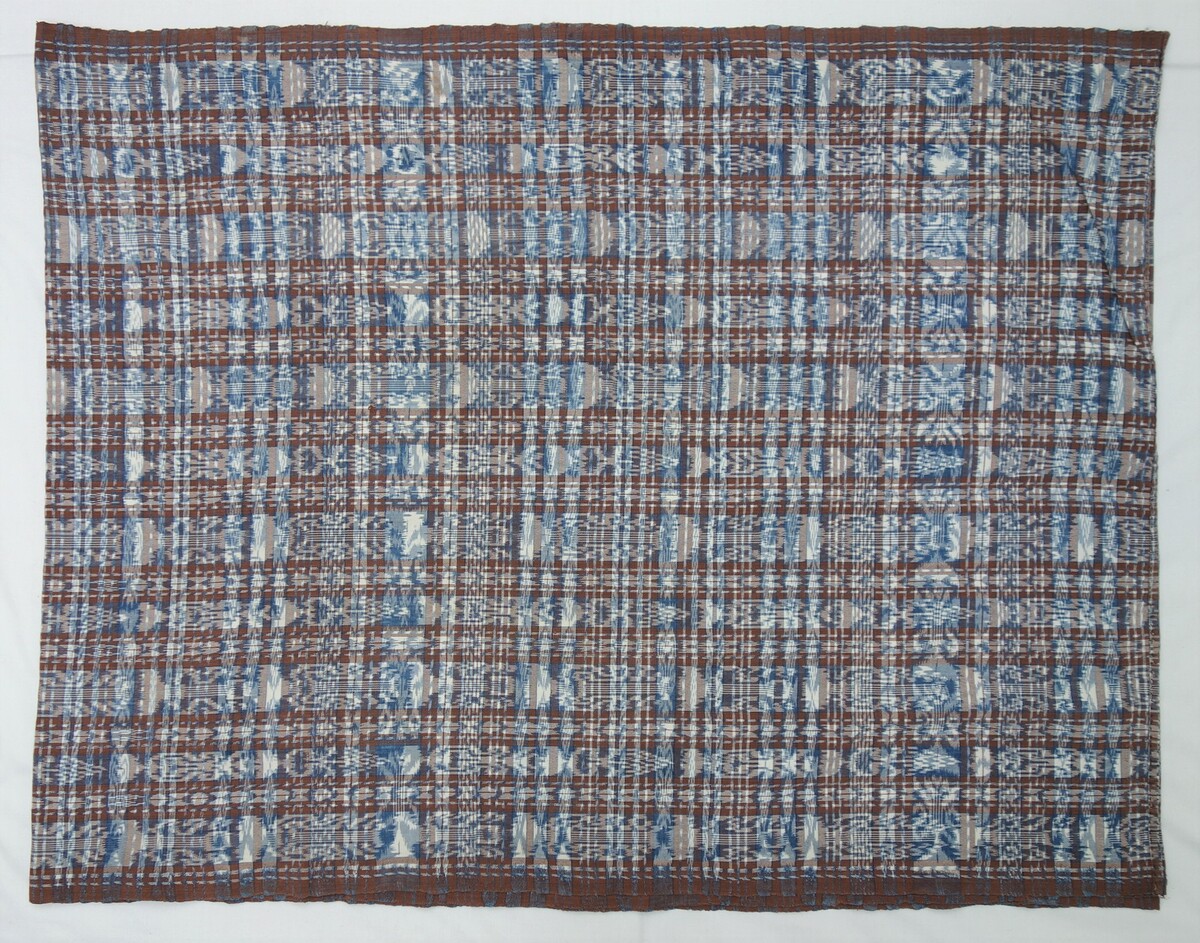 Length of ikat cloth, Guatemala, 1970s (TRC 2019.1964).Today, morga is out of fashion and skirts are most often made of jaspe – ikat – mostly produced by male weavers in the Totonicapán region, with highly stylized motifs of figures, pine trees, ceiba, etc, as well as what appear to be western patterns. These very elaborate double ikats require great skill and it is remarkable that they have become the equivalent of blue jeans for everyday wear. There is no evidence of the ikat technique in pre-conquest Central America and it is possible that it was brought by the Spaniards from the Philippines, where it was very highly developed.
Jaspe too has evolved. Originally, it was only worn by certain villages and might be soberly coloured (TRC 2019.1413). By the mid-late 20th century, however, jaspe was very generally worn and almost always in shades of indigo (or synthetic indigo) and white (TRC 2019.1412 or TRC 2019.1964). The former has a good example of the randa or decorative embroidered “seam”, which can be seen at the bottom of the photo of the woman choosing a backstrap loom. However, gradually more and more colours crept in (see photo or TRC 2017.0778) and by 2010 bright colours and even lines of tinsel were becoming popular.
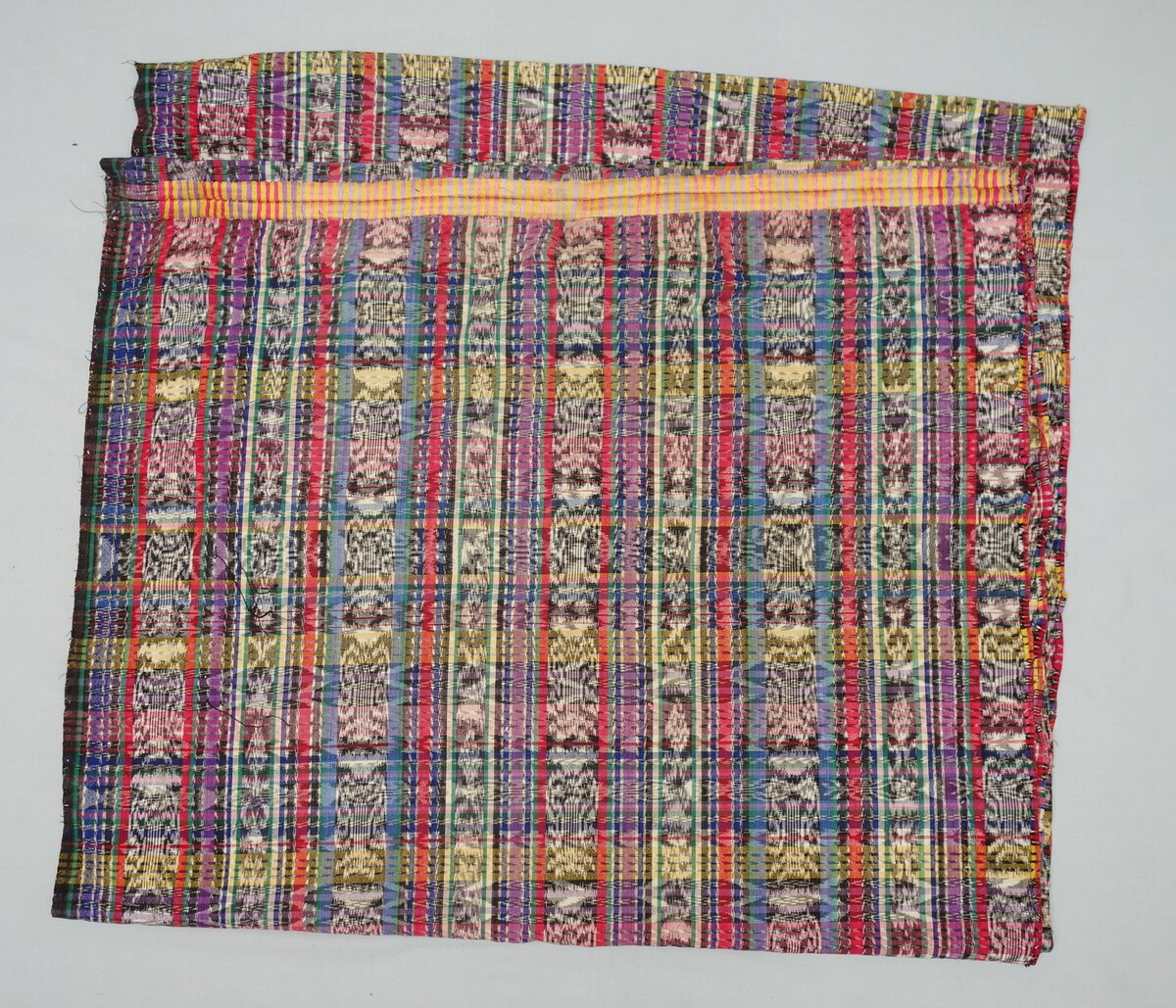 Skirt from San Andres Zecul, Totonicapan Dept., Guatemala, late 20th century (TRC 2017.0778).Because of the enormous tourist market in Guatemala, increasing numbers of huipils are made to satisfy demand. They are usually poorly made with cheap cotton and machine embroidery, but even so can be quite decorative. Used huipiles are sometimes dyed brown (TRC 2010.0363) for sale to tourists, perhaps to cover staining or to imitate the brown native cotton – cuyuscate (TRC 2011.0531) - which is now usually reserved for cofradia vestments. Many pieces are sold as “cofradia” when they are nothing of the kind. Not all communities were rich enough to use the most expensive materials, especially quantities of real silk, which had to be imported, and the finest cotton, but these ritual garments are always beautifully made and until very recently, genuine ones were rarely parted with.
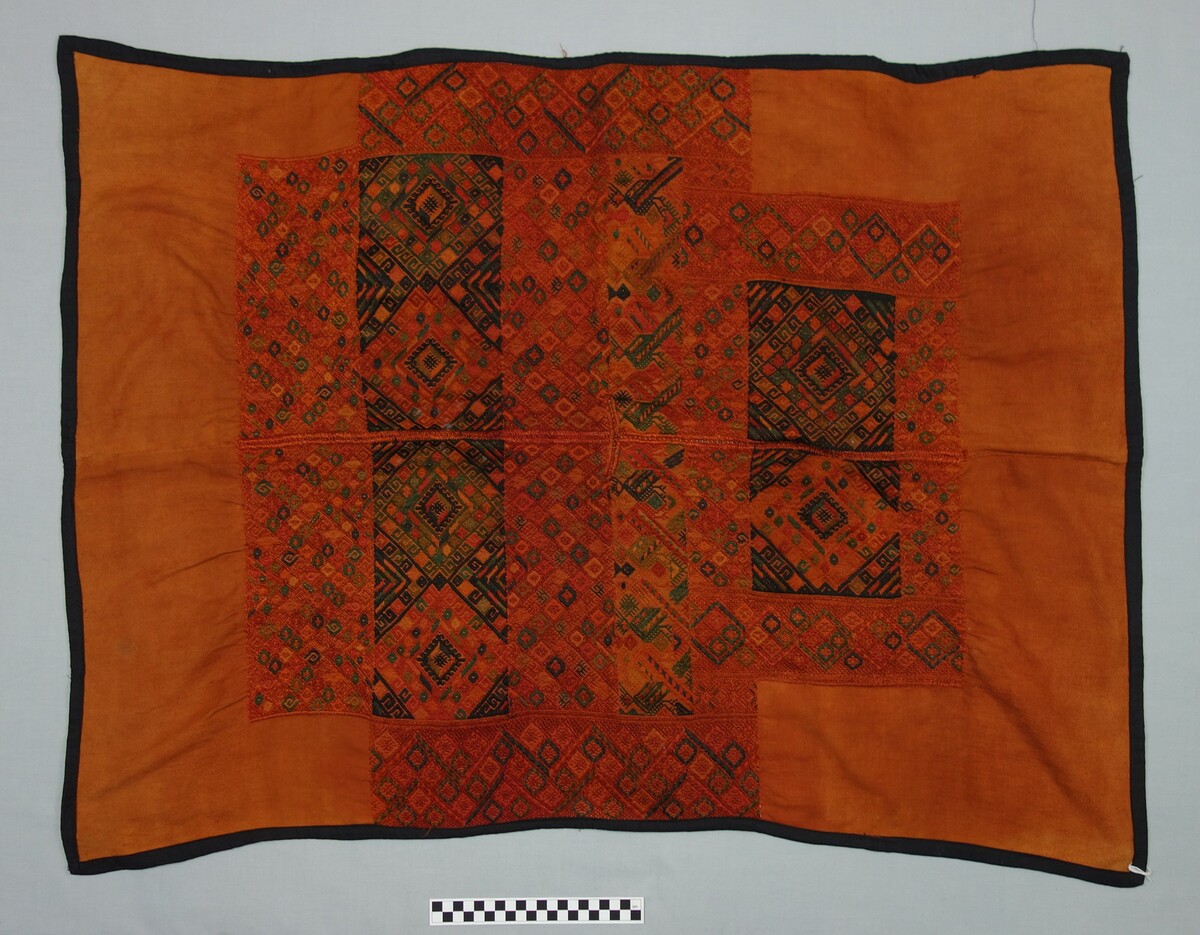 Length of cloth (huipil?), Nahuala, Guatemala (TRC 2010.0363).Since roughly the beginning of the 21st century, however, Evangelical groups, often funded from the United States, have made considerable inroads into the traditional Catholicism combined with pre-Hispanic religion. The missionaries have made every effort to induce the local women to abandon their ethnically distinctive dress and, by the same token, the old cofradia rituals have been banned. This has resulted in considerable quantities of used clothing, as well as belts, hair ornaments and perrajes, coming on to the market, including fine pieces, which in the past would never have been sold.
For decades, it has been predicted that women would stop weaving and indigenous Guatemalan dress would vanish, but happily so far that has not happened and weaving is considered to be a basic female activity. This was brought home to me ten years ago in the market at Sololá, where I was buying a number of used huipiles from a stall holder, probably in her late thirties. Unusually, she spoke good Spanish.
- I really don’t understand you people.
- Oh. Why?
- Well you clearly have money, because you’ve travelled here and you’ve bought my goods for cash without too much bargaining.
- So?
- So, why do you buy our old clothes? I wouldn’t dream of buying yours. If I had your money, I would buy silk, real silk, not sedalina, in every colour, and the finest cotton yarn, then sit down and weave all the beautiful things I have in mind. I would take weeks and months over each piece. As it is, I have to work quickly with whatever I can afford. So, why don’t you make beautiful clothes for yourself?
- I can’t weave.
She looked at my husband, who was waiting in the background with our sons.
- Is that your husband?
- Yes.
- You can’t even weave and he married you?
Caroline Stone, Cambridge, 20 April 2021