
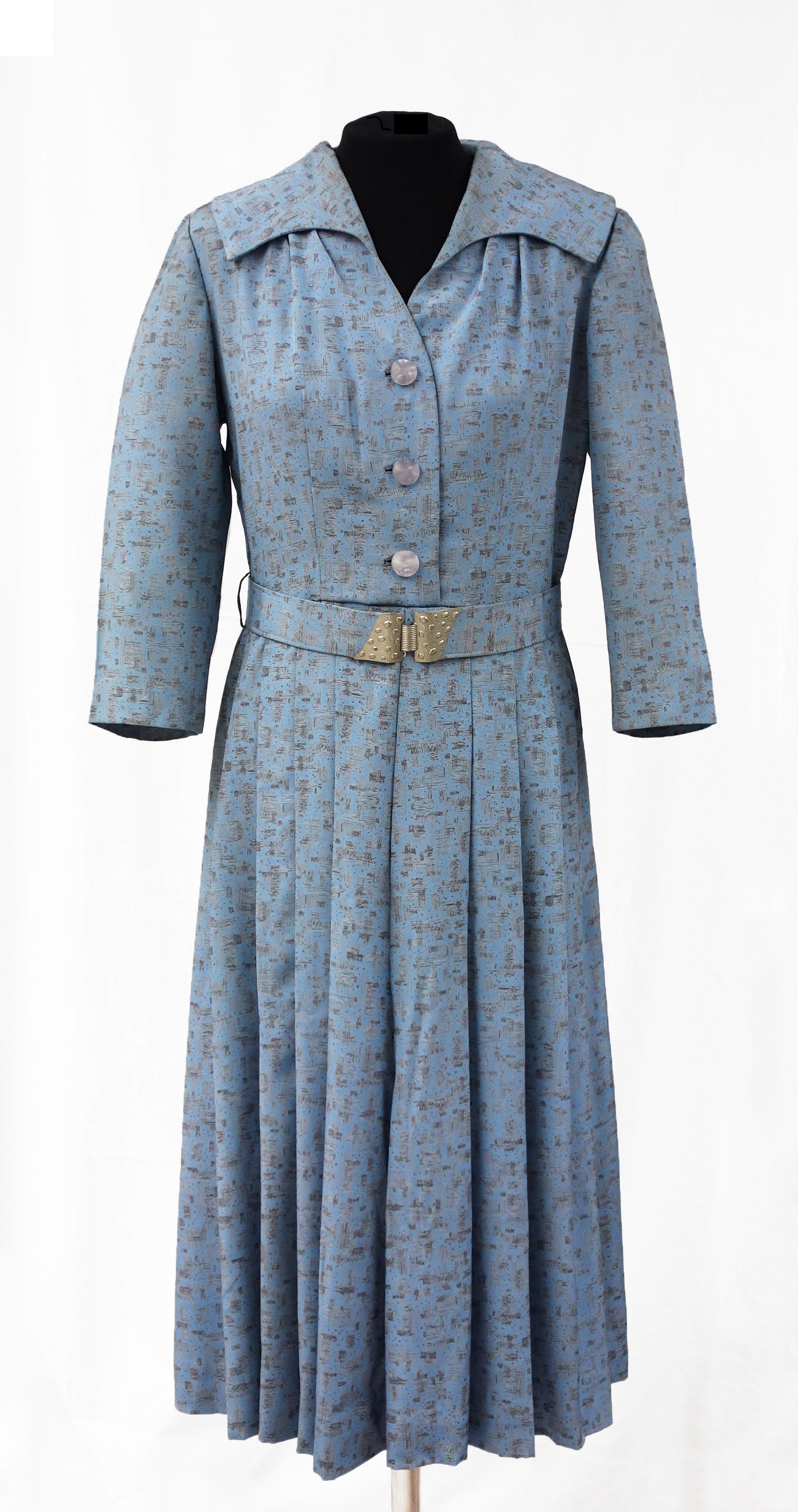
 New Look dress, late 1940's, early 1950's (TRC 2015.0030a-b).The end piece of the TRC’s current exhibition “Textile Tales from the Second World War” is a beautiful, blue dress from the end of the 1940’s, early 1950's, which was made in The Netherlands (TRC 2015.0030a-b). The changes in women’s wear in the period, as impacted by the difficulties of the war and a renewed energy afterwards, are quite clear when looking at this particular garment and others on display.
Rationing and fabric shortages led women to shorten their hemlines, re-use older dresses, wear tighter skirts or to forgo pockets (and sometimes even stockings) in an attempt to save on material.
Practicality overruled what had previously been seen as propriety. Reflective of the war as well in terms of style, some women’s jackets also tended to include padding and straight lines at the shoulders in an effort to emulate a military uniform’s style.
When looking at this specific blue piece from 1948 however, one will notice the rounder shoulder lines, pleating on the shoulders, the large collar and a fuller, long skirt that make it contrast with earlier wartime fashion.
The “extravagant” use of so much more material is indeed representative of renewed availability of resources after the end of the conflict. In fact, all these attributes are also rather reminiscent of the trend instigated by Christian Dior in France with his iconic New Look in 1947. Could this dress have been inspired by it? With its rounded curves and fuller, pleated skirt it could easily be argued that it was!
Women’s fashion is always an interesting reflection of societal considerations, and history can be looked at quite personally through clothing. With its padded, artificially curved or corseted models as well as longer skirts, Dior’s New Look has been seen as participating in the revival of a traditional female image after the war. Whereas during the war, women were encouraged to join the workforce to replace men and adopted more utilitarian clothing, the end of the 1940’s seemed to prefigure a certain return to more traditional features in female lifestyle and fashion.
Was this change representative of an evolving sense of femininity, the return to traditional gender norms or simply post-war opulence reflected in using more fabric? In any case, this new style was enormously popular and influenced women’s wear internationally for the decade to come, in fact until the 1960’s when skirt and dress hemlines were shortened again.
Augusta de Gunzbourg, 12 October 2020