





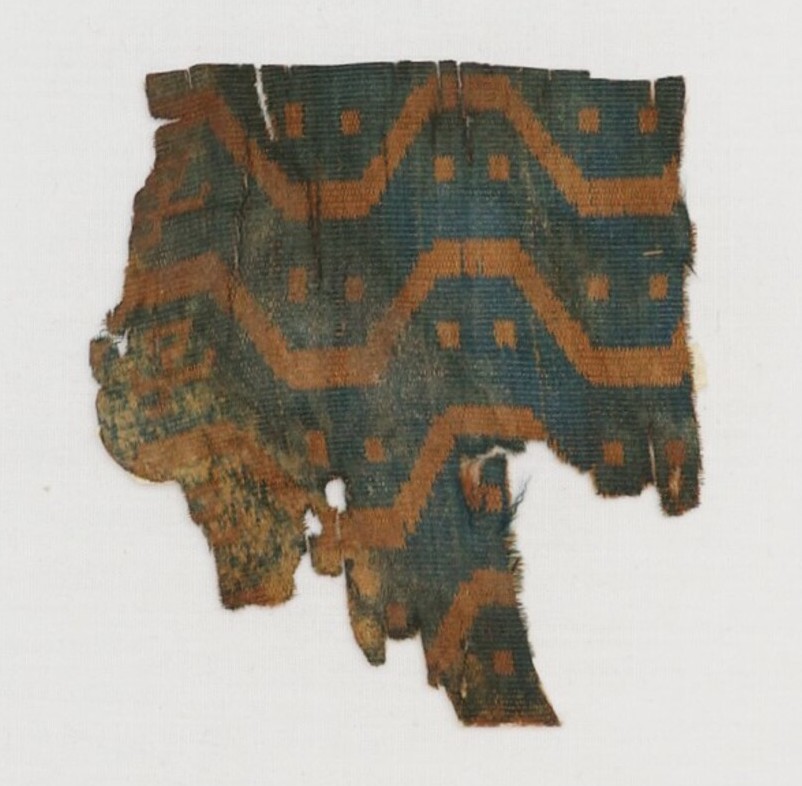
 Small fragment from the TRC collection, of a warp-faced compound weave, Niya (?), Xinjiang, China, 3rd century BC - 3rd century AD (TRC 2000.0009).The Cotsen Textile Traces Study Collection (at the George Washington University Museum-The Textile Museum, Washington, DC) was a prominent partner of the TRC in the recent online conference 'Textiles on the Move' (6-9 October), and it had its inaugural event recently, an online roundtable.
The Collection is composed of some 4,000 textile fragments, which range time-wise from a Chinese silk warp-faced compound weave (475-221 BCE; see also fragments in the TRC Collection) to modern American textile art, and from 1920s Wiener Werkstätte sample books to ancient Peruvian scaffold weaves. Housed in 761 hand-made boxes and divided into 15 geographical regions, it’s an impressive collection.
Two pieces and their accompanying presentations stood out for me. The TRC’s growing collection of quilts has made me appreciate the artistry and skill involved in patchwork. The Cotsen collection includes an 18th century patchwork coat (T-2852), which illustrates how textiles move across the world. The coat’s (mostly) cotton, silk and wool fabrics come from several places in India, but were traded to southern Indonesia, where they were made into a stunning male garment composed of at least 300 triangular pieces.
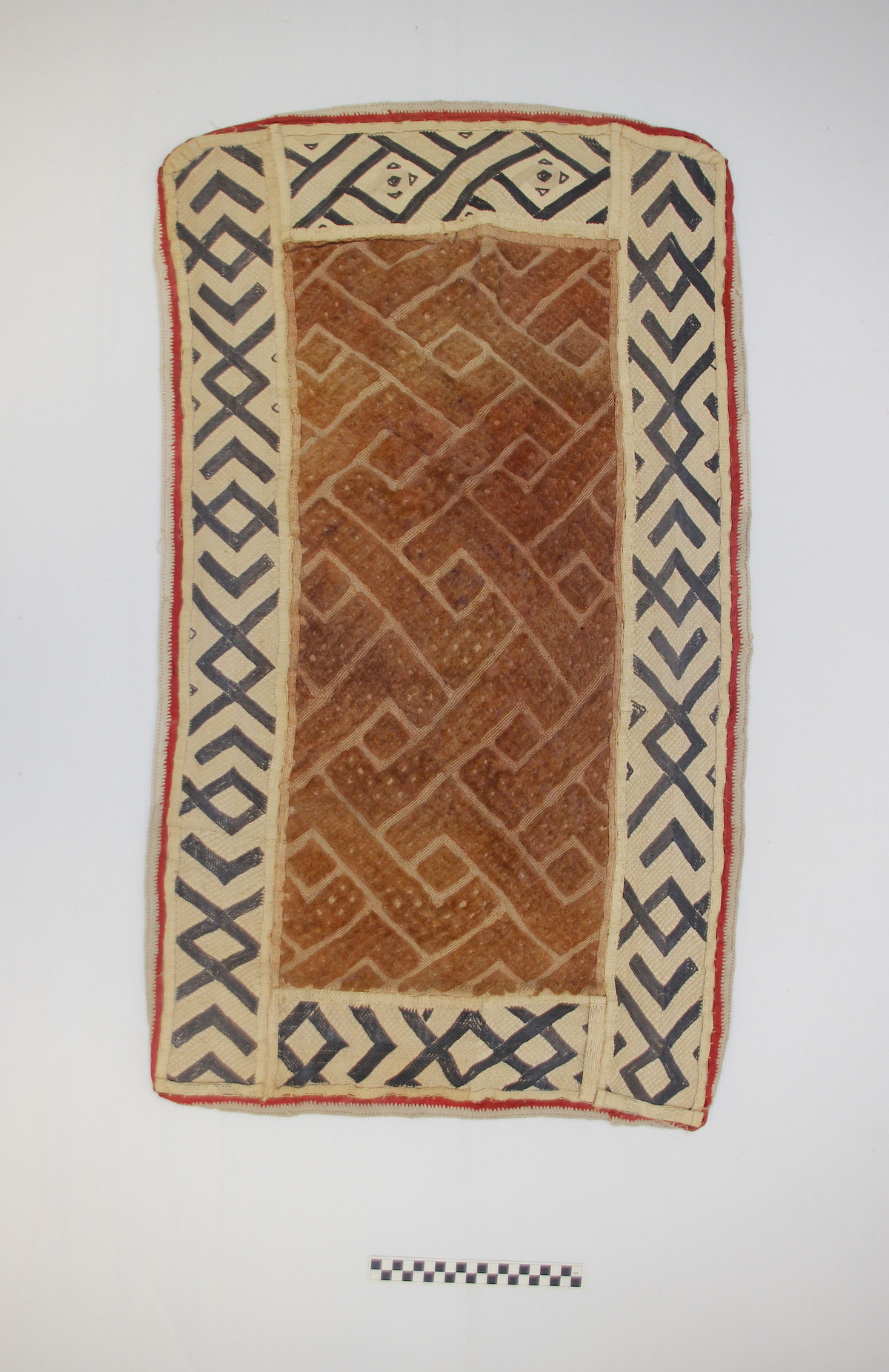 Raffia panel from a skirt, from Kuba, Congo, mid-20th century (TRC 2013.0296).Most of the fabrics were hand block printed but there is a strip from the Coromandel Coast with a hand-painted, floral motif. Only one other coat of this nature is known, and it is now in a museum in Singapore. The coat was probably thought to have a supernatural protective function. Given the labour involved in its making, it belonged to a very wealthy man.
The TRC has a beautiful panel of a raffia Kuba skirt (TRC 2013.0296) and embroidered Kuba raffia fragments (TRC 2019.1699 and 2004.0131), which made me eager to listen to a presentation, during the roundtable, on the Kuba kingdom (in what is now the Democratic Republic of Congo), and the skill in turning raffia palm fibre into garments, belts and headwear.
Until the mid-19th century the voluminous skirts, worn by both men and women, were usually monochrome in colour with small repeating design patterns, often embroidered by women for the men in their families. After this date, however, the geometric designs become bigger and bolder, frequently in contrasting colours. The designs on women’s skirts were more curvilinear and asymmetrical, with non-repeating patterns and sometimes edged with pom-poms or shells. Men’s skirts were more textured, often had fringes, and were worn with elaborate folds, pleats and ruffles.
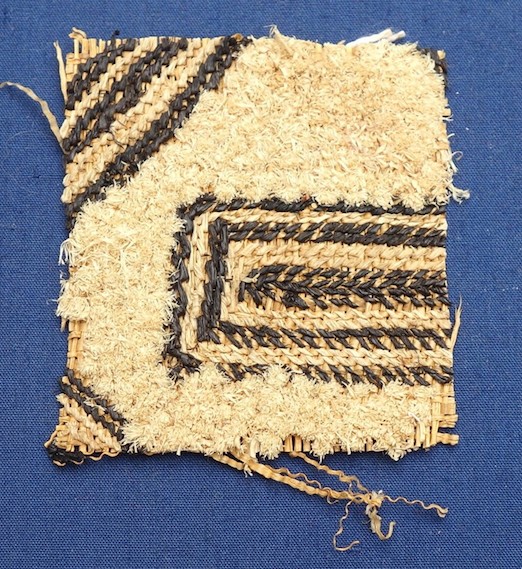 Fragment of decorated raffia weave, Kuba, Congo, mid-20th century (TRC 2019.1699).The Cotsen Textile Traces Collection is accessible online. The digital roundtable made me appreciate the TRC’s Collection even more. Both places share a passion for textiles and the mission to make them more accessible to researchers and the public.
I must admit I was jealous of the Cotsen’s additional resources. I can only hope that the TRC will find an equally wealthy patron, so we, too, can afford carbon-dating, a walk-in freezer, and to grant scholarships.
By Shelley Anderson, 26 October 2020


