

 Woman's carpet coat, 1970s, Western (TRC 2019.2858).A little while ago I took part in an informal discussion here in the Netherlands about how different cultures over the centuries have been involved in the mending, repairing, re-using and re-cycling of garments (more recently known as up-cycling). This is a subject that is growing in popularity with the increasing attention being paid to sustainability in all its many forms and the growing awareness of the disastrous environmental impact of the so-called fast-fashion, mainly produced in China. The London based journal, Selvedge, for example, has recently had a complete edition (vol. 102) dedicated to the concept of mending.
During the discussion, someone mentioned a carpet coat that she had worn in the 1970s. The coat had been made by the donor’s mother from a carpet they had at home and no longer used. The coat is long gone, but still fondly remembered. And some time ago we happened to put an example of a Dutch carpet coat online (TRC 2019.2858). Like the coat in the discussion, this addition to the TRC collection dates to the 1970s and was home made.
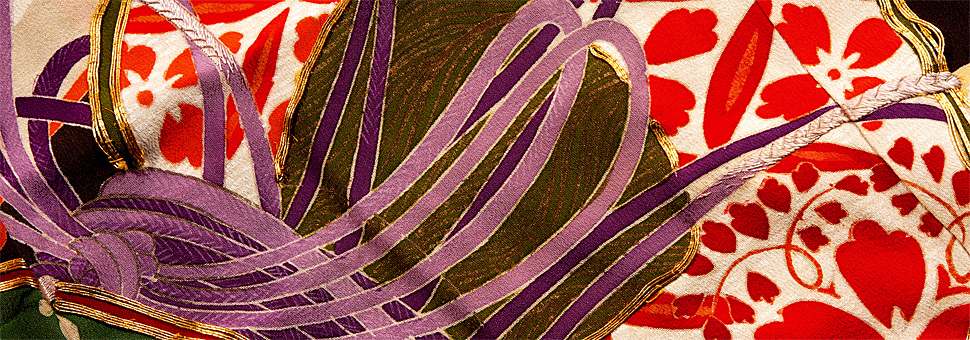
 Detail of carpet coat, TRC 2019.2858.But what is a carpet coat? In the 1960s and 1970s colourful and richly patterned coats were sometimes made out of pile Middle Eastern and Persian carpets, as well as flat-weave kilims (sometimes known as ‘tapestry’ coats). This type of garment was a popular and colourful form of clothing among some ‘hippy’ and later, New Age groups (comparable to the embroidered, Afghan sheep skin coats or pustin).
Such garments were made from both hand and machine-made carpets and they could be heavy and stiff to wear. The one recently given to the TRC Leiden dates from the 1970s and weighs several kilos. It looks wonderful, but is hard to put on.
It is also worth noting, that the TRC carpet coat itself has been mended at some point with a piece of carpeting. We are not sure why a patch was needed, but moth damage is suspected.
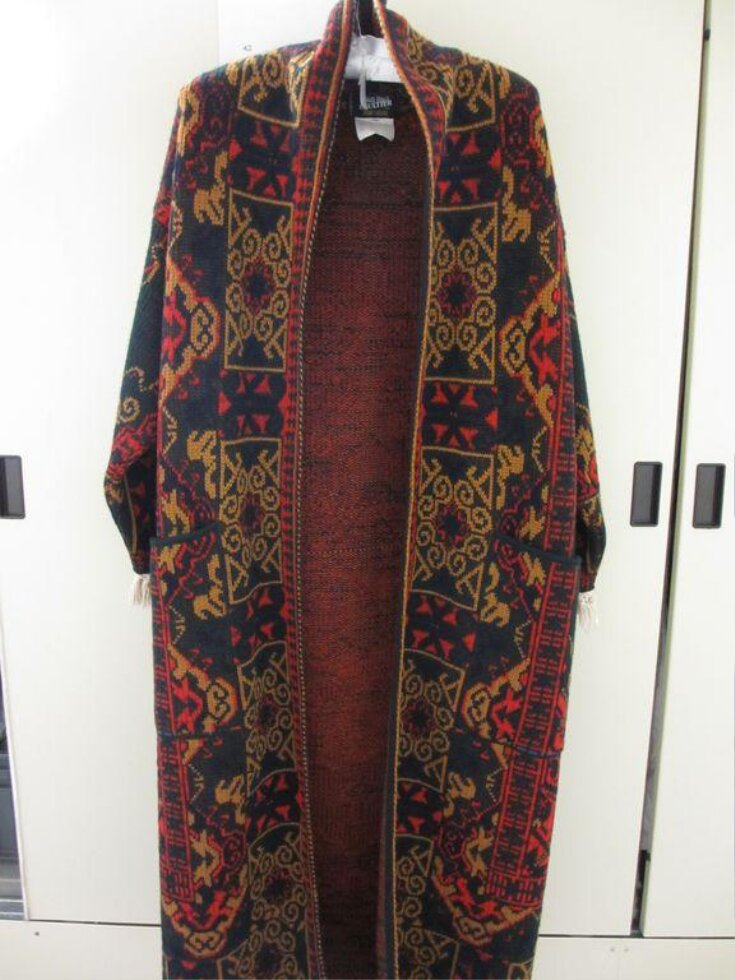 Coat designed by Jean Paul Gautier, based on Persian carpet (V&A 2012FL1677).Knitted examples
In addition to carpet versions, knitted examples also became popular among the fashionista thanks to haute couture examples by people such as the French designer, Jean Paul Gaultier (1952-). An example of a machine knitted example with an overall design copying the motifs found on Persian style knotted carpets can be found in the Victoria & Albert Museum (V&A T.377-1985). This garment dates to 1985.
‘Aubusson’ coats
In the 1996 the English designer, Roger Saul (1950-), the founder of the Mulberry fashion label, produced a full-length coat from a soft-furnishing material. The cloth was decorated with designs taken from the French carpets known as ‘Aubusson’ that date back to the 17th and 18th century. An example of this type of carpet coat is also housed in the Victoria & Albert Museum (T.33-1997).
The whole subject of coats, whether they are short, long, wide or fitted, and of whatever materials they are made or even how they are fastened, is fascinating and one that deserves further research. Not forgetting, of course, the stories behind individual examples. More coat stories to come in future TRC blogs!
Gillian Vogelsang, 28 October 2021