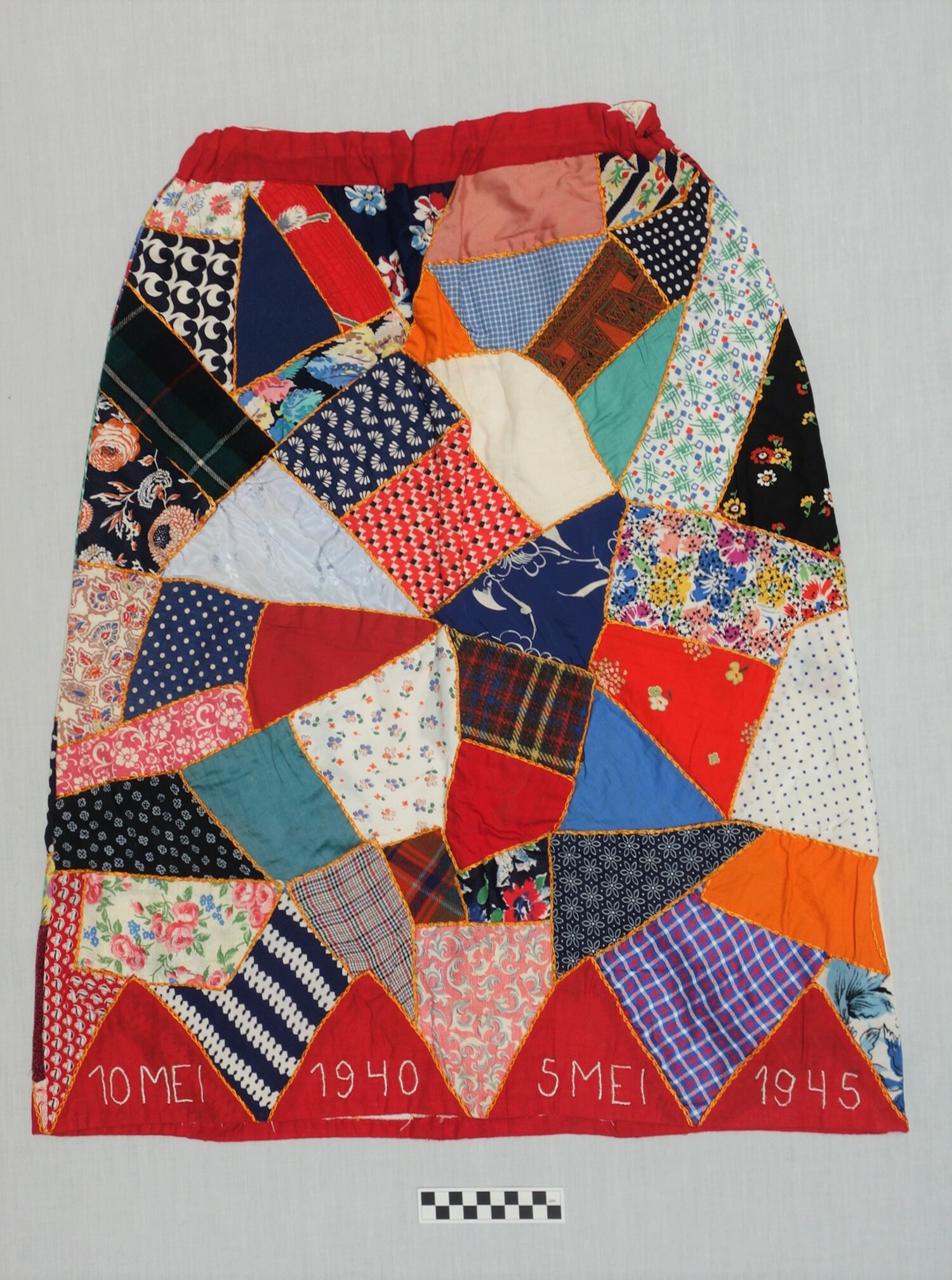
 Feestrok celebrating the liberation of The Netherlands in May 1945 (TRC 2011.0001a).On the first day back after the Christmas and New Year break we received an anonymous donation of a very special garment. It is a feestrok ("festival skirt") or bevrijdingsrok ("liberation skirt") from 1948, which was made, together with many other comparable skirts, to celebrate the liberation of The Netherlands in May 1945.
The idea of the feestrok has its origins in 1943, when Mrs. Mies Boissevain-Van Lennep (1896-1965), a member of the Dutch resistance, was imprisoned by the German occupying forces. She was secretly sent a scarf (lappendasje) made up of small pieces of cloth taken from the clothing of family and friends.
Upon her safe return, and following the end of the war in 1945, Mies Boissevain-Van Lennep, together with a group of other women, decided to create a garment that represented: "Unity in diversity" (eenheid in veelheid); "New from old" (nieuw uit oud); "Reconstruction from destruction" (opbouw uit afbraak); "One garment makes unity" (één dracht maakt eendracht).
The skirt was intended to reflect the diversity, unity and rebuilding of the Netherlands following the Second World War. In 1947 the national feestrok project was set in motion in conjunction with the Internationaal Informatiecentrum en Archief voor de Vrouwenbeweging, IIAV ('International Information Centre and Archives for the Women's Movement'). Some 4000 skirts were eventually made and officially registered.
In order for a skirt to be officially registered, it had to be made up of pieces of colourful patches deliberately sewn onto an old skirt, whereby the old skirt vanished and a colourful 'new' garment was created. At the front of the skirt, near the hem, there had to be a triangle in which 5 mei 1945 (5th May 1945) was embroidered. Some skirts also included other dates relating to family or national events, or when the skirt was worn on a bevrijdingsfeest ("liberation day").
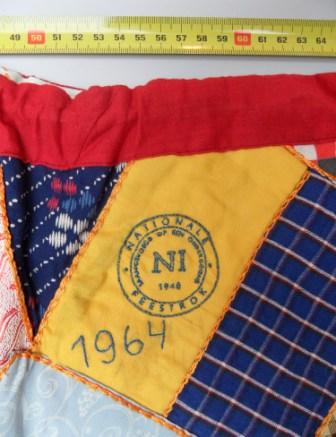
Each skirt was registered and the name, address and date of birth of the maker included, both in a national archive and on individual cards. The skirt was stamped and given a special number, which was stitched onto the skirt itself. Once a skirt had been accepted and registered then it could be worn on the 5th May anniversaries (bevrijdingsfeest ), Koninginnedag ("Queen's Day") and other important Dutch national holidays.
There was even a feestrok song composed by Elisabeth van Maasdijk:
Vlecht in Uw rok het patroon van Uw leven
Vrouwen en meisjes van dorp en van stad
Lichtend symbool van het vrouwelijk streven
Draagt het verheugd, als de bloem draagt haar blad.
Eenheid in veelheid van lijnen en kleuren,
Vormt met Uw rok het saamhorig verband,
In het geheel van historisch gebeuren,
Tooit het ontwerp met Uw hart en Uw hand.
Stempelt Uw rok met het merk Uwer dagen,
Voert dat wat was en wat IS in Uw Vaan.
Heden-Verleden, blijmoedig gedragen,
Sierre Uw kleed, Uw gezin, Uw bestaan.
During Queen Wilhelmina's fiftieth and last jubilee in 1948, the queen was serenaded with this song by about 1500 women, all of whom were wearing a feestrok.
Mrs. Slavekoorde's feestrok
The feestrok donated to the TRC came complete with its feestrok registration card. From this card it is known that the skirt was registered to, and presumably made by Mrs. S.M. Slavekoorde, Dorp 235A, Kesteren, which lies to the northwest of Nijmegen.
According to the registration card, Mrs. Slavekoorde was born on the 19th April 1915. The skirt was given the number 1964, and this number, as required, was stitched to the skirt itself (see the photograph to the right). As is required for a feestrok the garment is made out of numerous, colourful patches sewn together with orange thread. Along the front hem, as can be seen in the above photograph, is the inscription 5 mei 1945.
Gillian Vogelsang, January 2011.