
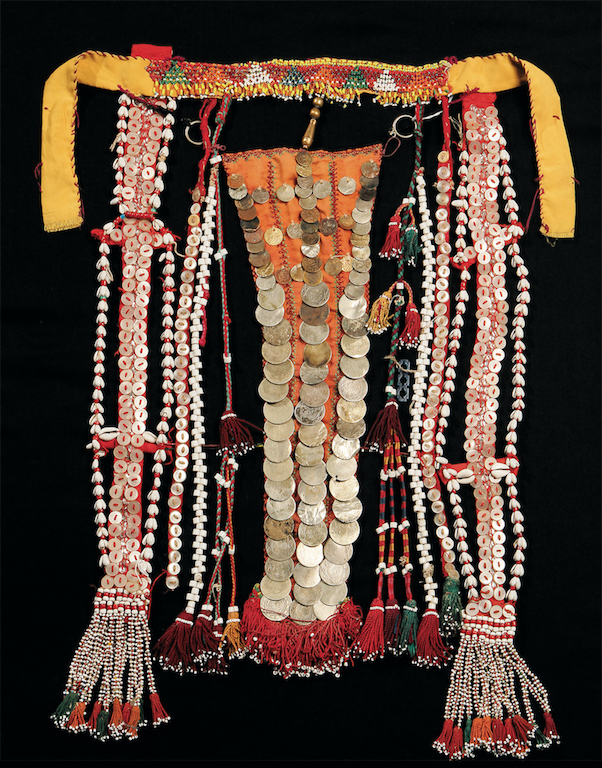
 Face veil from the Sinai, Egypt, mid-20th century (TRC 2004.0066).A two-day Veils and Veiling Workshop was held at the TRC on 4-5 November. It was a great pleasure to give as well as, for me, being instructive, thanks to the range and depth of the questions raised by the participants. The workshop was a mixture of practical and theoretical details concerning the history, use and social/cultural contexts of head, body and face veils of many different types and groups. The meaning of the head and its symbolic use for power was discussed in detail, but one of the questions was not easy to answer and needs further thought - what is the symbolic meaning of the nose!
Attention was paid to what was the difference between the main types of face veils - batullah, burqa, niqab, qina, etc., how they differ with respect to materials, construction and decoration, and whether this was a religious, social and/or economic indicator(s). We also looked at the various types of veils to be found in North Africa, the Eastern Mediterranean, the Middle East, the Arabian Peninsula, the Iranian world, as well as Central Asia and the northern Indian subcontinent. There was the opportunity to try on various forms from Egypt, Saudi Arabia, Yemen, Iran, as well as Afghanistan. The various forms of burqa and chadari associated with Afghanistan and Pakistan were discussed and then tried on, as it is so important to understand something of how it feels to wear these garments, rather than seeing them as abstract items in a photograph.
And this is one of the strengths of the TRC's ever growing collection and workshops - the chance to see, feel and discuss actual examples.
Gillian Vogelsang-Eastwood, 10 November 2016