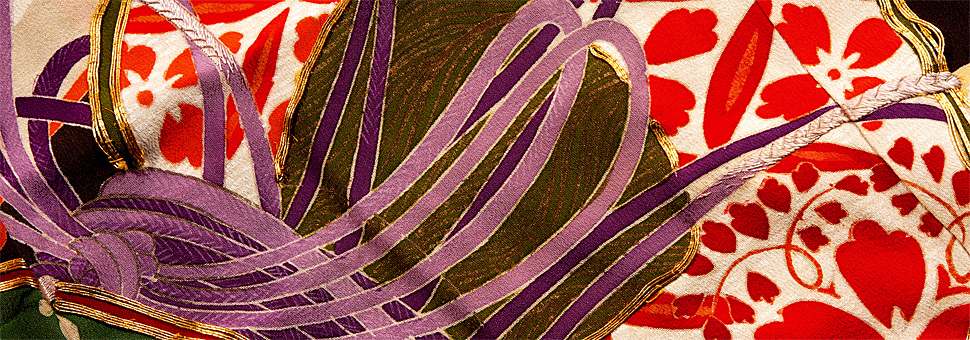


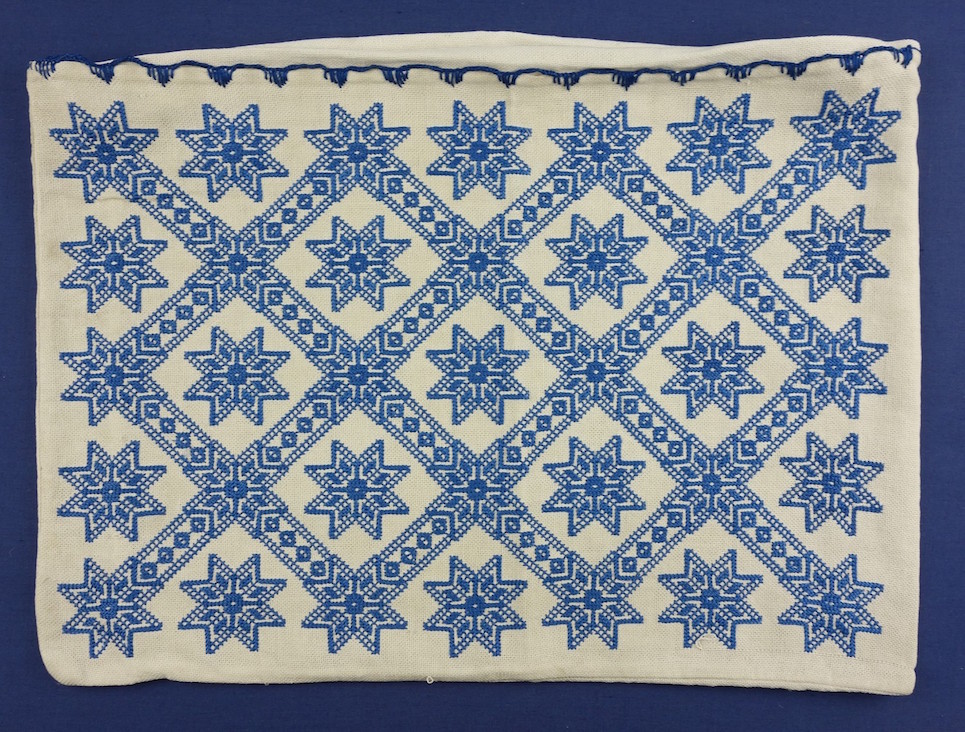
 Hungarian cushion cover, TRC 2016.2246. Click on photograph for PDF-file.A few months ago the TRC announced that it had the chance to acquire a small collection of Hungarian textiles, mainly embroideries. Thanks to the help of various people the items arrived at the TRC last week and we have been busy photographing and cataloguing them (they are now all online in the TRC Collection, nos. TRC 2016.2237 to 2016.2261).
The textiles include a variety of different embroidery techniques and designs. Over the next few weeks we will be putting various charts online via the TRC Blog. In fact, the first of these Hungarian designs (TRC 2016.2246) is now available (click image) and consists of an eight-pointed star set within a diamond-shaped trellis work. It is worked on an even weave cotton material using a mid-blue stranded cotton thread. The design is worked in cross stitch. The pattern comes from a cushion cover that dates to the latter half of the twentieth century.
Among the Hungarian objects was something we had not expected. We knew the new acquisitions 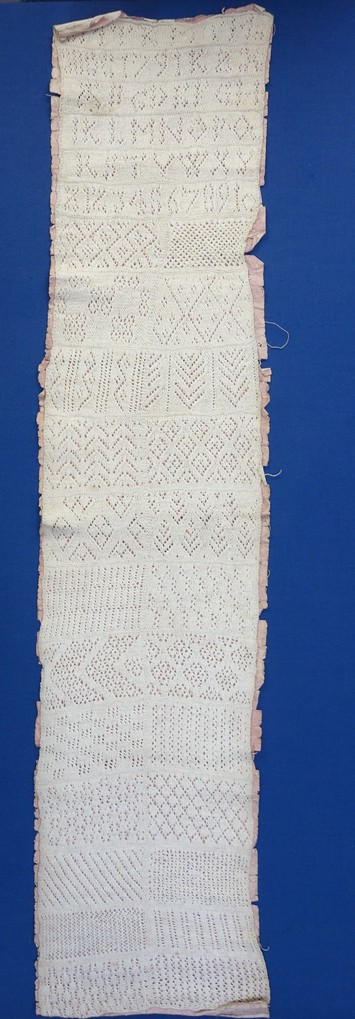 Knitting sampler dated AD 1791, TRC 2016.2261included a knitting sampler (TRC 2016.2261) and we had presumed it was early twentieth century in origin. On closer inspection, however, we found that there was a date, namely 1791, which would make it one of the earliest known dated knitting samplers from Europe.
The textile takes the form of a narrow band sampler and is knitted using a linen thread. The top half of the sampler follows a classic needlework sampler format, namely it has various initials, a date, the alphabet, followed by 0-10 in numbers. The rest of the sampler is divided into two vertical rows with numerous lacy knitting patterns. We are now looking for someone who would be willing to translate these patterns into charts so that they can be published online for everyone to enjoy!
Gillian Vogelsang-Eastwood, 12 November 2016