

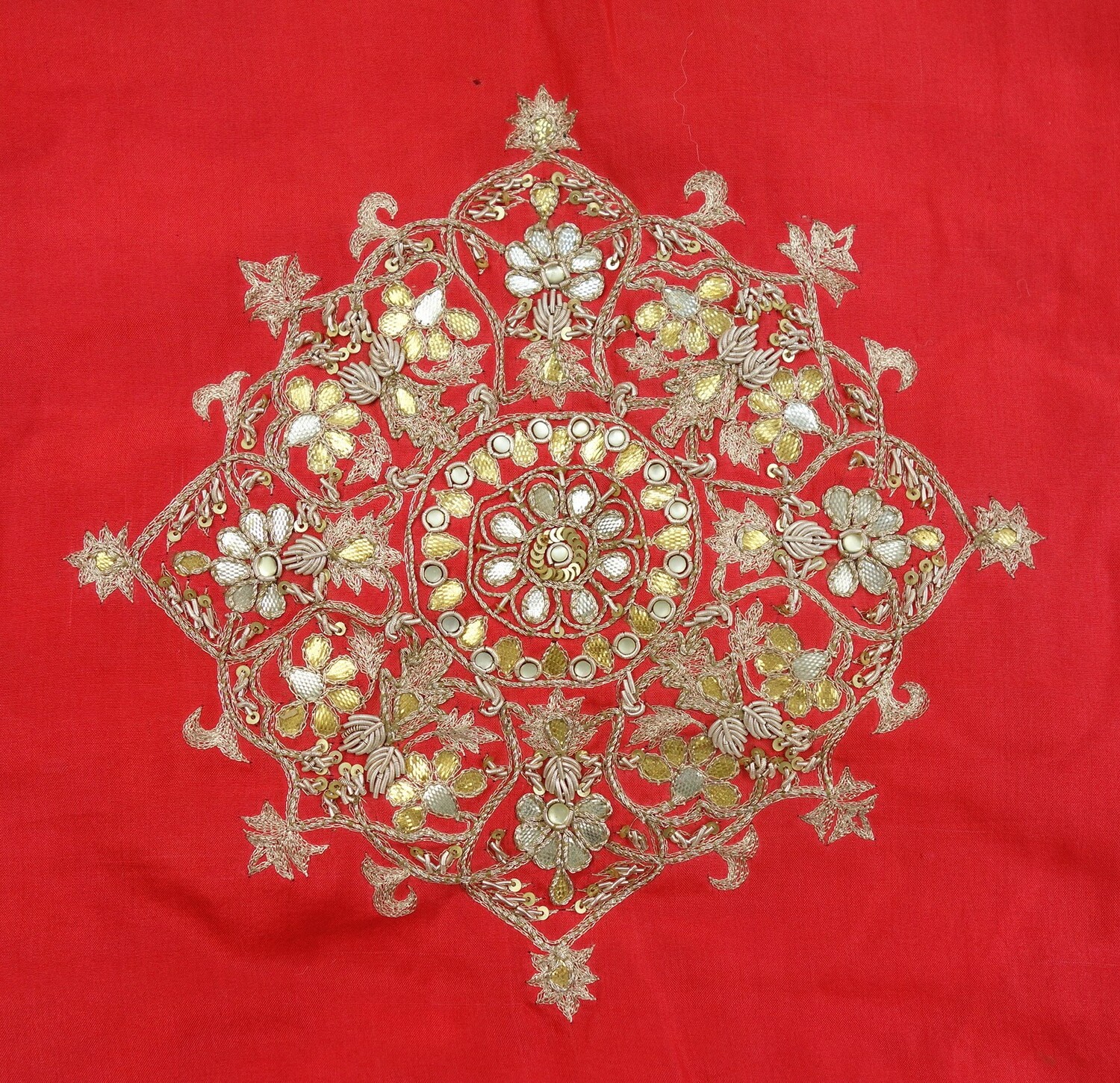
 Modern example of gota and zardozi work from the City Palace, Jaipur (TRC 2017.2741). Acquired for the TRC collection on 1st August 2017.Today, Gillian and I visited Jaipur, the capital of Rajasthan, India. Since neither of us had ever been here, we were very curious this morning when our taxi driver and his brother, who have been with us for the last few days and have proven to be very patient and amused by our company and weird interests, drew up at the hotel and took us to the city centre. Our first port of call was the City Palace, where, we had been been told, there was a small display of garments worn by the past Maharajas of the city.
We were extremely surprised to discover that the palace grounds house a beautiful little textile museum with the most interesting garments, well displayed and with excellent text boards. They include some beautiful chogas, angharkhas and jamas, as well as a late-nineteenth century Chinese gown bought by the then Maharaja. The most prized item in the displayed collection is a pashmina (both warp and weft) floor covering dating to the sixteenth or seventeenth centuries.
Anyone paying a visit to Jaipur and being interested in textiles and garments used and worn by the Maharajas of Jaipur for the past few hundreds of years should certainly pay a visit. And not only the museum itself was a pleasant surprise, so was the museum shop with high quality merchandising, including textiles and garments made and embroidered in the palace workshop.
The afternoon we spent touring Jaipur and Jaipur bazaar, looking for textiles and textile materials. We ended up in a shop called Satguru’s, managed by Mr Aneesh Sharma, who not only showed us some of his interesting textiles, but also obviously loved talking about them and explaining techniques and giving us the local names. We bought several interesting Rajasthani embroideries, demonstrating various local techniques, including so-called Rajasthani phulkari (normally associated with the Panjab). We completed our tour in the bazaar itself, looking for materials for gota embroidery (characterised by pieces of metal thread ribbon cut or folded to shape). When with the help of many bystanders and some tea one of the bazaaris finally turned up with what we wanted, we decided that it was time to call it a day. A cappuccino in the City Palace was a well-earned reward. Tomorrow we will be heading back to Delhi.
Willem Vogelsang, 1st August 2017