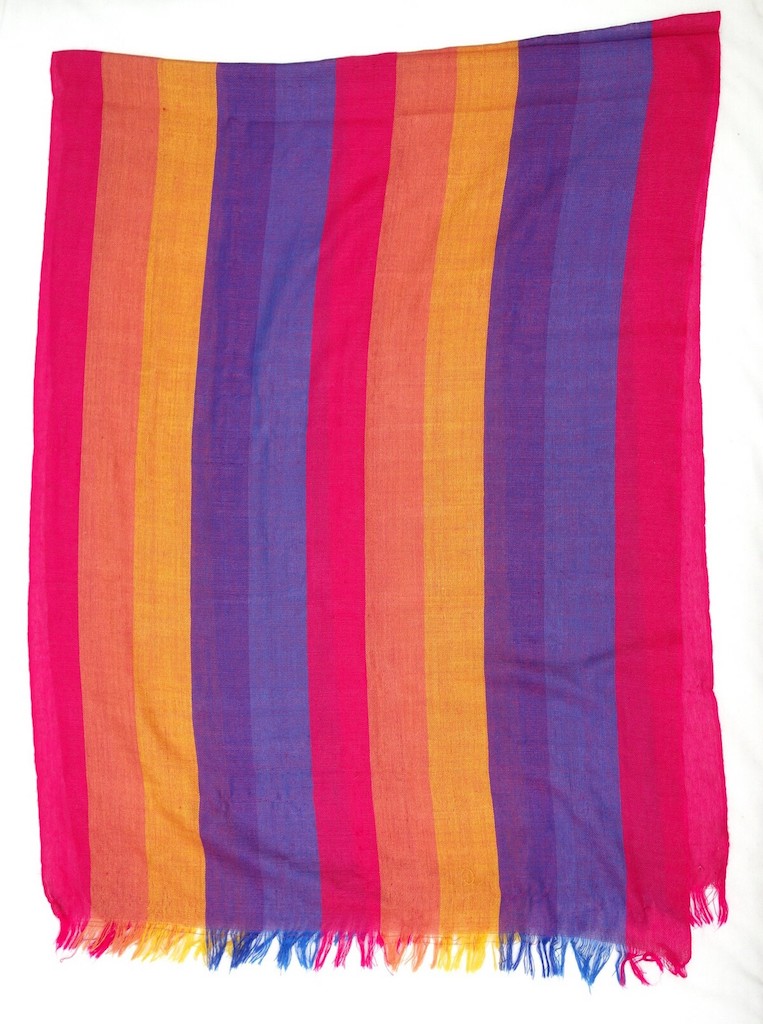
 Woman's shawl inspired by the LGBTQ flag, Equador, c. 2002 (TRC 2019.1996).On Thursday, 12 September 2019, Shelley Anderson wrote:
Some recent colourful donations to the TRC mark the 50th anniversary of the modern movement for LGBTQ+ rights. One of these donations is a rainbow flag (TRC 2019.1995), which has been seen at celebrations around the world. The colours are reproduced on T-shirts such as the special 2019 Pride T-shirt designed by Viktor & Rolf for the HEMA department store chain (TRC 2019.1994), and the limited edition sneaker with rainbow coloured laces and soles by Converse (TRC 2019.1997a-b).
Rainbow colours are also used in the generous donation the TRC has received from the US tie company Ty-amo. They give the traditional male tie a make over and produce ties for both women and men because they want to break “…through outdated stereotypes—in society and in our closets.” Their ties, by designer Alex Summers, may be longer than the standard neckties and can be used as ties, head wraps, scarves or belts. Two special edition ties for the 2019 50th anniversary have been produced and kindly donated to the TRC for the upcoming digital exhibition on LGBTQ+ dress (TRC 2019.2002 and TRC 2019.2003).
The six striped rainbow flag has been a symbol for LGBTQ+ communities since 1978, when it was designed by American artist Gilbert Baker (1951-2017) for San Francisco’s (USA) Gay and Lesbian Freedom Day Parade. “We needed something to express our joy, our beauty, our power. And the rainbow did that,” Baker said. He dyed and hand sewed together a flag of eight colours, and assigned a meaning to each colour: pink (sex), red (life), orange (healing), yellow (sunshine), green (nature), turquoise (magic), blue (harmony) and purple (spirit).
The flag proved popular. In 1979 Baker asked the Paramount Flag Company of San Francisco to mass produce the flag. The dye for pink was difficult to obtain, so that colour was dropped. Organizers wanted an even number of stripes so the flag could be split and hung vertically as a banner, so the turquoise colour was also dropped.
A different sort of flag also involves colours. Four large kerchiefs, in orange, blue and two different shades of red, have been donated (TRC 2019.1998, TRC 2019.1999, TRC 2019.2000, TRC 2019.2001). They relate to a practice called ‘flagging’ or the hanky (short for handkerchief) code. Flagging involves wearing a coloured handkerchief (or neck bandana, or, more recently, fingernail polish) to signal a specific sex act the wearer wants. The handkerchief is worn in the left pocket or the right. The side indicates whether the wearer wants to be passive or active. Flagging was popular in gay bars and cruising areas in the 1970s, when homosexuality was criminalized and discretion was necessary in order to avoid police arrest or assault. Flagging’s origin is uncertain, though some historians think it dates to the late 1840s or mid-1850s.
All these donations show how dress colour is a way of expressing identity and group membership. For LGBTQ+ people, colour also functioned as a code when same sex behaviour was criminalized. You can learn more at the TRC’s upcoming digital exhibition on “Rainbow People: Celebrating 50 Years of Stonewall”.