• F3
  • F4
  • F2
  • F1

Photograph, dated 22 December 1943, with Ida van Gent - van der Meij wearing her wedding dress from 1938, now dyed in a lilac colour.Photograph, dated 22 December 1943, with Ida van Gent - van der Meij wearing her wedding dress from 1938, now dyed in a lilac colour.On Thursday, 26 September 2019, Gillian Vogelsang wrote:

Today (24 September 2019), we had a very interesting donation for the TRC’s Collection, namely a lilac coloured dress with a strong Leiden connection. The dress was initially made by Ida van der Meij (1910-1977) as her wedding dress, when she married Jan van Gent (1909-1983) in Leiden on 20 April 1938. At that time the dress was white. Ida van der Meij’s family lived at Hoge Rijndijk 254, Leiden, which actually is close to where the TRC is situated.

On 22 December 1943, when the Netherlands were occupied by German forces, her brother, Jacobus van der Meij (1917-1958), married Maria de Koning (1918-2008) from Leiderdorp, close to Leiden. It was wartime and clothing was scarce, so Ida dyed her wedding dress lilac, changed the shape of the sleeves and used this updated garment for her brother's wedding.

The dress (TRC 2019.2154) and photographs of the weddings in 1938 and 1943 will be on display in the TRC’s exhibition about textiles and clothing during the Second World War (summer 2020).


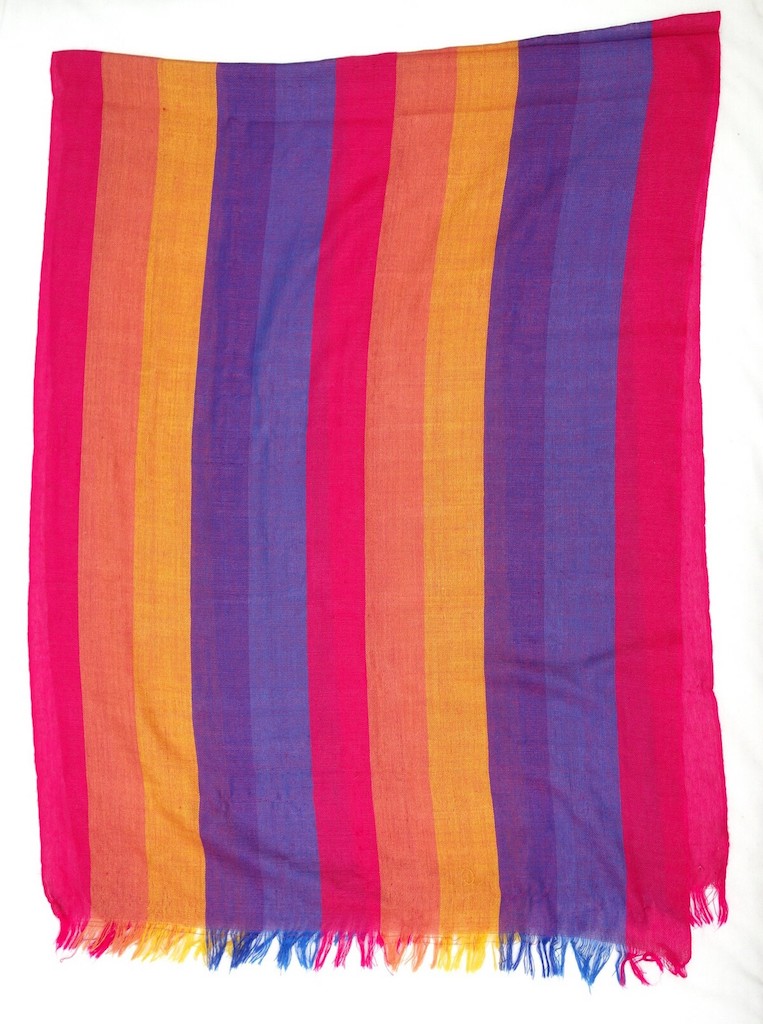
Woman's shawl inspired by the LGBTQ flag, Equador, c. 2002 (TRC 2019.1996).Woman's shawl inspired by the LGBTQ flag, Equador, c. 2002 (TRC 2019.1996).On Thursday, 12 September 2019, Shelley Anderson wrote:

Some recent colourful donations to the TRC mark the 50th anniversary of the modern movement for LGBTQ+ rights. One of these donations is a rainbow flag (TRC 2019.1995), which has been seen at celebrations around the world. The colours are reproduced on T-shirts such as the special 2019 Pride T-shirt designed by Viktor & Rolf for the HEMA department store chain (TRC 2019.1994), and the limited edition sneaker with rainbow coloured laces and soles by Converse (TRC 2019.1997a-b).

Rainbow colours are also used in the generous donation the TRC has received from the US tie company Ty-amo. They give the traditional male tie a make over and produce ties for both women and men because they want to break “…through outdated stereotypes—in society and in our closets.” Their ties, by designer Alex Summers, may be longer than the standard neckties and can be used as ties, head wraps, scarves or belts. Two special edition ties for the 2019 50th anniversary have been produced and kindly donated to the TRC for the upcoming digital exhibition on LGBTQ+ dress (TRC 2019.2002 and TRC 2019.2003).

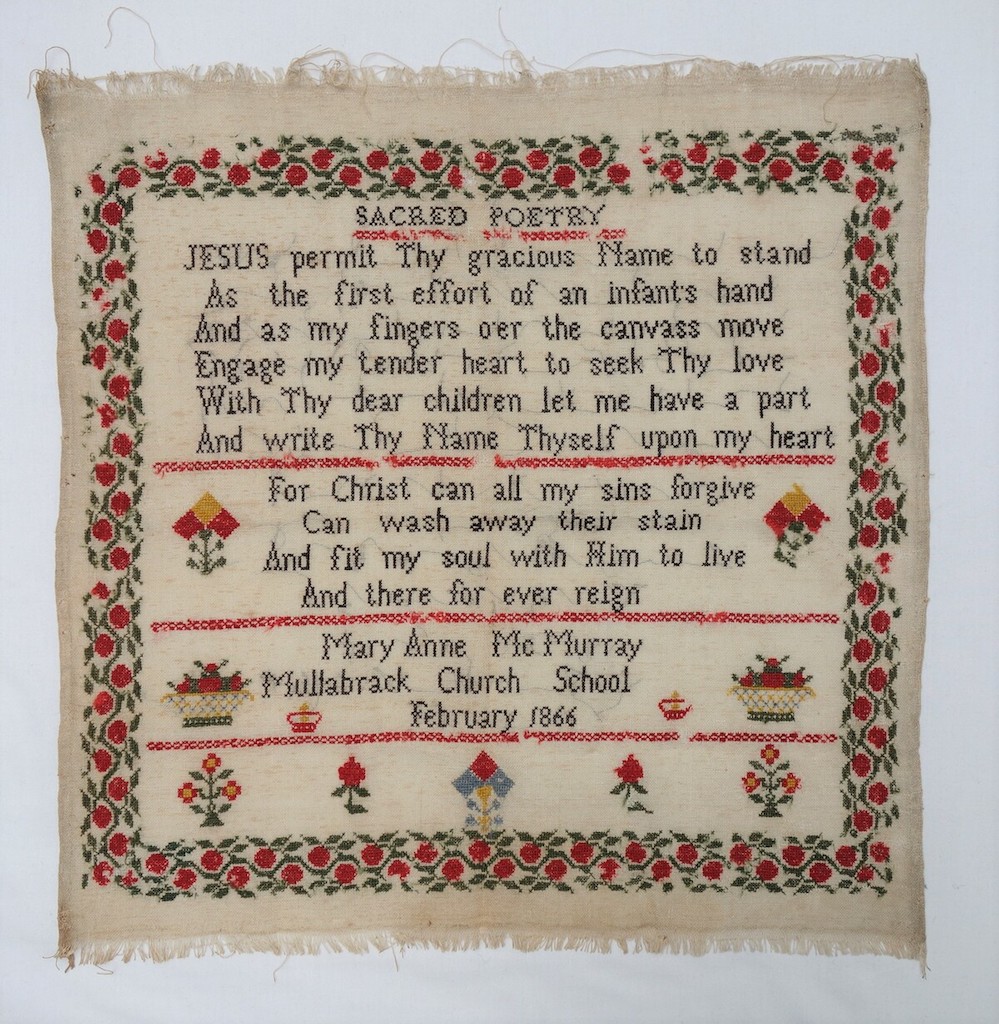
Sampler made by Mary Anne McMurray in 1866, Ireland (TRC 2019.2023).Sampler made by Mary Anne McMurray in 1866, Ireland (TRC 2019.2023).On Thursday, 12th September 2019, Gillian Vogelsang wrote:

The TRC Leiden has just acquired a sampler (TRC 2019.2023) worked in 1866 by a girl called Mary Anne McMurray, who went to the Mullabrack Church School, in Co. Armagh, Northern Ireland.

Mary Anne McMurray may be a girl with the same name who was born in Drumachee, near Mullaghbrack, in 1856. This would make her ten years old when the sampler was stitched. The stitching, it should be added, is consistent with embroidery of a school girl of that age. If this identification is correct, then she went on to marry Wallace Coburn (1828-1906) and had three children. She died in 1897 at the age of 41 and was buried in Lisnadill, Northern Ireland.

Mullabrack Church School was a Protestant primary school in the town of Mullabrack. The building still exists, but no longer used as a school.

Lies van de Wege and Amber Butchart at the opening of the Socks&Stockings exhibition. Photograph by Joost Kolkman, 2019.Lies van de Wege and Amber Butchart at the opening of the Socks&Stockings exhibition. Photograph by Joost Kolkman, 2019.On Saturday, 7th September, Gillian Vogelsang wrote:

The Socks&Stockings exhibition is now open! Thanks to the help of many people, notably Lies van de Wege and Chrystel Brandenburgh and their fantastic knitting crews, we have a very special exhibition. People are calling it colourful, warm, interesting, full of surprises and simply, it‘s GOOD.

What made everything so special was the presence of English fashion and dress historian, Amber Butchart, who officially opened the exhibition and gave a lecture on the history of European silk stockings. Twice in fact, because so many people registered for the lecture we asked Amber to do it again the following day. About 50 people came to the opening and both lectures were full with some 30 people attending each time. Her lecture was informative, well presented and not surprisingly there were many questions afterwards.

Amber had long heard about the TRC Leiden, but had never actually been before. She really liked our approach and the fact we have a ‘broad-based encyclopaedic collection’. She has already asked if she can use items from the collection for a couple of exhibitions and a book. Amber is planning to come back to Leiden on a regular basis and is more than willing to give more lectures on different aspects of European fashion history.

In addition, Amber has very kindly agreed to become an Ambassador for the TRC Leiden and tell her extensive network about what we are doing, what we can do and what we want to do in the future. Interesting days ahead! The exhibition will be open until Thursday, 19th December 2019.

A birthday cardA birthday cardOn Saturday, 7th September 2019, Willem Vogelsang wrote:

I was a bit puzzled lately about this phrase, used by such British luminaries as Boris Johnson. He used it, apparently under his breath, when talking about Jeremy Corbyn. I asked my own Brexit refugee here in Leiden about it, but she had no clue either. Admittedly, she has been living in Europe (!) for some 35 years and may have missed essential developments in English idiom. Also, she never went to Eton, which seems to preclude anyone from joining the ruling British establishment and the likes of Johnson (unless you marry a Russian plutocrat, but she hooked up with an impoverished Dutch academic).

Of course I could ask my mother-in-law, who some years ago told her hairdresser (I should not have listened to her telephone call) that she had a son-in-law who had a ‘reasonable’ command of English. (What about her command, I always wondered, she lived for a long time in Yorkshire, so who is the foreigner?) Should I ring her? Put her to the test? Perhaps better not. A call from Europe early in the morning would ruin anyone’s day in England.

Anyhow, what is this big girl’s blouse? At first I thought it referred to a blouse filled up by a big girl. Big, as in well-endowed (another recent development in the English language, I noticed). That, it soon became clear, was not the case.

So, my research (carried out in bed this morning), told me the phrase refers to a big blouse for a girl. So what does that mean? I have had to deal with the Brits for some time, and I know that the word ‘girl’ is not always appreciated when applied to, what I think is now called a young woman. So the ‘big girl’s blouse’ is apparently somewhat derogatory.

But what the heck is wrong with a big blouse for a girl /young woman? At that stage my research descended to the next level. I found a wonderful website that provided me with the information that I so urgently needed. The phrase seems to originate from northern England (well, my in-laws come from Yorkshire, so there you are; perhaps I should ring my mother-in-law after all).

When applied to a man it means that he is somewhat effeminate, but at the same time it is not really abusive. There is something teasing about it. The phrase seems to be used by now all over the Anglo-Saxon world, unknown to me (but I am European, so what do I know). There even seems to be an Australian feminist comedy series with that title. I am proud to say I did not know that either. So there you are: a girl’s blouse as an item of apparel has reached dazzling depths of fame. The world of dress is full of surprises.

For those of you who want to know more, click here

A huipil from San Lucas Tolimán, Guatemala, 20th century (TRC 2019.1838).A huipil from San Lucas Tolimán, Guatemala, 20th century (TRC 2019.1838).The past few weeks have been dedicated to getting the Socks&Stockings exhibition ready for the grand opening on Thursday (5th September). It is a surprising exhibition, full of warmth, colour and so many different techniques. A challenge to lovers of knitting and those who think they know all about hand knitted socks!

At the same time, we have been thinking about the TRC Collection, how to use it and how to further build up the sections on the Americas and Sub-Saharan Africa. Then all of a sudden, literally in the last week or so, we were given a selection of Guatemalan, Mexican and Peruvian textiles and garments from three different sources. We are now thinking about staging an exhibition about these garments and textiles, which will take place in 2021.

Just to give you an idea of what will be happening exhibition-wise at the TRC Leiden over the next few years, the Gallery plans are:

  • Autumn 2019: Socks&Stockings
  • Spring 2020: 200 years of American Quilts (Leiden Mayflower Year)
  • Summer 2020: Textiles, Garments and World War Two
  • Autumn 2020: Ties to History: A look at men’s neckwear and its links to historical people and events
  • Spring 2021: The Huipil: An essential Middle and South American garment with many facets
  • Autumn 2021 2000 years of Asian influences on Western textiles (an extended version of a pop-up exhibition held in the summer of 2019).

The vast majority of the objects in all of these exhibitions comes from the TRC, so confirming the scope and depth of its encyclopedic textile and dress collection!

Nigar Shukri and Maryan Koehler dressed in Kurdish clothing from the area of Urmieh, northwestern Iran (1974 or 1975).Nigar Shukri and Maryan Koehler dressed in Kurdish clothing from the area of Urmieh, northwestern Iran (1974 or 1975).On Tuesday, 20th August 2019, Gillian Vogelsang wrote:

Two boxes arrived last Friday (16th August 2019) from the USA, with some very different stories. The first box contained a small group of Iranian and Afghan garments that date from 1972-1975 (TRC 2019.1853a-1867). They were donated by Maryan Koehler. Some pieces were actually worn by Maryan at the time, while others were given to her when she worked in the country. More specifically, she was with the US Peace Corps teaching at the University of Isfahan, and between 1973 and 1975 she was at what was then called the Rezaiyeh College of Agriculture (now called Urmia University, in the northwest of the country) as a professor of English.

Maryan Koehler sometimes dressed in Kurdish clothing from the area. The Kurdish garments were given to her by her friend Nigar Shukri. Maryan Koehler is now tidying up and has been looking for a suitable home for her items. After looking on the internet she felt that the TRC Leiden understood these pieces and would make them available to a wide public.

Detail of a hand-embroidered huipil from Guatemala (Knobler donation).Detail of a hand-embroidered huipil from Guatemala (Knobler donation).


The second group of textiles (TRC 2019.1837-1849) helps to fill a ‘gap’ in the TRC Collection. Thanks to the generosity of Chuck and Carolyn Knobler, USA, we have been given a selection of huipil (women’s tops) and a shawl from Guatemala and Mexico. Most of these pieces date to the latter half of the 20th century and are made from locally woven cloth (back strap looms).They are decorated in a variety of techniques and styles, including woven and embroidered forms. Some of the embroidered examples will be used in a future publication about hand embroidery from the Americas.

Zoek in TRC website

Contact

Boerhaavelaan 6
2334 EN Leiden.
Tel. +31 (0)71 5134144 (kantooruren)  
office@trcleiden.org

Het TRC is elke dag geopend tussen 10.00 en 15.00 uur.

facebook 2015 logo detail


instagram vernieuwt uiterlijk en logo


Bankrekening

NL39 INGB 0002 9823 59, t.a.v. Stichting Textile Research Centre.

Financiële giften

Het TRC is afhankelijk van project-financiering en privé-donaties. Al ons werk wordt verricht door vrijwilligers. Ter ondersteuning van de vele activiteiten van het TRC vragen wij U daarom om financiële steun:

Giften kunt U overmaken op bankrekeningnummer (IBAN) NL39 INGB 000 298 2359, t.n.v. Stichting Textile Research Centre. BIC code is: INGBNL2A

U kunt ook, heel simpel, indien u een iDEAL app heeft, de iDEAL-knop hieronder gebruiken en door een bepaald bedrag in te vullen: 


Omdat het TRC officieel is erkend als een Algemeen Nut Beogende Instelling (ANBI), en daarbij ook nog als een Culturele Instelling, zijn particuliere giften voor 125% aftrekbaar van de belasting, en voor bedrijven zelfs voor 150%. Voor meer informatie, klik hier