• F2
  • F3
  • F4
  • F1

Op woensdag 13 mei werd het Nationale Textiel Festival feestelijk ingeluid in de Leidse Pieterskerk. Tijdens de opening, door burgemeester Henri Lenferink, vond de prijsuitreiking plaats van de internationale wedstrijd ‘Water-Land’. Van alle inzendingen waren er 54 geselecteerd. Vele bezoekers bewonderden deze prachtige kunstwerken van verschillende materialen. Veel aandacht trok de Haagse kunstenaar Lichel van den Ende met zijn performance ‘Selfcantus’.

In de Pieterskerk toonden vele professionele kunstenaars hun werk. Er werden techniekdemonstraties gegeven, o.a. kantklossen, weven, speciale borduurtechnieken, quilten en nog veel meer. Men kon ook diverse korte workshops volgen. Verder was er gelegenheid voor restauratie adviezen en taxatie. Ook de kraampjes met textielbenodigdheden waren aanwezig. Niet alleen in de Pieterskerk was het een drukte van belang. Ook de vele adressen van de textielroute werden druk bezocht. Over vijf jaar is er weer een Textiel Festival, misschien weer in Leiden.

Tineke Moerkerk, 17 May 2015

The last few days have been very busy in Leiden with respect to textiles. There were two major events, and several smaller ones. The two large events included the Textiel Festival Leiden: Ambacht en experiment (Leiden Textile Festival: craft and experiment) that lasted from the 13th - 16th May. The event was organised by STIDOC (Stichting Textiel Informatie en Documentatie Centrum) with the help of various other textile groups. There were over forty official venues in Leiden displaying, discussing and encouraging people to try different textile techniques. There were also shops and stalls selling everything you need and did not know you needed to make textiles of all different types. There were varous workshops about blackwork embroidery (Lien van den Hoogen), about spinning and weaving with newspaper (Renée Campagne) and about bobbin lace making (Ephrem Muskee).

The textile events and exhibitions in Leiden included plants and plant dyes, and dyeing with natural dyes, at the Hortus Botanicus. The SieboldHuis showed its exhibition of Itchiku Kubota kimonos. There were ikats at the Volkenkunde Museum. The Weever's Huis displayed a collection of modern double weave textiles, while the TRC displayed its exhibition about the Street of the Tentmakers, Cairo.

At the same time the ETN (European Textile Network, http://www.etn-net.org/etn/211e.htm) organised its 17th annual meeting in Leiden, with numerous lectures and workshops on different textile themes - there were complaints that people were forced to choose between really interesting lectures and seeing the festival itself - it made for some hard descisions.

The festival ended on Saturday 16th May, but there was a mini-symposium on Sunday 17th at the SieboldHuis about Itchiku Kubota and his kimonos with three speakers: Linda Hanson the curator of the current exhibition, talking about kimonos in general; Dale Gluckmann, a freelance textile curator talking about the background to Itchiku Kubota and his kimonos and finally, Jacqueline Atkins who talked in detail about the master dyer himself and what he wanted to achieve by trying out different materials, dyeing techniques, designs, and so forth. She discussed his great concern with the function and future of the kimono and his artistic vision that led him to fashion ideas that some traditional kimono lovers found abhorrent , including the cloth used, the designs on the kinomos and how a kimono could be worn in a 21st century manner with Western style high heelded shoes!

Gillian Vogelsang-Eastwood, 17 May 2015

Some really nice news. An international award has been granted to Kim Beamish for his documentary 'The Tentmakers of Cairo'. Kim has been helping with the setting up and organisation of the current TRC exhibition on The Street of the Tentmakers in Cairo, Egypt. The Prix Buyens-Chagoll is awarded to a film of humanist dimensions focusing on stories that confer meaning to the future of mankind. It is said: "Kim Beamish blended in with a group of men as if he were one of them, freely recording their daily lives as craftsmen making carpets. Lives that are forcefully woven into the political situation in Egypt today and the current state of crisis. The filmmaker also reveals the beauty of the carpets created by these virtuoso craftsmen. Another aspect that touched us was the desire to transmit millennial expertise, which is accepted humbly and naturally by younger generations." The TRC exhibition remains to be seen until 2 July.

Gillian Vogelsang, 25 April 2015

Following up on previous blogs, we can now relatively safely identify the embroidered kerchief from Stadskanaal. In the previous blog, we tentatively linked the kerchief to the internment camp 'Ons Belang', constructed in Stadskanaal immediately after the end of World War II, in order to house former collaborators with the Germans. We now have confirmation of this hypothesis: One of the embroidered names is that of Tony Bijland, to whose name is added the embroidered word 'zwemster' (swimmer [fem.]).

Tony Bijland was a female swimming champion who was particularly active in the early 1940s. Born in 1923/24, she trained in Hilversum with the HZC swimming club. In various war-time newspaper articles she is linked to the 'Nationale Jeugdstorm' (the Dutch variant of the Hitlerjugend). She joined the 'European youth swimming championships' in (German) Breslau in 1941. She was interviewed for the Deutsche Zeitung in den Niederlanden (Thursday, 13 July 1944; with photograph). Whether or not she sympathised with the German occupying forces remains unknown. We should not forget she was very young at the time, but it does explain her presence in the internment camp in 1945. How she ended up there, and how and why her name appeared on an embroidered handkerchief, remains a moot point.

Gillian and Willem Vogelsang, 14 April 2015

The plot thickens. Last week we told you about a commemorative kerchief from Stadskanaal, a small town in the northeast of The Netherlands. We added that the kerchief included the embroidered signatures of some twenty-five names, plus references to the town of Stadskanaal, the name of 'Ons Belang', and two dates in the year 1945. This week we have received really interesting information from various sides.

As a result the story has unexpectedly taken a new twist. As pointed out to us (Deandra de Looff, many thanks!), the name of 'Ons Belang' was not only that of the local straw board factory, but also that of a temporary internment camp for men and women arrested for collaboration with the Germans. In fact, the camp was 'opened' on 7th May, some three weeks after the liberation of the area, and remained in use well into 1946. The camp was located on the premises of the straw carton factory, 'Ons Belang', hence of course the name of the camp. The initials J.K. that were embroidered on the kerchief, as we initially read them, could in fact also be read as I.K., for 'Internerings Kamp', as Deandra de Looff suggested. Furthermore, the embroidered names, as suggested by another correspondent, are not local, and likely represent people from outside Stadskanaal (thank you, Jacco Pranger).

The dates on the kerchief, which could be read as 17 May 1945 and 5 September 1945, may have been of great importance to the camp, the internees or their guards.

We will continue this intriguing piece of research, based on a simple handkerchief given to us by the owner of a local Leiden curio shop. It may well reflect a darker and hidden aspect of Dutch post-war history. We will keep you posted.

Gillian and Willem Vogelsang, 12 April 2015

Saturday, 4th April 2015: While visiting a curio shop in Leiden, we were looking at some old textiles, including part of a mid-19th century Cashmire style shawl. But among the various textile items there was also an embroidered kerchief worked in a red and beige cotton thread. It is an example of a commemorative embroidery, albeit on a small scale. The embroidery includes a central text that reads Stadskanaal J.K. 17-5-1945 Ons Belang 5-9-45. Surrounding it are numerous signatures.

Embroidered kerchief, internment camp, 1945. TRC CollectionEmbroidered kerchief, internment camp, 1945. TRC CollectionStadskanaal is a town in the province of Groningen in the northeast of the Netherlands. Ons Belang ('Our interest') was the name of a company producing straw-board.  It was opened in 1910, one of numerous socialist co-operatives that were established in the early 20th century in the Netherlands. The date on the embroidery is no doubt of particular importance: the nearby major town of Groningen was liberated from the Germans by mainly Canadian troops in mid-April 1945.

Ons Belang changed its name several times in the 1960s and 1970s and in 1978 the company was closed down. If you have any information about the people, company or what happened on the 17 May 1945 at the company please let us know.

Gillian and Willem Vogelsang, 4 April 2015


Perhaps I am becoming a bit of a fetishist, but after my blog of last week about some Afghan young men wearing a burqa to protest against the suppression of women's liberties in Afghanistan, there is another media report that drew my attention, again from Kabul. This time it is an Afghan performance artist, the 27-year old Kubra Khademi, who for eight (!) minutes walked the streets of Kabul wearing a kind of suit of armour over her normal clothing, with large metal breasts and buttocks, to protest against, as it is reported, the endemic harassment she and other Afghan women have to endure when they go out into the streets. A brave gesture, since she had to go into hiding after her performance. Yet, she told the reporter that there was one young boy, about ten years old, that got the message: "Look at that girl: she does not want to be touched."

Willem Vogelsang, 12 March 2015

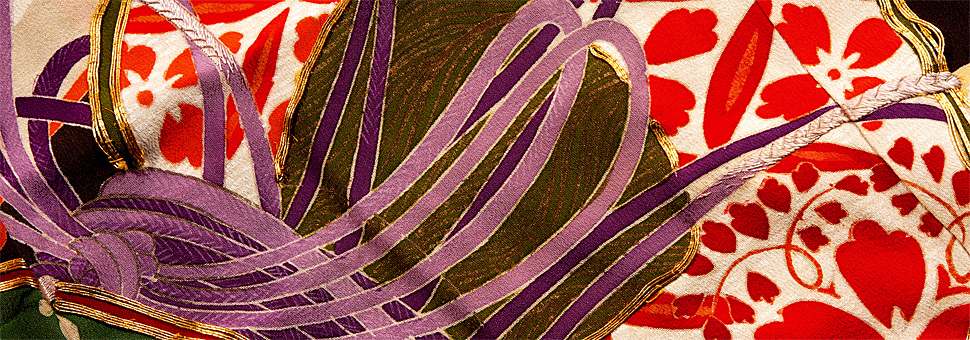
Last night a friend and I went to the opening of a new exhibition, called Zijden Pracht (‘Silk Splendour’) at the Japanmuseum SieboldHuis, Rapenburg 19,Back of a Japanese kimono created by Itchiku Kubota, on display in the SieboldHuis, Leiden, The NetherlandsBack of a Japanese kimono created by Itchiku Kubota, on display in the SieboldHuis, Leiden, The Netherlands Leiden, The Netherlands. The kimomos on display come from the Kubota Collection, Japan. The exhibition is curated by Linda Hanssen.

The exhibition focuses on the hand dyed kimonos made by the Japanese master textile dyer, Itchiku Kubota (1917-2003). Some of the kimonos took forty dye baths, 300 colours and up to a year to be created. The garments can be viewed (and worn) as individual items, but some of them were made and decorated as part of a series ('winter', 'autumn', 'universe') and can thus be placed next to each other to create a scroll-like painting, with the design moving from one kimono to the next. The attention to detail, in the main design, background patterns, and the overall effect, is truly amazing. These are the work of someone who has not just mastered his craft, but has shown to be a true genius.

There are sixteen kimonos on display and they are truly unbelievable. If you have the chance to see the garments then it becomes much easier to understand the intense amount of work involved in creating just one of these kimonos, let alone the various series. And it will leave you reeling.

The exhibition will be on display until the 31st May 2015, and if you are in Leiden then this is a MUST for anyone who loves textiles. It is not often you get a chance to see such works of art (literally) and these kimonos are simply and utterly stunning items.

Gillian Vogelsang, 7 March 2015

Zoek in TRC website

Contact

Boerhaavelaan 6
2334 EN Leiden.
Tel. +31 (0)6 28830428  
office@trcleiden.org

facebook 2015 logo detail


instagram vernieuwt uiterlijk en logo


Bankrekening

NL39 INGB 0002 9823 59, t.a.v. Stichting Textile Research Centre.

Openingstijden

Het TRC is gesloten tot maandag 4 mei vanwege de verhuizing naar de Boerhaavelaan. We blijven bereikbaar via email (office@trcleiden.org) of telefoon: 06-28830428.

Financiële giften

Het TRC is afhankelijk van project-financiering en privé-donaties. Al ons werk wordt verricht door vrijwilligers. Ter ondersteuning van de vele activiteiten van het TRC vragen wij U daarom om financiële steun:

Giften kunt U overmaken op bankrekeningnummer (IBAN) NL39 INGB 000 298 2359, t.n.v. Stichting Textile Research Centre. BIC code is: INGBNL2A

U kunt ook, heel simpel, indien u een iDEAL app heeft, de iDEAL-knop hieronder gebruiken en door een bepaald bedrag in te vullen: 


Omdat het TRC officieel is erkend als een Algemeen Nut Beogende Instelling (ANBI), en daarbij ook nog als een Culturele Instelling, zijn particuliere giften voor 125% aftrekbaar van de belasting, en voor bedrijven zelfs voor 150%. Voor meer informatie, klik hier