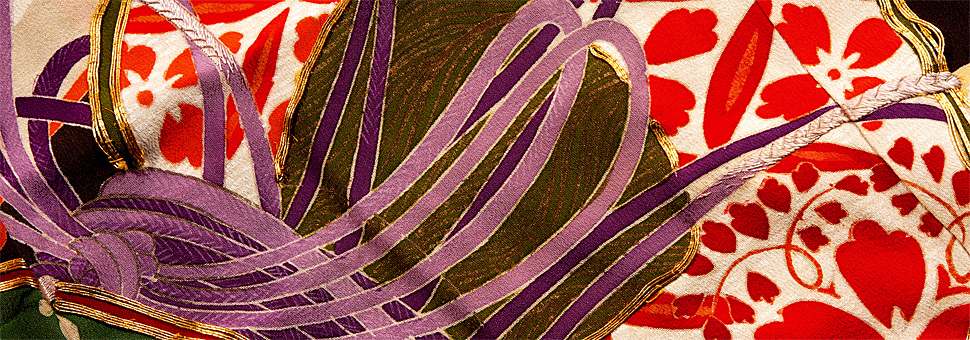

The last few days we have been busy visiting various museums and cathedrals in northern France as part of the TRC’s work for volume 4 of Bloomsbury’s World Encyclopedia of Embroidery, namely, Scandinavian and Western European embroidery. Part of the trip, it should be added, has been financially supported by a travel grant from DutchCulture (Amsterdam).
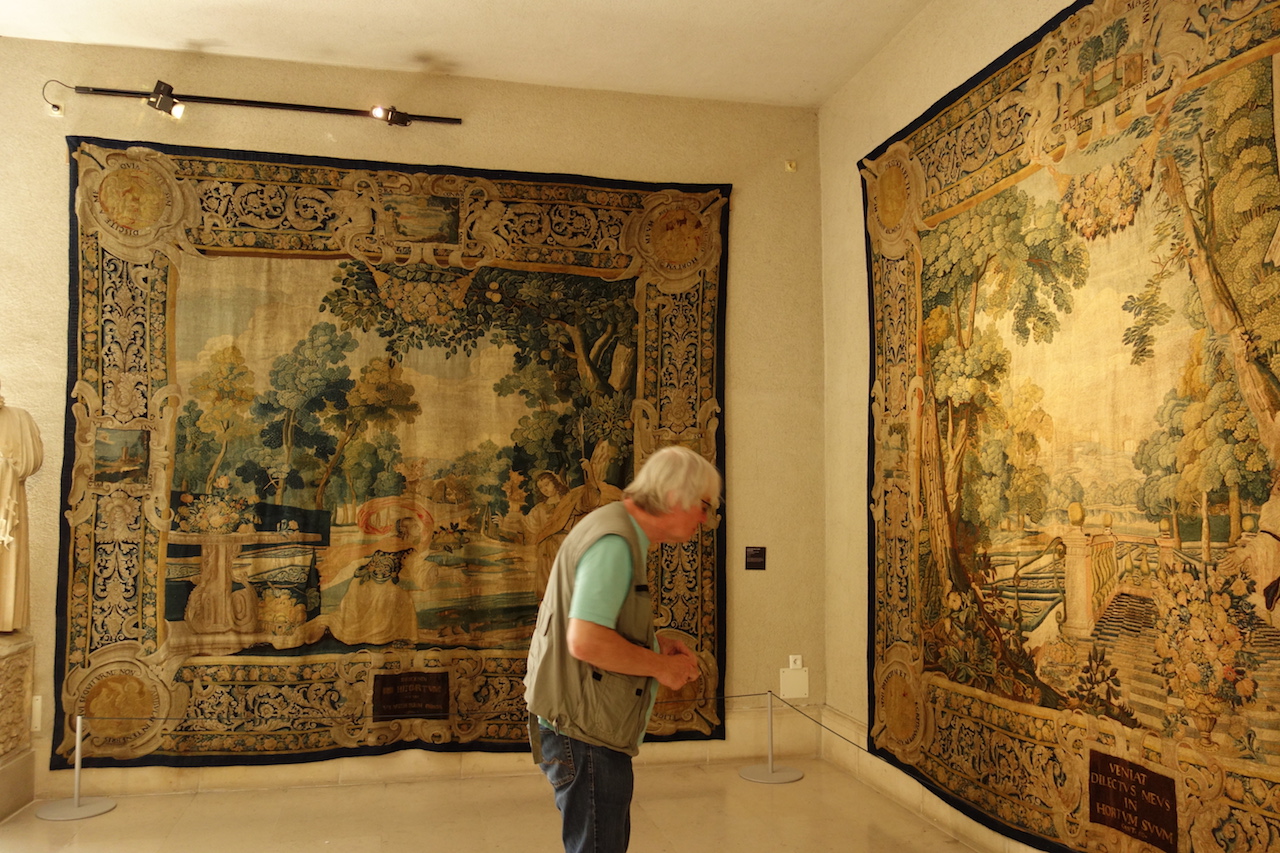 Willem looking at one of the four embroidered wall hangings (photograph author).
The first day, after an early drive from Leiden, was spent in Reims to see the famous mid-17th century series of four embroidered wall-hangings that are now in the Palais du Tau. The building itself is the former palace of the archbishop of Reims (built in the shape of the Greek 't', hence the name) and is associated with the kings of France whose coronations took place in the adjoining cathedral, which was sadly almost completely destroyed during the First World War, but has since been magnificently rebuilt.
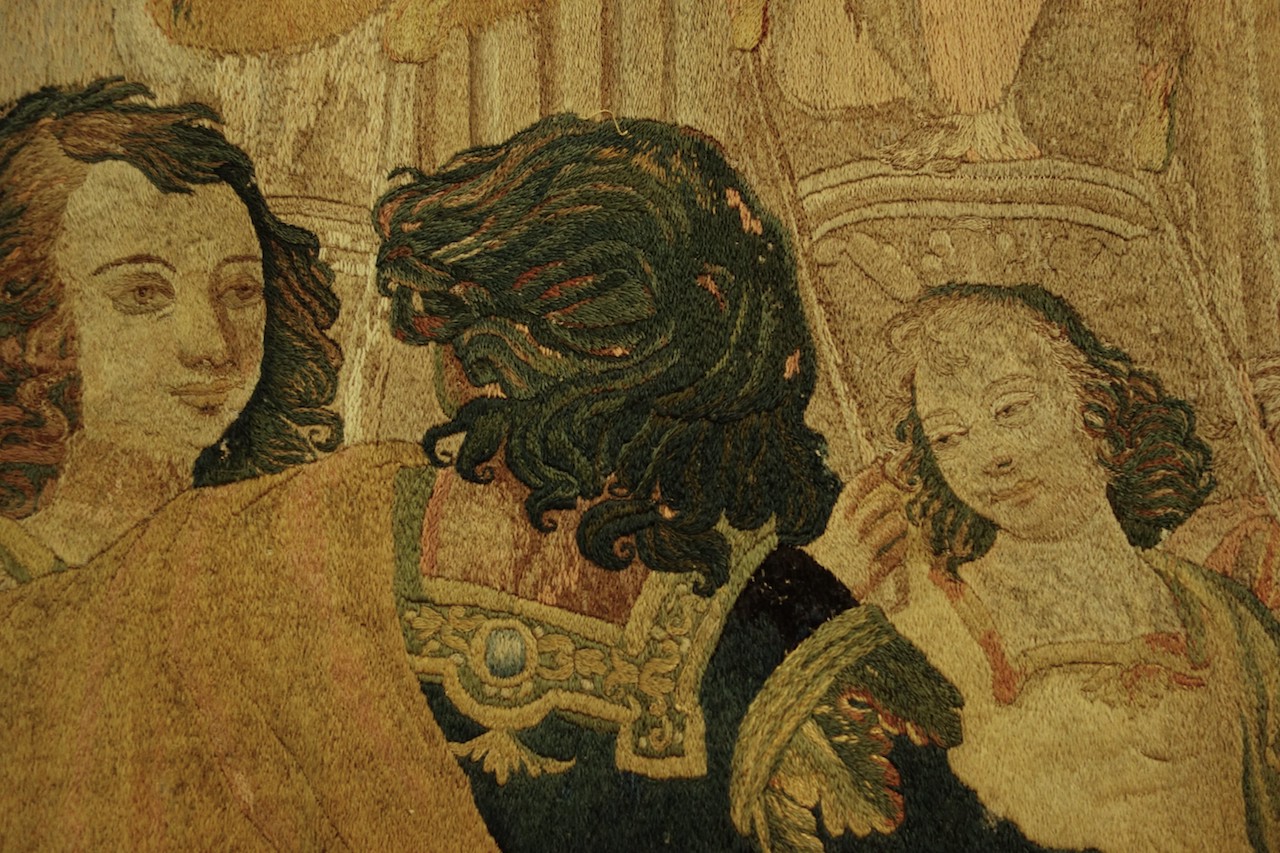 Detail of one of the embroidered wall hangings in the Musée du Tau, Reims (Photograph author).
The Palais houses some fantastic woven tapestries, but we were especially attracted by the four embroidered wall hangings, which each measure some three by four metres. They are of the type often called needle paintings, but unlike others they are worked in free-style form.
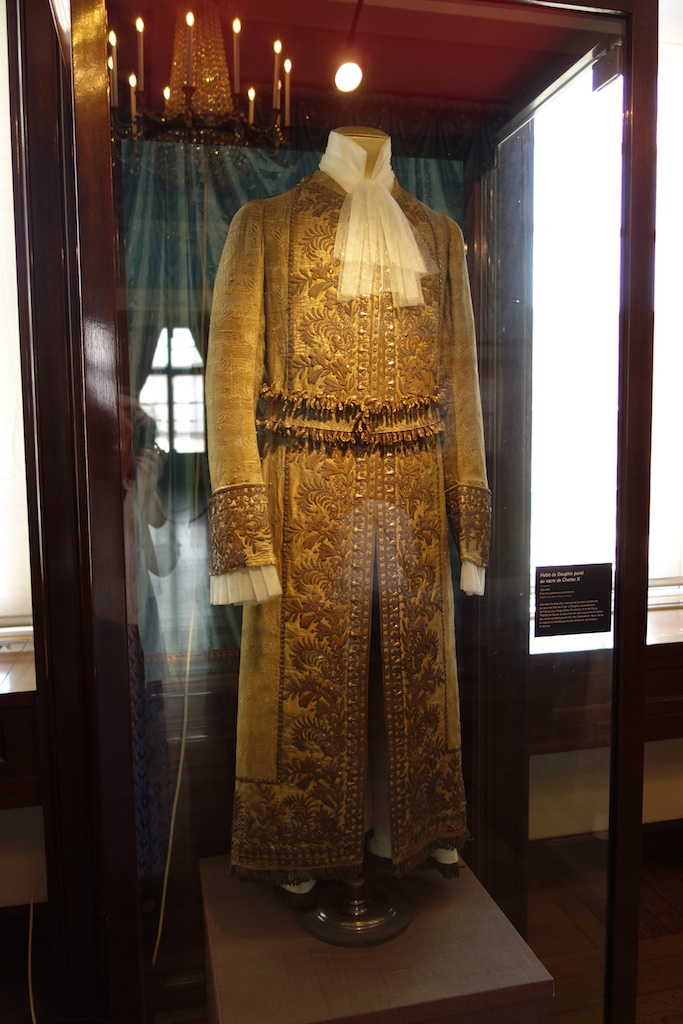 Embroidered outfit of Louis Antoine de Bourbon, for the coronation of his father, Charles X (photograph author).The wall hangings have a common theme, namely "The Song of Songs” (Le cantique des cantiques) and include: The Union of the Bride and Groom; The Bride meets the Groom at the Entrance to the Garden; The Bride in the Garden of the Beloved, and The Beloved with the Bride in the Garden.
The hangings were ordered by Marguerite Gomyn, widow of Pierre Dufour, on the marriage of one or more of their sons between 1645-1655. The embroideries were probably carried out by specialist embroiderers in a convent. The ground is made of linen that is totally covered with filling stitch, with some couched gold thread (passing), using woollen yarns in a variety of colours. Spectacular!! These items will certainly feature in the Encyclopedia.
 Blue plaque commemorating Charles X of France, who lived in exile at 72 South Audley Street, Mayfair, London, between 1805 and 1814 (photograph Wikipedia).Also on display in the Palais du Tau were various densely and luxuriously embroidered garments linked to the coronation of Charles X in 1825. Charles X, it may be added, was King of France from 1825 and 1830. He was the younger brother of Louis XVI (who was executed in 1793) and Louis XVIII. Very intriguing were the elaborately decorated garments worn at the coronation by his eldest son, the Dauphin (Louis Antoine de Bourbon, 1775-1844).
Something else we noticed at the entrance to Reims cathedral were sculptured, hanging curtains, which we couldn't help comparing to painted curtains that we saw in the Sistine Chapel in Rome (see an earlier blog) and, of all places, in Assen in the northeast of the Netherlands (see blog).
Sunday afternoon, after our visit to Reims, we drove on to Sens, southeast of Paris, to see the relics of Thomas Becket, but that is for the next blog.
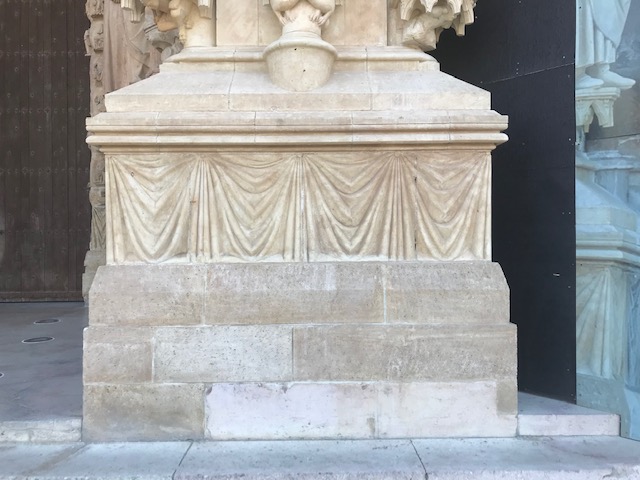 Sculptured, draped curtains at the entrance to Reims cathedral (photograph Willem Vogelsang).
Gillian Vogelsang, 5 July 2022
For more information about the Reims tapestries and embroidered wall hangings, an open access PdF file can be downloaded here.