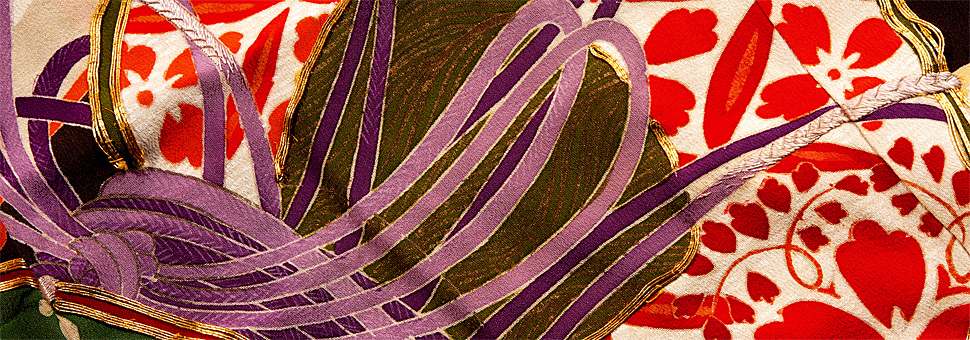
On Monday, 13 April 2020, TRC volunteer and TRC Facebook guardian, Shelley Anderson wrote:
The lovely poppies printed on cotton published on 12 April on the TRC homepage, reminded me of a time when embroidered flowers were considered as much a science as a craft. In the eighteenth century there was a fashion for needle painting. Skilled embroiderers would meticulously reproduce an oil painting using embroidery and shaded silk threads. And one of the most skillful and celebrated needle painters was a woman named Mary Delany (1700-1788), famous for her botanical needlework.
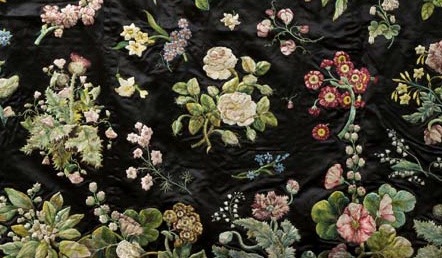 Example of needlework by Mary Delany.
Mary was educated in London (one of her teachers was the composer Händel), until a change in her family’s fortunes meant, at age 17, that she was married against her will to a much older man. Desperately unhappy, she threw herself into needlework and into botanical painting. After her husband’s death she continued these passions, visiting famous plant collectors to study their collections, and even growing exotic plants herself in her eleven-acre garden in Ireland. She would dissect and study plants carefully, then recreate them in her embroideries. Her letters state that she embroidered church furnishings with different roses, with oak leaf borders; in the Ulster Museum (N. Ireland) some of her needle work survives, decorated with violets, auriculas, geraniums, poppies or Madonna lilies.
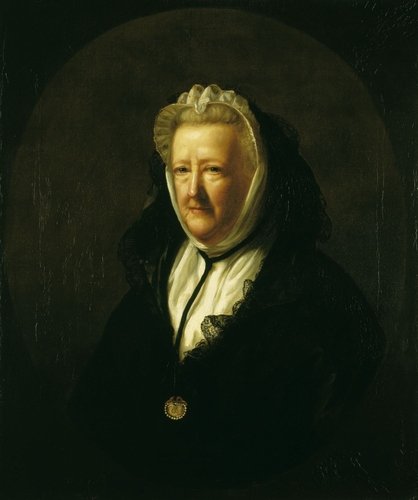 Mary Granville, Mrs Delany (1700-88), by John Opie (1782), and commissioned by King George III. Courtesy of the Royal Collection Trust (RCIN 400965).
A memorial plague in St James's, Piccadilly, says: 'She was a lady of singular ingenuity and politeness and an unaffected piety. These qualities endeared her through life to many noble and excellent persons and made the close of it illustrious by procuring for her many signal marks of grace and favour from their Majesties.'
Her skill in both painting and needlework was such that she gained Queen Charlotte’s royal patronage. One of Delany’s most famous accomplishments was a court dress she wore to the 1751 birthday ball of Frederick Prince of Wales. The black silk overskirt featured over 200 species of full coloured, embroidered flowers, from anemones to tulips, jasmine to sweet peas. Some of the flowers were padded to give a three-dimensional effect.
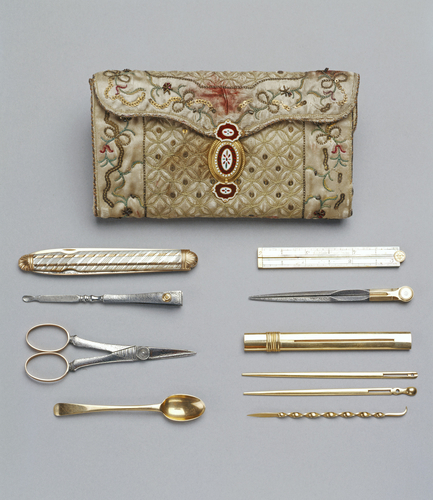 Needlework pocket-book with sewing tools, probably decorated by Queen Charlotte and given in 1781 to Mary Delany. Courtesy Royal Collection Trust, RCIN 45126.
While many of the flowers she embroidered and painted may be familiar to us today, it’s important to remember that many were also exotic imports at the time. With no photography or photocopying available, her embroideries and paintings were a way to disseminate new botanical discoveries. Her ten volume set of some 1000 cut paper flowers is now housed in the British Museum. I only wish more of her embroideries were in museums today.
For more on Mrs Delany, click here for an article in The Gardens Trust, 7 July 2018.