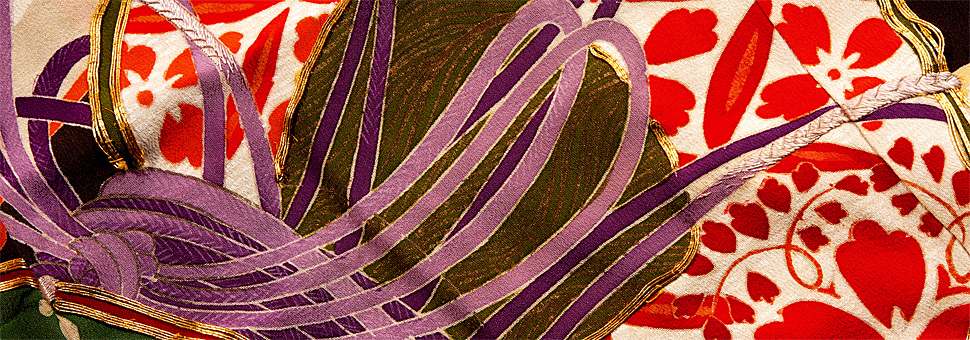
 Detail of an Indian shawl with the buteh motif, 20th century (TRC 2017.1351).A lot has been written in recent years about cultural appropriation. We published a blog about this trendy concept some years ago (13th March 2016). Cultural appropriation, in brief, refers to the borrowing of a specific aspect of one culture and deliberately using it in one's own. It is about Europeans wearing a kimono, or people in Iceland wearing a sombrero.
I cannot, and could not take this discussion, which started in the US, too seriously; borrowing from other cultures has always been going on under the general term of adopt and adapt. Humanity would be very poor if people did not look beyond their own village. And I do enjoy a pizza, although I am not Italian.
Yet, last week I was confronted with what I would call a 'real' and indeed blatant example of cultural appropriation.
We were involved in an online conference called 'Textiles on the Move' (6-9 October 2020), organised by the International Institute for Asian Studies (Leiden), the Tracing Patterns Foundation (Berkeley) and the TRC Leiden. During the conference I gave a short presentation about the buteh-paisley motif, with a brief history and an introduction how the motif, which originated, with the name of buteh, hundreds of years ago in the Iranian/Indian cultural orbit, and via the Scottish town of Paisley, is now being applied throughout the world and has a pervasive influence on Western fashion and garments.
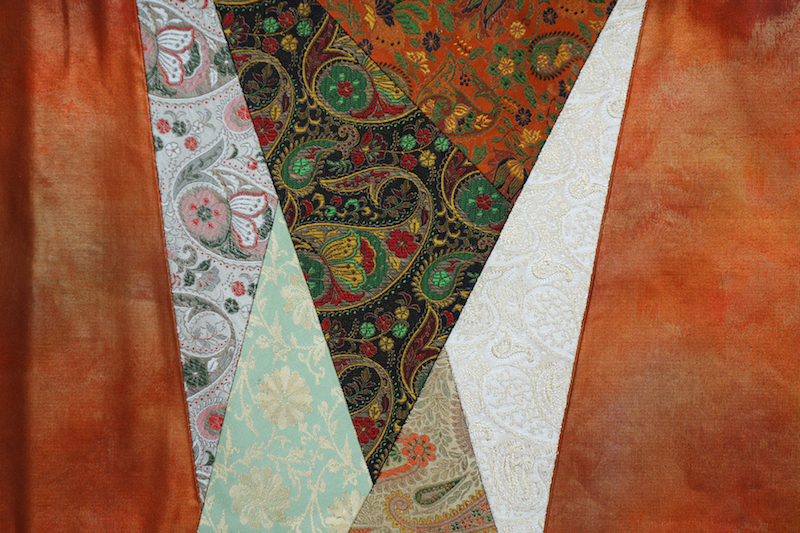 Detail of a Japanese sash (obi) for a woman, late 20th century, with various paisley motifs (TRC 2020.3936).One of the questions I was asked during the webinar concerned the question of copyright. Has the motif ever been copyrighted and indeed could it be patented, given its long history of hundreds of years and its widespread use throughout the world? My immediate reaction was no, it cannot be. It would be like trying to patent a circle, although specific versions and more ornate forms of the motif might be patented or registered.
My second reaction was to google and I came across an interesting and relevant article in the Scottish newspaper, The Herald (12th April 2003). The article was called “Paisley patterns all fashion in Japan. Design giant snaps up rights to market motif in Far East”. The story highlights the global popularity of the motif and how a large Japanese design giant (Kanebo Fashion Research) has 'bought' the rights to use various variations of this motif from the Scots in Paisley.
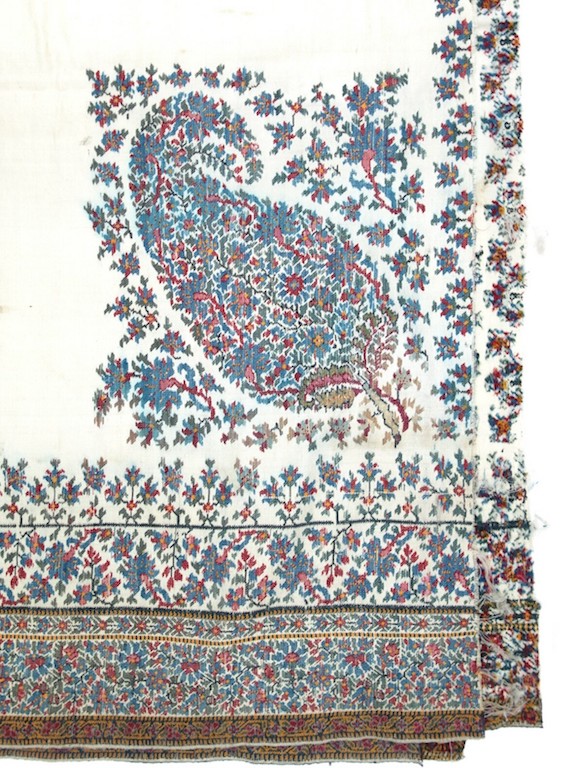 Detail of a European shawl from the 19th century with the buteh/paisley motif (TRC 2019.2029).According to the anonymous journalist the motif was very popular in East Asia because 'Japan loves Scotland for its culture and heritage. The further away something is, the more interest the Japanese have in it." The journalist then stated that ''The Paisley motif is very popular in Japan because it means high quality, and the Japanese have a high regard for historical accuracy and authenticity.'' It was also noted that the pattern was developed by weavers in the town of Paisley (Renfrewshire, south of Glasgow) 200 years ago.
This statement was reinforced by the words of Valerie Reilly, who was keeper of textiles at the Paisley Museum who said: ''The Paisley Pattern is very important to Paisley's economic and cultural history and it's wonderful to think that the patterns developed here 200 years ago by the Paisley weavers still attract international attention and will now be worn again.''
Hmmmmm, there are various points I would like stress: The motif is much older than 200 years. It originated in Iran (not in Paisley). It was introduced to India, came to Europe in the late 17th century, became popular by the 18th century and then it went to Paisley. It is certainly not Scottish in origin. Also it has never gone out of fashion in the 19th and 20th centuries. it may not have been continually used in high end fashion, but it never went out of popularity! It can still be found in many countries, from the Americas, Europe, to Africa and East Asia.
 The new logo of the Renfrewshire Council, with a paired buteh/paisley motif.But the story continues and gets even more intriguing: Another article in The Herald (29th April 2017) was called “Paisley bids to find pattern for success by protecting brand”. In this article, the question of branding, copyright and licensing of the paisley motif was raised and noted by George Adam, Paisley MSP. He said: “The idea of licensing the Paisley patterns produced by manufacturers in Paisley’s past is very interesting. There are a number of Paisley shawls which are noted as having national significance in the Paisley museum. These patterns could be subject to some form of protection.”
Really?
A few years ago the Renfrewshire Council adopted a new logo, based on what has been called the Paisley Teardrop motif. But, it is still the buteh/paisley motif!
Now all of this is what I would call Real Cultural Appropriation.
Gillian Vogelsang, 10th October 2020.