

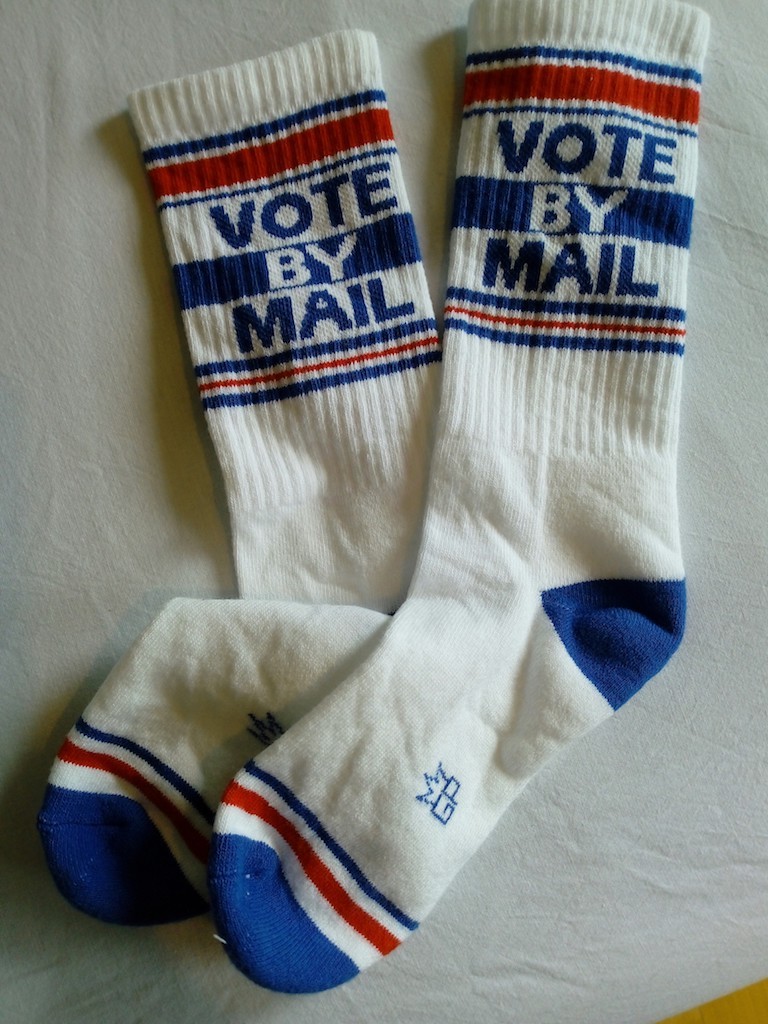
 Pair of socks with the text, "Vote by mail", USA, 2020 (TRC 2020.4198a-b).Over 400 women’s marches took place in all fifty US states yesterday (17 October 2020). The marches drew hundreds of thousands of women together, both in person and virtually, to encourage other women to vote in the upcoming US presidential election, and to honour the legacy of deceased Supreme Court Justice Ruth Bader Ginsburg. Many marchers wore ‘dissent collars’ (see TRC blog 10 December 2018) and pink pussy hats.
The Textile Research Centre (TRC) in Leiden has two pussy hats (TRC 2017.0186 and TRC 2017.0187) in its collection. Pussy hats are hand-made, square-shaped caps made from wool or acrylic yarn, usually coloured pink. They can be knitted, crocheted or sewn.
After Donald Trump won the US presidential election in November 2016, American knitters campaigned to make more than one million of these hats, to be given as gifts for marchers to wear at the first 2017 Women’s March in Washington, DC. The hats became so popular that American craft shops reported running out of pink yarn. Pussy hats could be seen at Women’s Marches in Amsterdam, Rio de Janeiro and Tel Aviv.
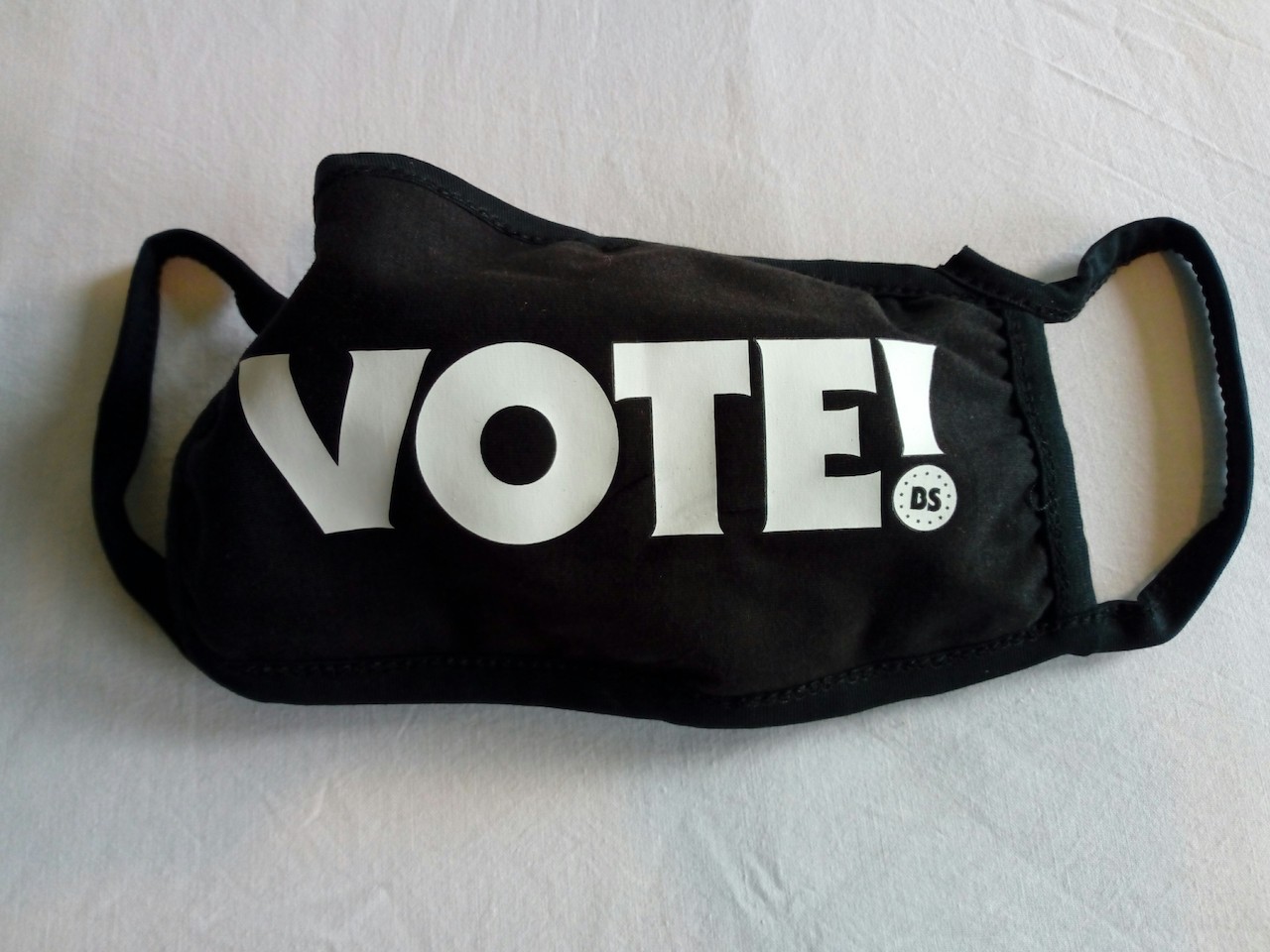 Face mask with the text "Vote!", USA, 2020 (TRC 2020.4199).When a pussy hat is worn on the head, two tips appear, similar to a cat’s ears. This is not the origin of the cap’s name, however. The word ‘pussy’ in English is an insulting term for a woman’s genitals and reflects lewd remarks made by Donald Trump about women.
Outraged by the remarks, knitters Krista Suh and Jayna Zweiman of Los Angeles, California (USA), thought of creating a symbol for women’s solidarity and so launched the Pussyhat Project: "It's reappropriating the word 'pussy' in a positive way….Wearing pink together is a powerful statement that we are unapologetically feminine and we unapologetically stand for women’s rights." (see TRC blog 23 February 2017 for more information).
Many of yesterday’s marchers also sported T-shirts and face masks with messages encouraging people to vote. The TRC has recently acquired a face mask (TRC 2020.4199), and a pair of socks (TRC 2020.4198a-b), with similar messages, showing once again how versatile and political textiles can be.
Shelley Anderson, 18 October 2020