

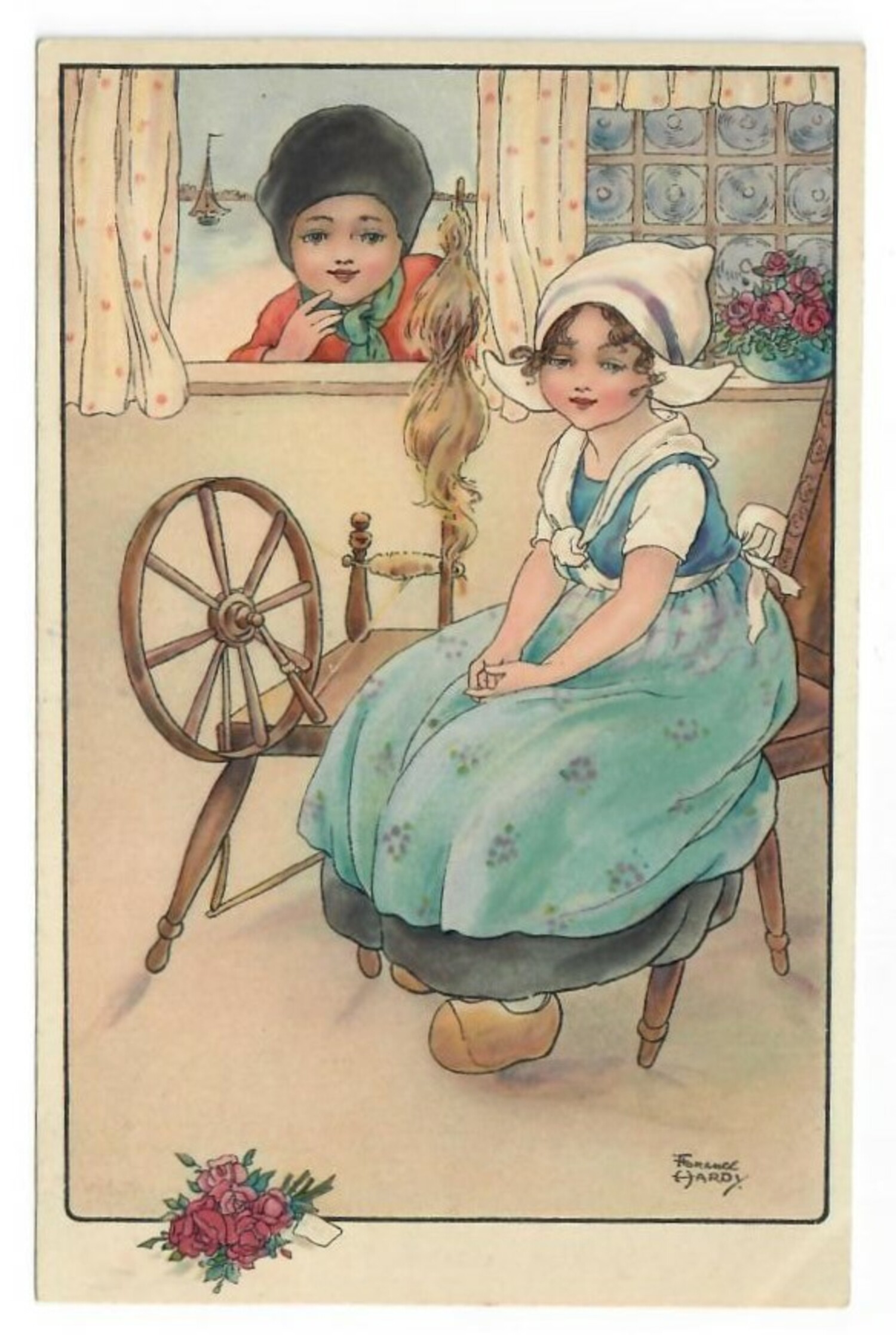
 Postcard from Belgium, franked on 13th August 1914, depicting a boy and girl in Volendam (NL) style cloth. The girl is sitting next to a spindle wheel with distaff. The image was painted by Florence Hardy (TRC 2020.4250).A little while ago we were contacted by Padma Rubiales, California, about a collection she had made of early postcards that depict spinning wheels. She had offered the cards to various museums in the USA, but sadly no one wanted them. Were we at the TRC in Leiden interested in having them as a donation?
We were intrigued and said yes, partly because we want to increase the TRC's collection of old prints, postcards and photographs (these are really useful in illustrating publications and exhibitions), and partly because many of us like spinning!
The postcards arrived a few days ago and I am so pleased we said yes. Not simply because they show many different types of spindle and spinning wheels. They also illustrate a range of dressed distaffs, as well as women using drop spindles. There are also some related techniques, such as a woman with a piece of embroidery.
The postcards depict women from a variety of different countries, including Ireland, Sweden, Switzerland, USA, Wales, The Netherlands, as well as Algeria and Japan. Most of the postcards date from the late 19th century until the 1930's. A number of the cards are franked and so we have the date when they were posted.
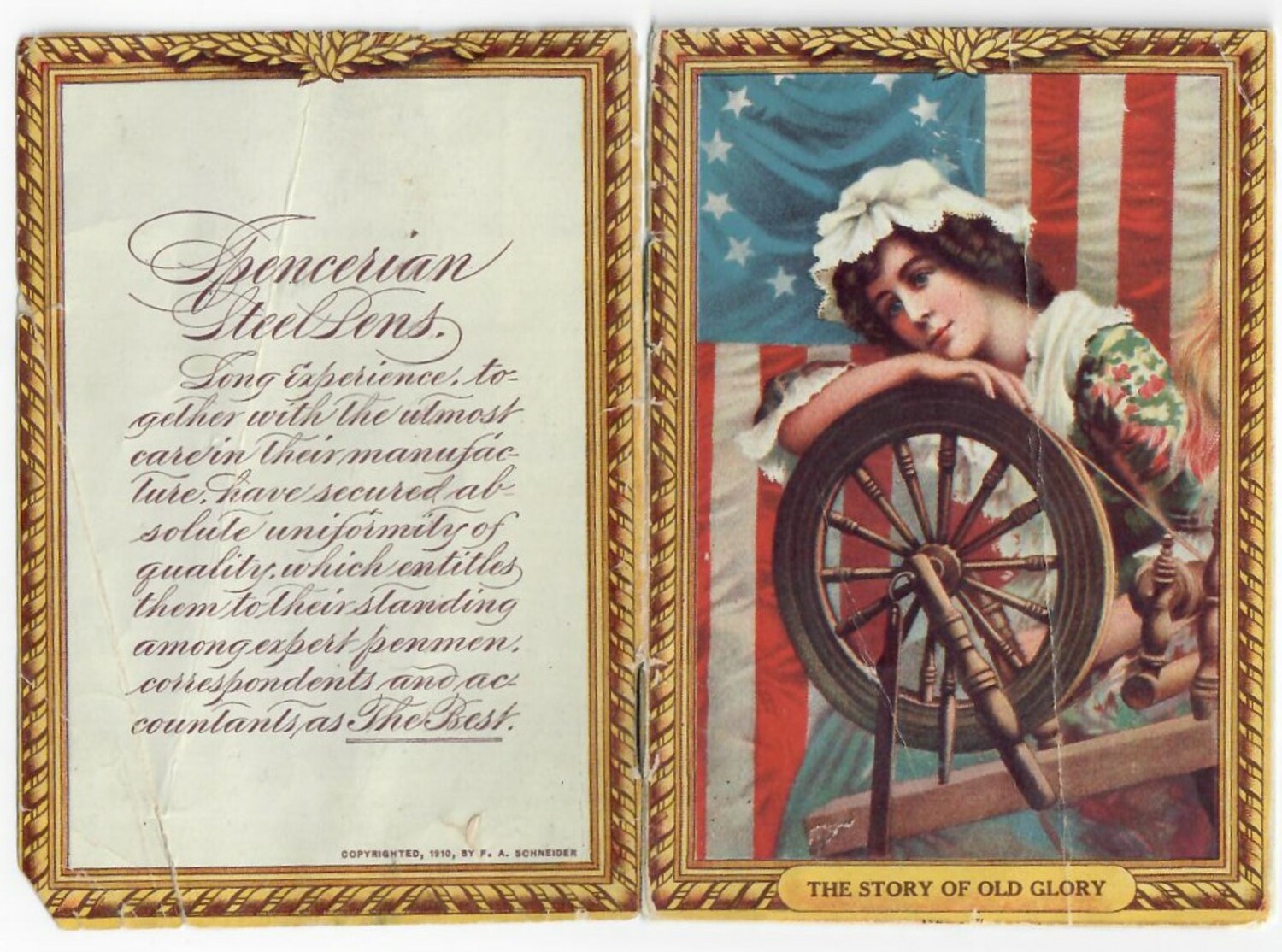 Early 20th century American booklet depicting a woman next to a spinning wheel and the text: "The story of Old Glory" (TRC 2020.4243).
The range of wheels that is being depicted is astonishing (including spindle, spinning, horizontal, vertical, castle, travellor and Great Wheel). Amazing are also the many different ways in which the various distaffs are dressed. It is quite clear, however, that some of the photographs are very theatrical; it is sometimes doubtful whether the 'spinner' could actually spin. Others are more realistic.
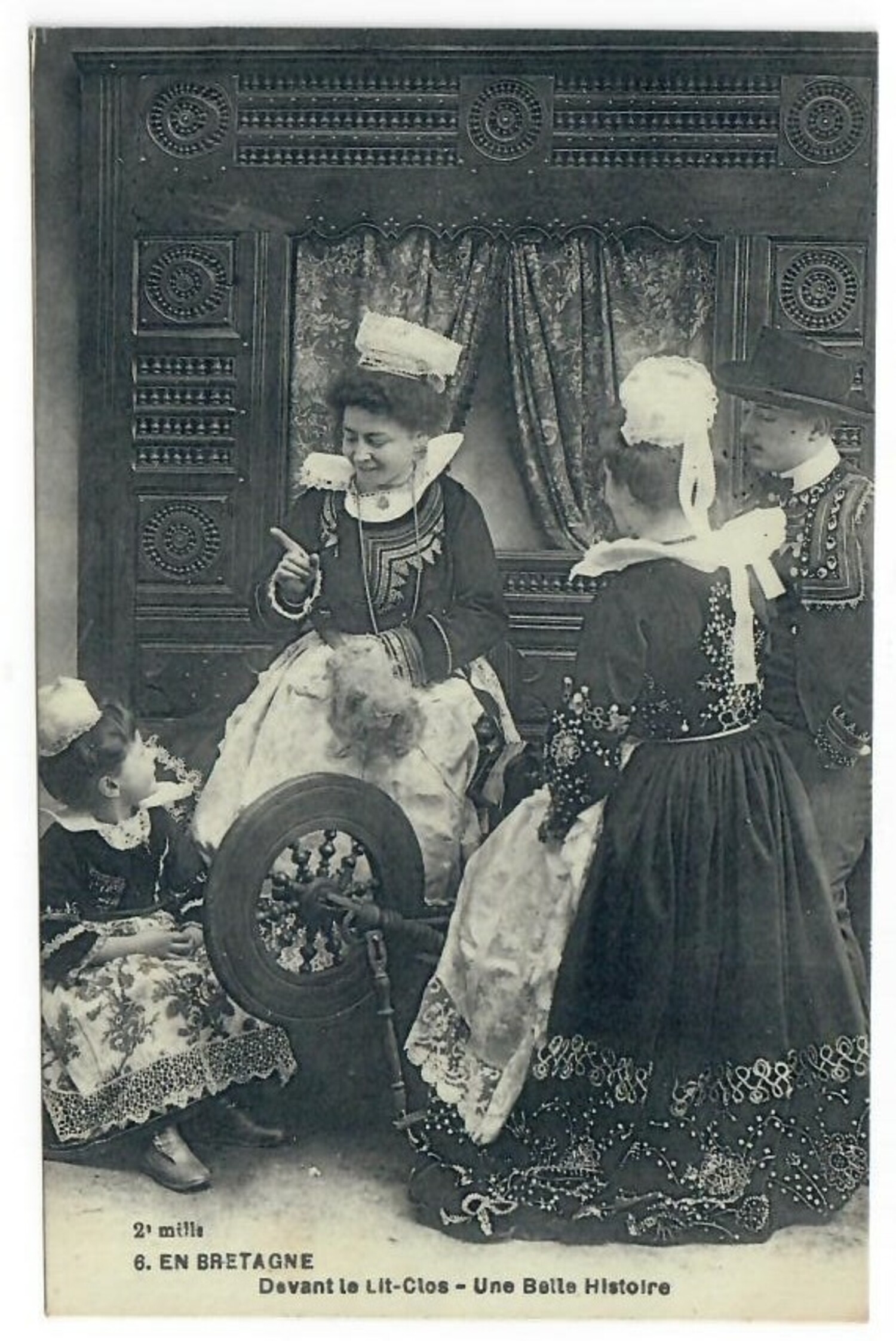 Postcard from France, early 20th century, depicting two women, a girl and a man wearing local dress. One of the women is seated next to a spinning wheel. There is a text on the front that states: "2 mille 6. EN BRETAGNE Devant le Lit-Clos - une Belle Histoire" (TRC 2020.4247).But there are some other stories behind many of these postcards. For example, many of the men, and especially the women, are depicted in local or regional dress and there are often details about the region they come from.
With respect to the German postcards, thanks to a donation of hundreds of German garments in 2016 by Mrs. Kircher, we have many of these regional outfits and so these postcards can be used to illustrate how the outfits were worn over a hundred yeards ago.
There is also a more poignant element to the postcards. Many of them have messages written on the reverse side of the cards and refer to people having holidays, separated from family and friends and missing them, and people simply wanting to keep in contact.
Some of the cards are dated to the summer of 1914, while others were posted a year later when life had changed forever due to World War One (1914-1918). We will probably never know who these people were or why they thought the receiver would appreciate a postcard with a spinning wheel.
All I can say is that we at the TRC appreciate the kind donation of these postcards, with their visual and written messages.
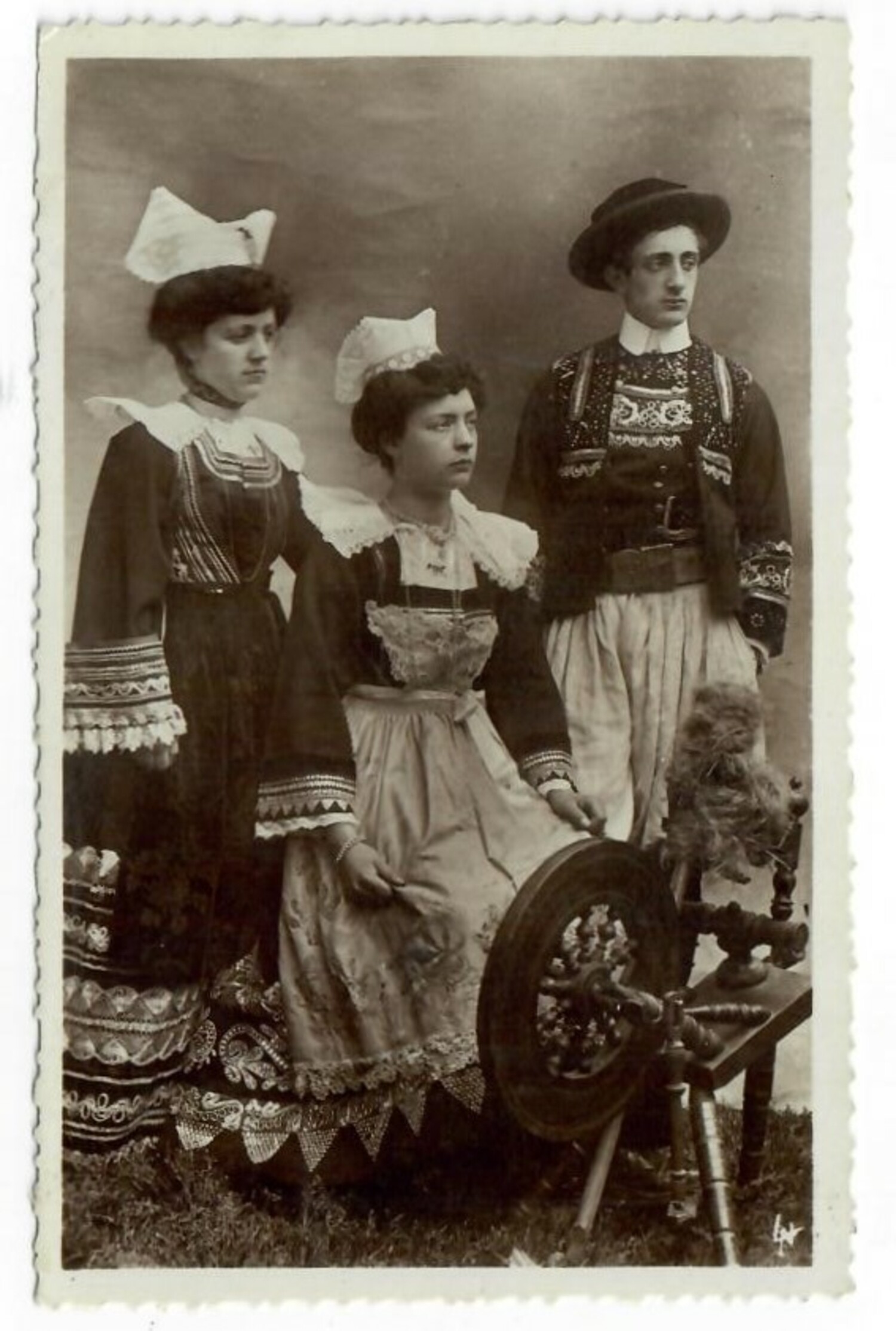 Postcard from early 20th century France, depicting two women and one man in local dress. One of the women is sitting in front of a horizontal spinning wheel. There is a text on the reverse that states: "3734 - Costumes de PONT-AVEN" (TRC 2020.4246).There are 160 postcards and three stereoscopic photographs in the donation and we will be putting them online in batches of about twenty each time over the next few months.
The donation was made under Code 501(c)(3) of USA law, which means that financial and object donations to a registered charity can be tax deductable for American tax payers. For more information, click here.
Gillian Vogelsang, 22 October 2020.