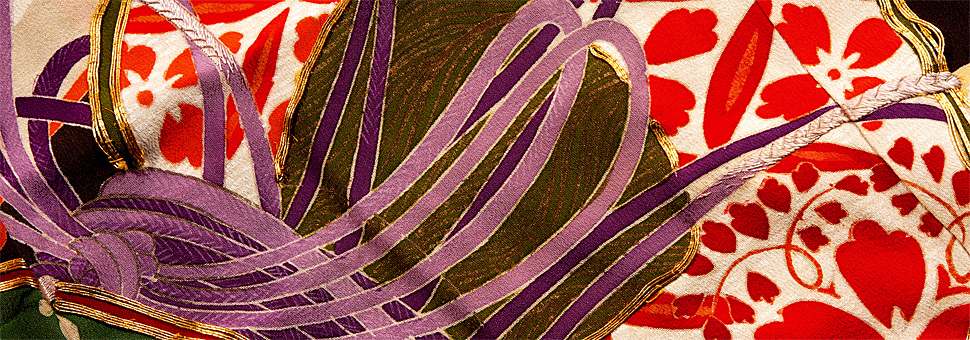


 Model wearing a festive Ma'an dress from WIdad Kawar collection, with striped atlas material. She is also wearing the characteristic Ma'an headdress (arge). Photograph by Fatima Abbadi - Mignon Group.During the last few months, the TRC published two blogs about some spectacular forms of traditional dress from Jordan. These blogs were written by Fatima Abbadi, from Capelle aan den IJssel, near Rotterdam in the Netherlands.
Here we publish another blog by her hand, about traditional dress from the town of Ma' an, south of Amman. The TRC is fortunate to have a traditional coat from Ma' an (TRC 2005.0076).
Ma’an is a city some 220 km south of Amman, the capital of Jordan, along the road to the Gulf of Aqaba. During the Ottoman period it flourished as an important market and halting place for merchants and pilgrims heading to the holy cities during the period of the Hajj. Its strategic location was emphasised by the construction of the Hijaz railway, between Constantinople and Mecca.
For centuries, pilgrim caravans passed through Ma' an. They came from different countries and regions, such as Central Asia, Iran, Turkey, Syria, Palestine. Along with them came large numbers of traders and artisans, such as coppersmiths, silver smiths and weapon smiths.
During the stay of the pilgrims and others in Ma'an it was the best opportunity for all of them to buy or exchange various goods, such as silk and cotton fabrics that came from Syria, swords and daggers from India, carpets from Iran, or even products that came from Europe. This made the city of Ma’an a vibrant market place with all sorts of goods that originated from different parts of the world.
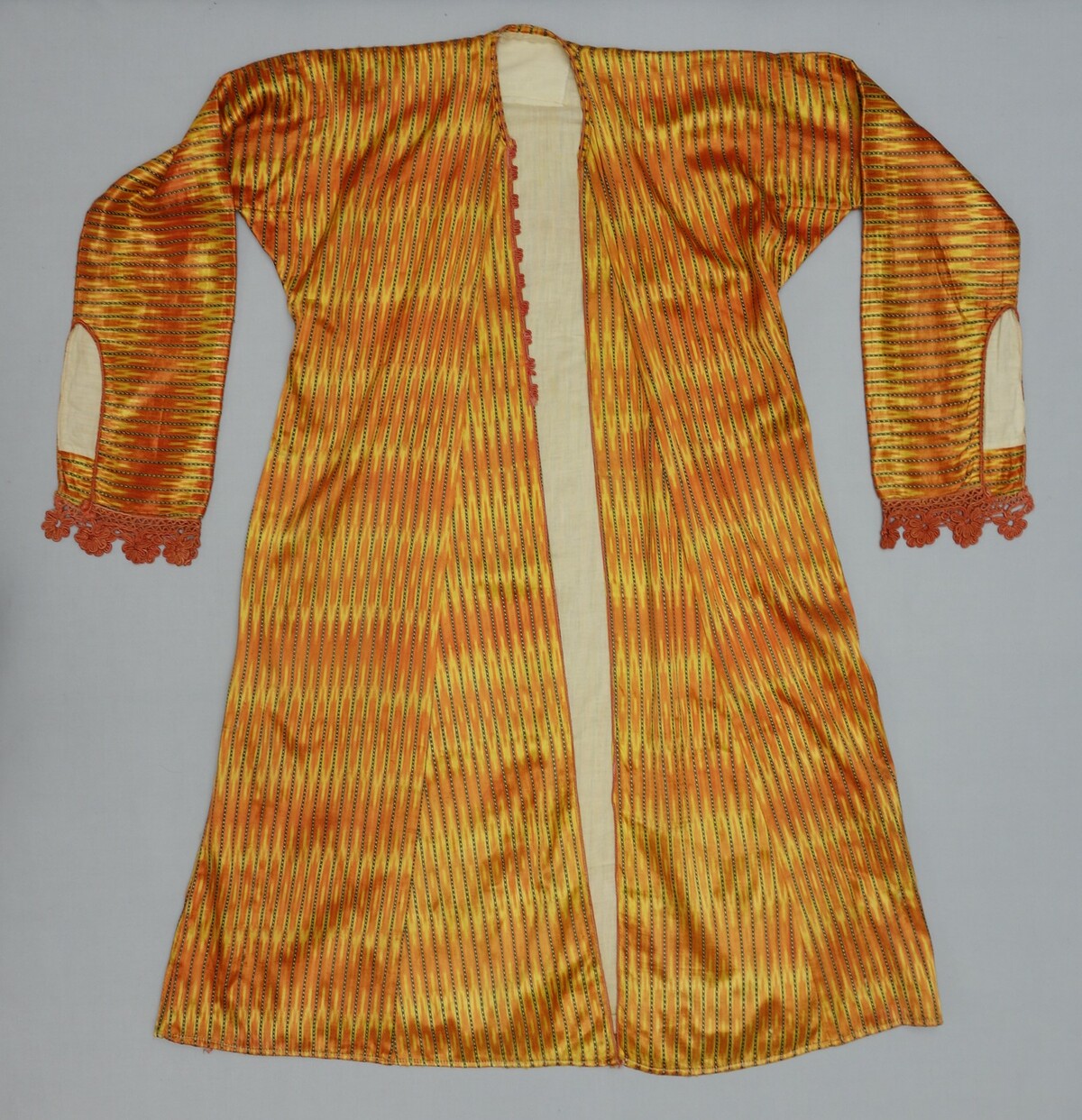 Long woman's coat of ikat dyed silk, Ma' an, 1920's (TRC 2005.0076).Local women of Ma’an were attracted by the abundance of different types and colours of fabric offered by the rich market. This, in my view, contributed to developing some of the most beautiful Jordanian dresses and coats. The rich silk fabrics and their style reflect the prosperity that the city and the local women enjoyed in full.
Ma’an women had two festive dresses , thoub harir and thoub hermez. They have in common the same large cut, minimum embroidery and two pointed sleeves of different sizes. The reason for the different sleeve size is that the women used the longer sleeve to pull it over their head as a head cover. The daily outfit of young women used to be made of green and red atlas (satin) fabric, usually imported from Syria, with the same festive dress cut but with sleeves much smaller.
Ma'an women also wore long coats over the dresses, with the dress sleeves hanging out of the coat sleeves. The example in the TRC collection (TRC 2005.0076), which was made and worn in the 1920's, is made from Syrian silk atlas material with a striped ikat design.
Ma’an brides wore a beautiful headdress called arge, which was a gift from their bridegroom on her wedding day. It consisted of a rectangular headband with abundant gold and silver coins, beads and tassels, and with amulets inserted into it, making it appear like a beautiful crown.
Although Ma’an dresses came with little embroidery, women enjoyed embroidering their cushions with finest silk thread, using couch stitching and laid work. Both styles of embroidery have probably been influenced by pilgrims from Central Asia. The embroidery patterns were zig-zag and star shapes, enclosed X-shapes, multi-colour abstract designs.
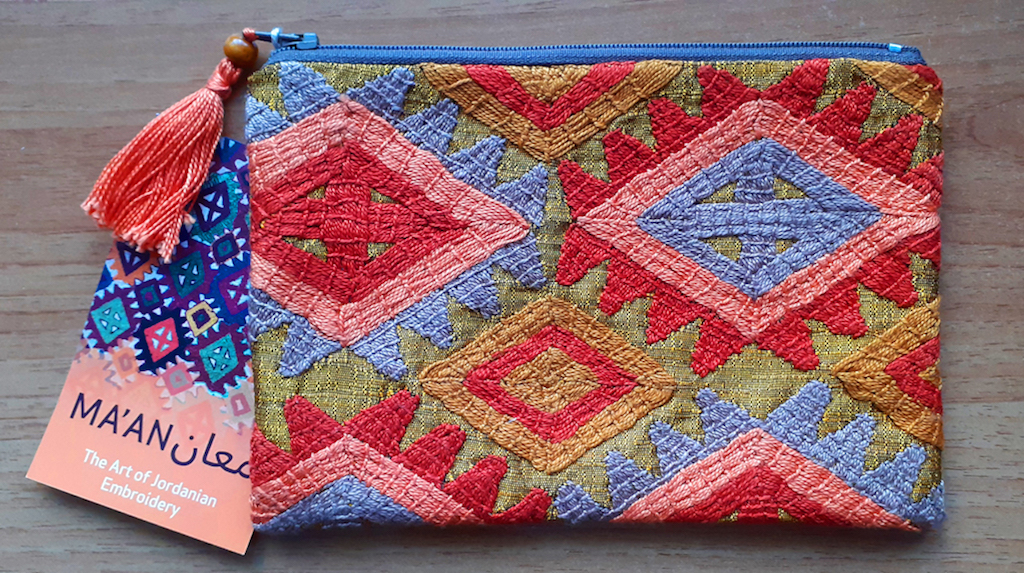 Sample of Ma'an local women's work produced by the Jordan Craft Centre in collaboration with the Tiraz Centre.Nowadays this rich traditional custom has been completely abandoned and even lost, confined to museum exhibits. If you visit Ma’an today, no traces of this colourful dress can be found or even of the vibrant Ma’an market. This is due to the demise of the Hijaz railway, economical changes and the advance of modernisation and globalisation that bought to the local market different types of dress styles and fabrics.
Thankfully, the Jordan Craft Centre and Tiraz Centre, both in Amman, have been training for several years local women on how to learn and reproduce Ma’an embroidery motifs on bags and cushions with the intent to support them locally. At the same time it can become a way to preserve, talk and pass down this heritage to the future generations.
Fatima Abbadi, 3 October 2020.