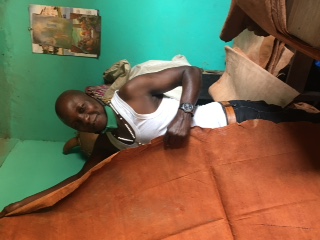
 Large sheet of bark cloth, for sale in Kampala, early 2021 (photograph Caroline Stone).It has been suggested that bark cloth may be the oldest textile in the world, pre-dating the invention of weaving. A number of cultures have made bark cloth, especially in Austronesia, and the earliest example is from South China, c. 6000 B.C. Others made use of bark in related ways. The Ainu, for example, split the bark of the Manchurian elm to make a thread that could be woven and in Russia birch bark has been used for centuries as a writing material, for shoes, bags and all kinds of containers - but not as a textile.
In Uganda, bark cloth - olubugo - seems to have originated around the 14th c. with the Baganda people of the kingdom of Buganda in the south of the country and according to oral tradition was originally reserved for royalty and for certain ritual purposes. Indeed, the mallets used for beating the cloth formed part of the royal regalia. Important examples of olubugo at the Kasubi Royal Tombs, a World Heritage site, were largely destroyed by fire in 2010.
In the course of time, it gradually came to be more widely adopted and in the 17th c. it was made compulsory for farmers to produce bark cloth, which was exported to the surrounding countries, including what is now Tanzania, in exchange for Ivory, salt, copper and tobacco. Thus, until the importing of cotton cloth by Arab and European traders in the 19th c., bark cloth was the principal textile available. Most households would have trees from which the cloth could be made - generally mutuba (Ficus natalensis) and a man would not have been considered marriageable unless he could provide bark cloth for his bride.
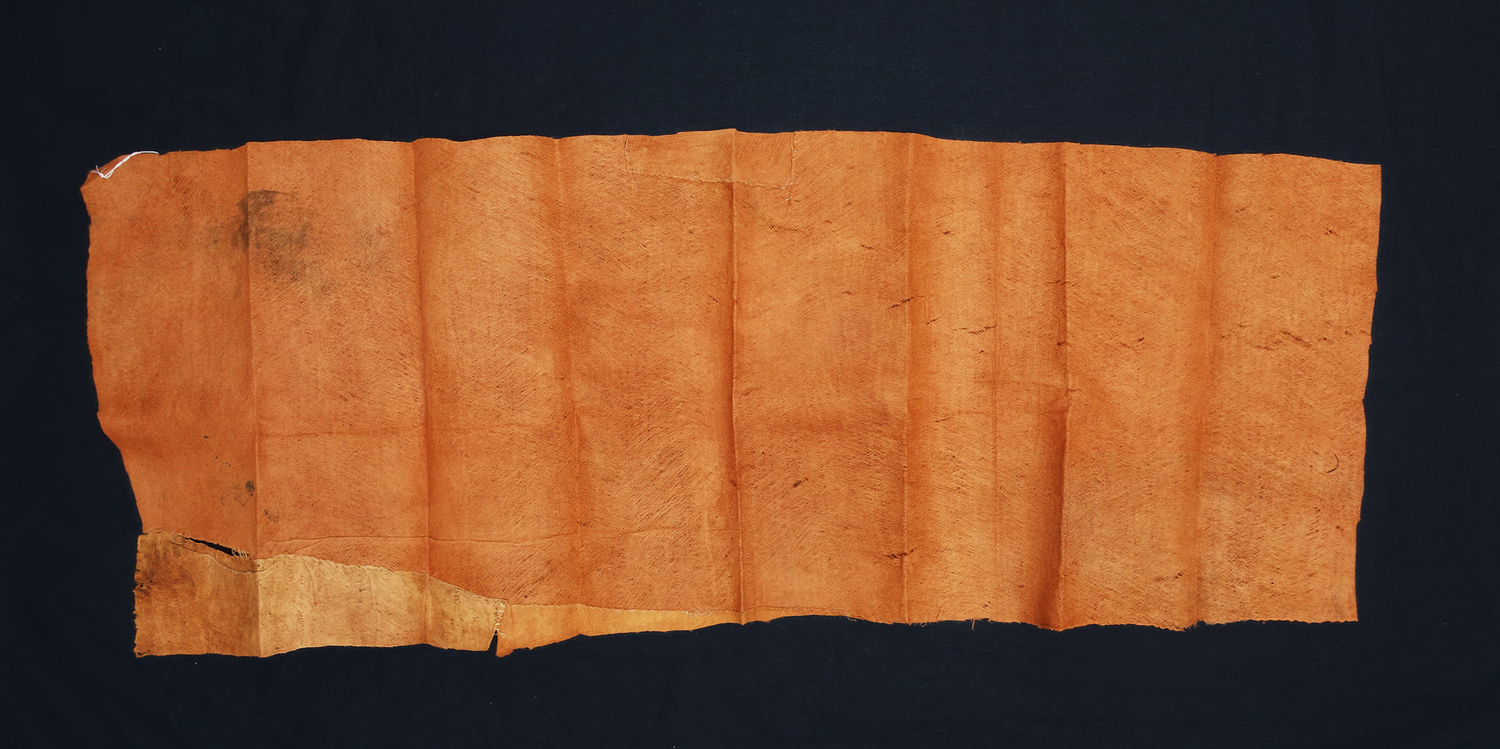 Large sheet of bark cloth (130 x 49 cm) from Uganda, now in the TRC collection (TRC 2021.0960).Bark cloth, although much less common today, still has great ritual and cultural significance in Uganda and is on the list of the "Intangible Cultural Heritage of Humanity" (2008). The standard bark cloth is a reddish brown, but cream-coloured or cloth dyed black was produced for royalty and for ceremonial purposes.
The bark is peeled from the trees during the rainy season and the area of the trunk that has been stripped is often 'bandaged' with banana leaves to promote healing. If the trees are well cared for, the bark can be harvested annually, unlike Portuguese cork, which takes some nine years to regenerate. After the outer bark is scraped away with a knife, the inner strips are soaked in boiling water to soften them. Various weights of mallet, some grooved, are used to beat the bark thin and stretch it into a large sheet. The cloth is sometimes decorated with simple geometric wood block prints dipped in a natural earth dye, usually a darker brown. The design may be similarly added using a stencil.
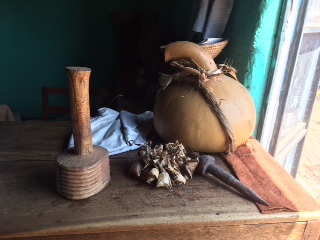 Various objects, including a mallet, related to the bark cloth industry, Uganda, early 2021 (photograph Caroline Stone).Today, an important use for bark cloth is for shrouds, since the material is not only sacred, symbolising the ancestral spirits, but believed to have mummifying properties. Shops selling it and other objects, such as gourds, which have ritual purposes, are often close to coffin-makers. The cloth is also worn on ceremonial occasions, either like a toga over one shoulder and, for women, secured with a sash, or fastened round the waist, like a sarong.
Naturally, the locals prefer pieces that are as perfect as possible, without tears or mends, but foreigners tend to like the ones with 'darns' (usually white) and patches, slightly reminiscent of Japanese boro. In recent years, there have been efforts to find new uses for bark cloth to appeal to the tourist market and so it can be found made into hats, bags, purses and other small items, sometimes decorated with a little crude western-style embroidery.
Caroline Stone (Cambridge), Kampala, 8 March 2021 (published 8 April 2021)