




A few days ago the TRC in Leiden published a blog about pins and pin heads that were found in Zeeland, the Netherlands, and date to before 1532, and were recently given to the TRC. The donation also includes several hooks and eyes and I would now like to put these unprepossessing items under the Dino-Lite microscope.
 Two metal hooks from Zeeland, before 1532. Magnification: 15.2. Dino-Lite microscope (TRC 2021.2739a and b).
There are various forms of hooks and eyes present, but basically the hooks (TRC 2021.2739a-l) are made by using a length of wire with loops at each end, which was then folded in half, probably with pliers of some kind, into a long U-shape leaving the two loops next to each other at the top. The lower half of the U-shape was folded back on itself to create a hook.
 Two eyes with twisted ends, Zeeland, before 1532. Magnification 16.8 (TRC 2021.2741e-f).
The eyes were made in three different ways, with (A) a wire circle with the ends twisted back on themselves (TRC 2021.2741c-f) and (B) a length of wire bent into a U-shape with small loops at each end (TRC 2021.2740a-e). A third type (C) is a combination of the two (TRC 2021.2741a-b). In addition to the hooks and eyes, the donation included several metal circles (TRC 2021.2744a-e), which may have been used as eyelets.
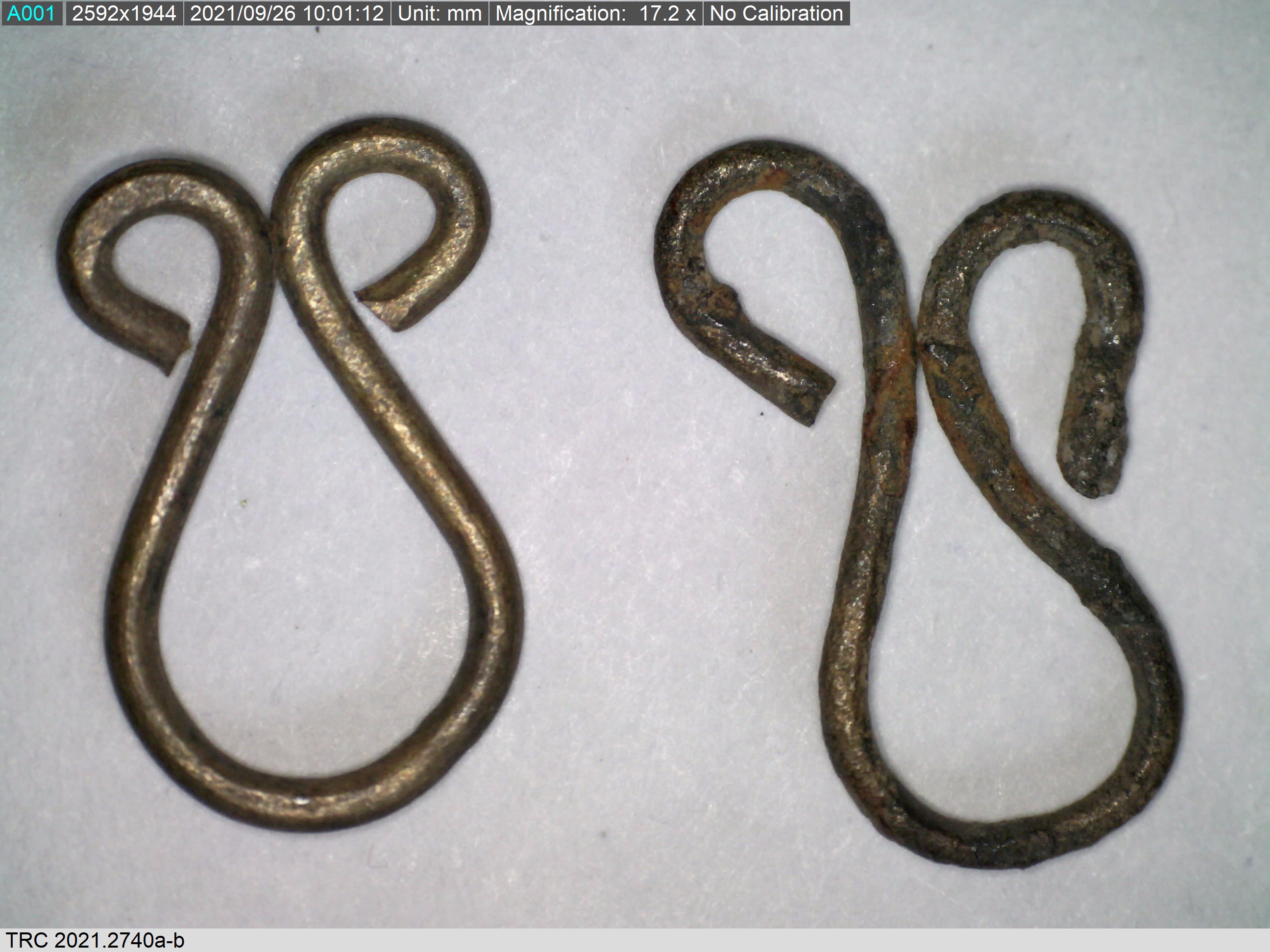 Two eyes with simple loops at the ends, Zeeland, before 1532. Magnification: 17.2 (TRC 2021.2740a-b).
These findings inevitably lead to the question when exactly did hooks and eyes develop as a form of fastener for garments? A quick online search suggests that some believe that they are an American invention dating from the 19th century. However, if you dig a little bit deeper then it soon becomes clear the history of hooks and eyes is much older and can be traced back to the produce of artisans in medieval Europe.
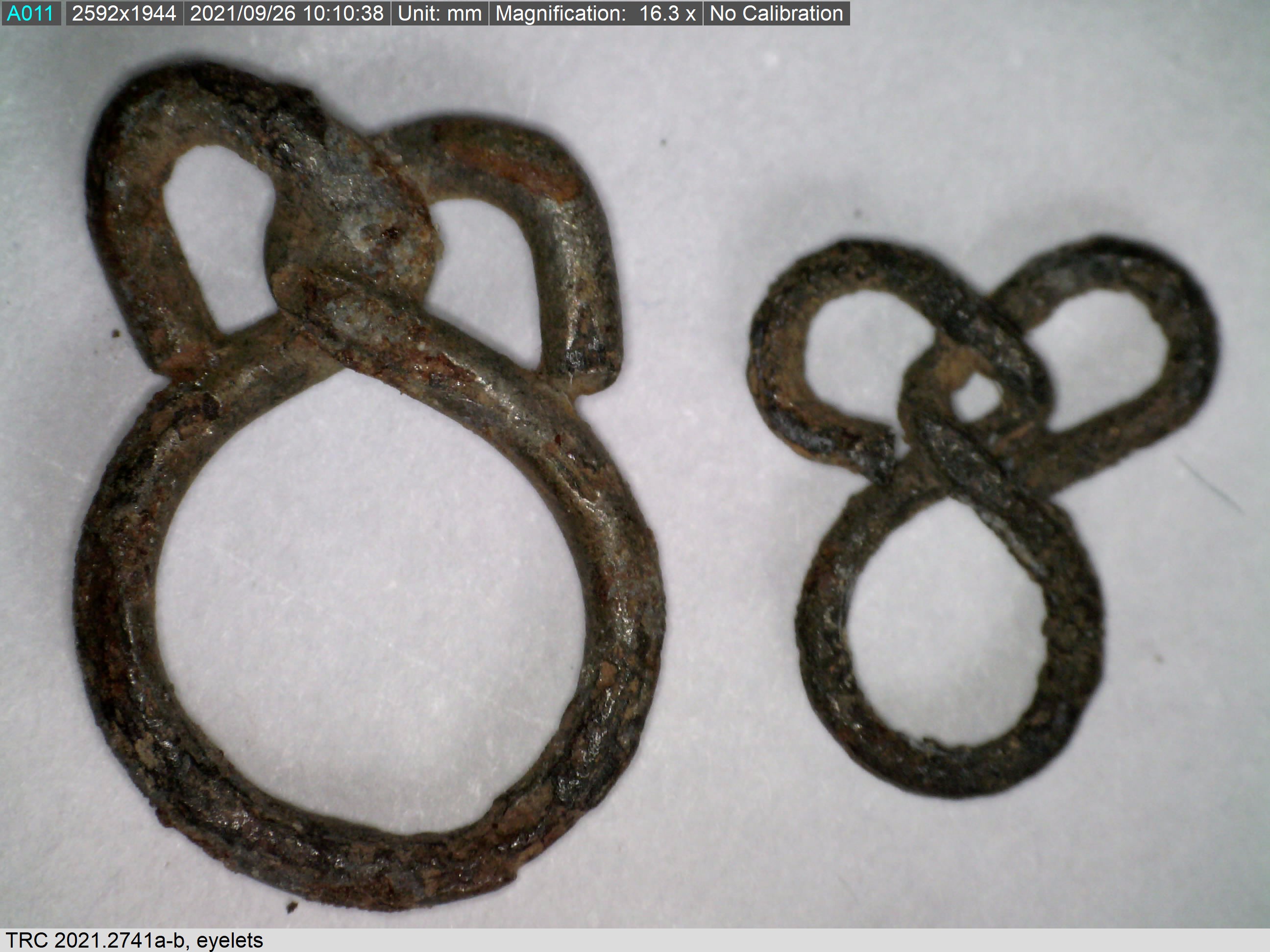 Two eyes with twisted and looped ends, Zeeland, before 1532. Magnification: 16.3 (TRC 2021.2741a-b).
In the Dictionary of Fashion History, for example, Valerie Cumming, Cecil W. Cunnington and Phillis E. Cunnington (2010:105) indicate that there is a 14th century written reference to a form of 'hooks and eyes' in England that were known as crochets and loops. Furthermore, by the early 16th century, according to various sources, hooks and eyes were made and used in various parts of Europe.
In an earlier book by Cecil and Phillis Cunnington, called The History of Underwear (1992:20), there is a reference to a painting by the Flemish artist Pieter Brueghel the Elder (c. 1525-1569) called The Old Shepherd, which is dated to about 1567. The portrait is of an old man who is wearing a linen shirt that is open at the collar to reveal two hooks and corresponding eyes.
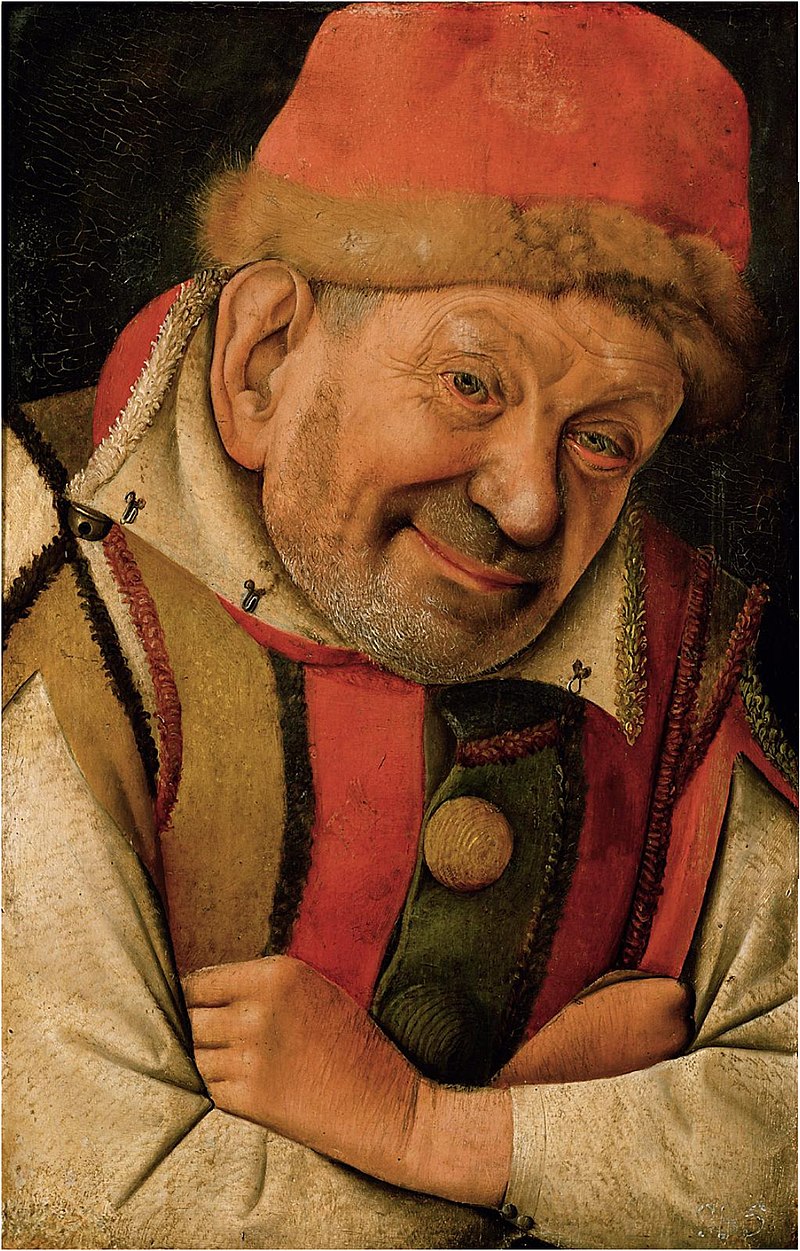 Jean Fouquet, Portrait of the Ferrara Court Jester Gonella, c. 1445. Kunsthistorisches Museum, Vienna. Public domain.
However, it would appear that the painting is not by Brueghel, but by the French painter, Jean Fouquet (c. 1420-1481), who worked for various royal and noble courts in Italy. It would seem that the portrait depicts Pietro Gonnella (c. 1390-1441), who was a jester at the court of the House of Este in Ferrara, in northern Italy. The portrait is now in the Kunsthistorisches Museum, Vienna and has been dated to c. 1445. As Gonnella died in 1441, it is not clear if the date should be a little earlier, or the portrait was made shortly after his death.
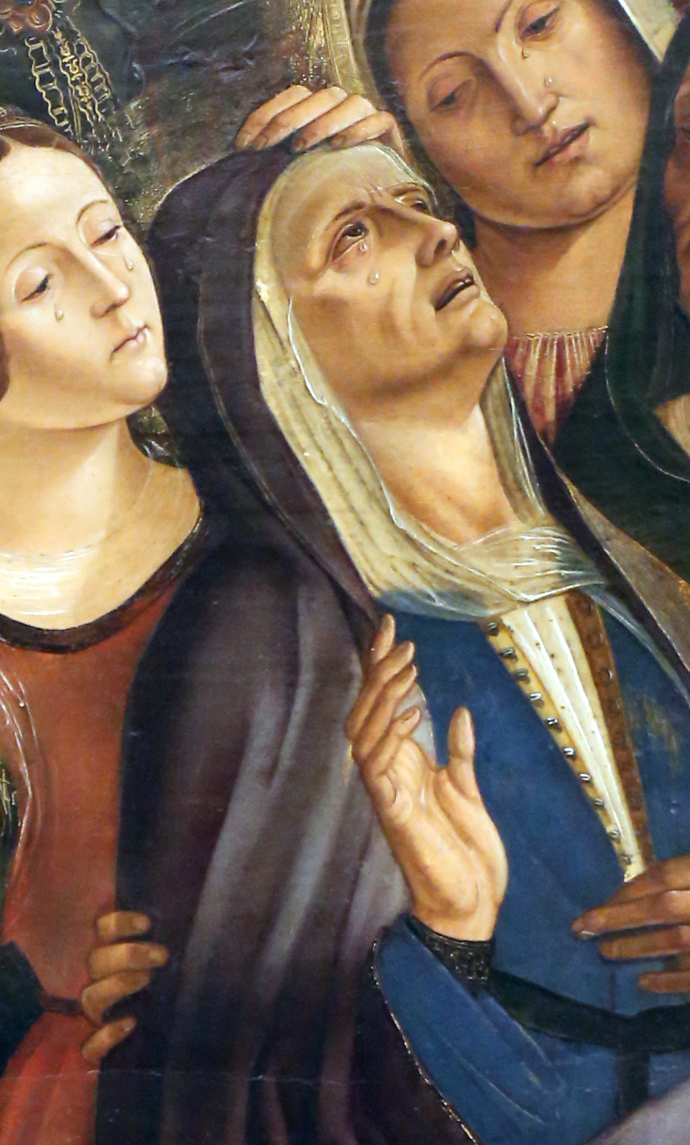 Crucifixion, by Francesco Bianchi, c. 1490-95. Palazzo dei Musei (Modena). Public domain.
Hooks and eyes are also depicted in a painting by the Italian artist Franceso Bianchi (1447-1510) of the Crucifixion. The painting dates to 1490-1495. The Virgin Mary has fainted at the foot of the cross and her bodice is partially undone, as a symbol of distress and mourning. This artistic device has allowed Bianchi to show a line of hooks and eyes on the inside of her garment.
What is clear from these two paintings is that the use of metal hooks, with either eyes or loops, can be dated to at least the mid-15th century and that their form is very similar to those found in Zeeland that date to before 1532, so about a hundred years later. It was not until the mid- to late 18th century that mechanically made hooks and eyes became available in Europe and took over the artisan role of the hook and eye maker.
Gillian Vogelsang-Eastwood, 26 September 2021.




,_1490-95_ca._04_girolamo.jpg)