Turkey is famous for the production of oya, which is a form of lace that is often found on the edges of women’s headscarves. Oya has been produced in Turkey for at least 400 years and is probably much older. Its production and use (with a variety of different names) can be found throughout the eastern Mediterranean and indeed all over the former Ottoman Empire.
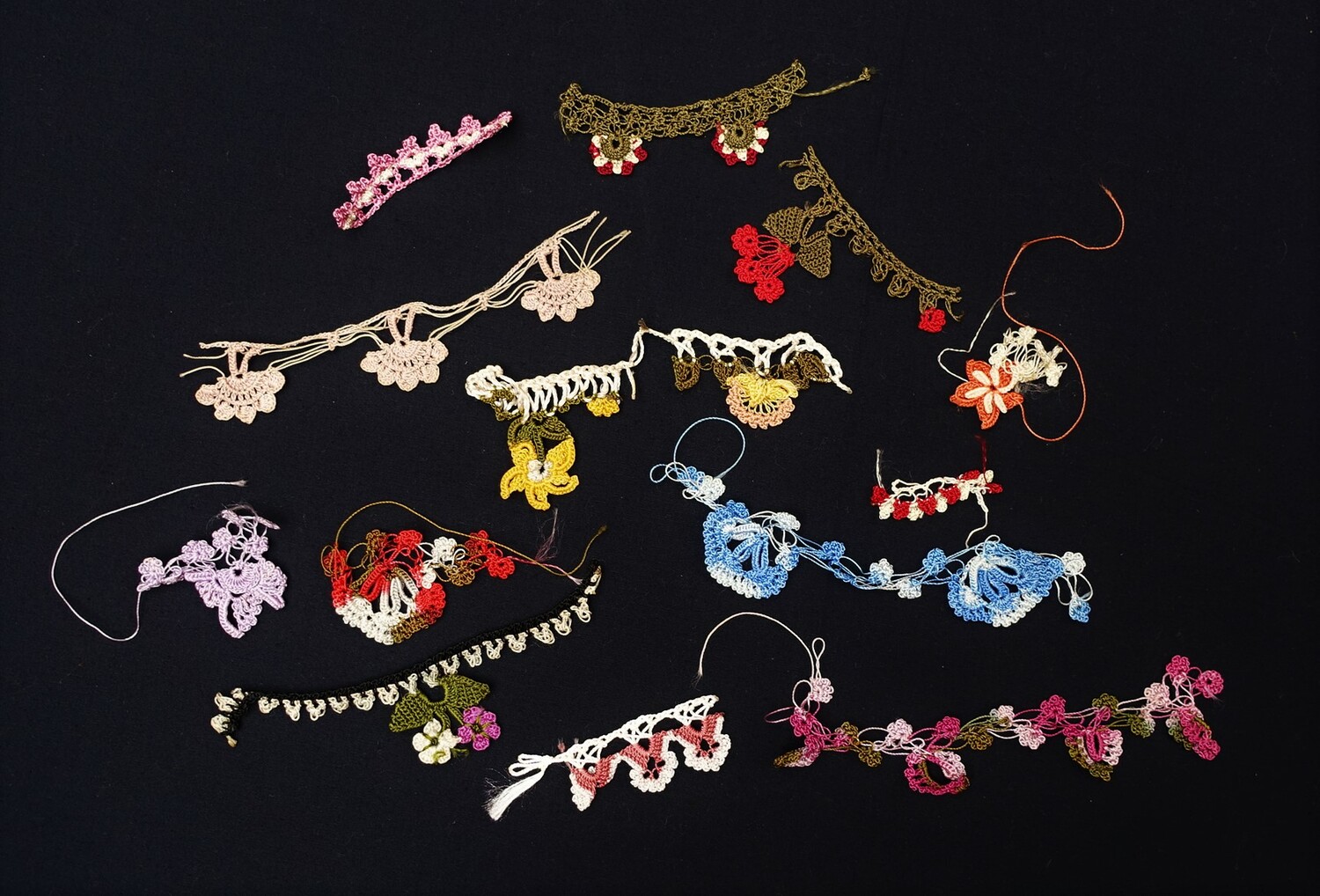 An oya-maker's library, showing a selection of oya edgings that she could make, for customers to choose from. Turkey, 2008/2009 (TRC 2009.0291).
Nowadays, there are four basic types of oya, namely needlelace, crochet, hairpin lace and tatted forms. The most widely used technique and indeed the most versatile is needlelace, which requires the use of long, fine needles and produces both 2-and 3-dimensional forms.
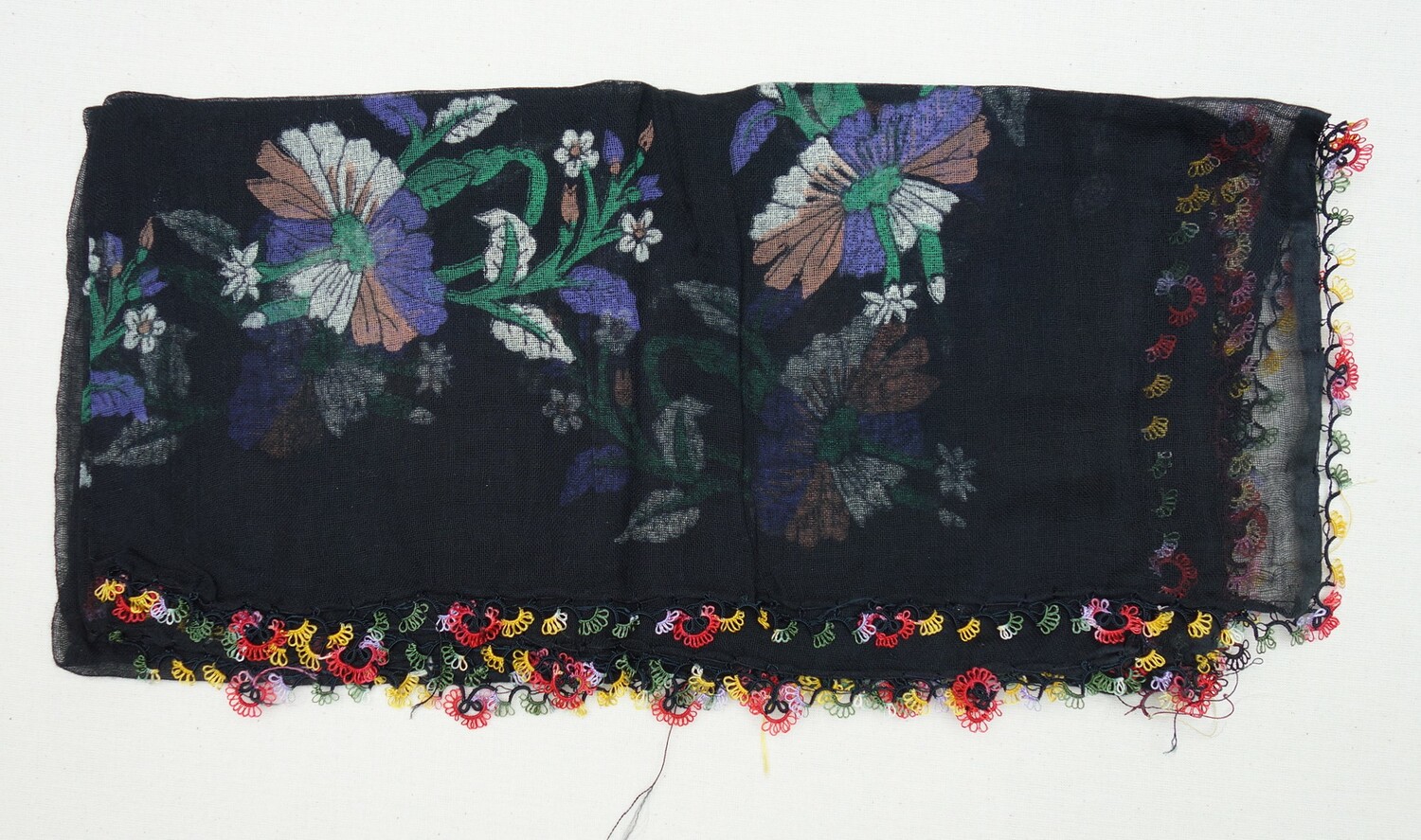 Headscarf with oya edging. Turkey, 1999 (TRC 2000.0084).Different oya motifs are worn at different times, daily, at weddings, for mourning, and at other moments in a woman’s life. These moments are often marked by subtle variations of oya, but to those who can read the messages, they tell of happiness, sadness, or basically the feeling of just getting on with life and its myriad of small events.
The older forms of oya were made out of silk or cotton yarn, while modern forms are generally made from synthetic threads that keep the objects' shape and colour and can be manipulated into a wide variety of forms. Popular motifs include flowers (especially carnations, daisies and tulips), butterflies and birds, as well as shapes such as scalloping, geometric motifs (especially rectangles and squares) and even more abstract forms. Sometimes small glass beads, both seed and bugle forms, are used to give added depth and colour to the various designs.
 Oya decoration for a headscarf, needlelace. Turkey, early 20th century (TRC 2002.0047).Some of the oya edges are made by women for personal and family uses, others are made by professional oya makers, who often live in villages and then come into their local towns and cities to sell their hand crafted products.
Oya and Leiden
In 2009/2010 the TRC Leiden presented a small exhibition about oya and in preparation was able to acquire a wide range of oya lace and related items, which tell the story of oya production from the basic materials and tools to the end product. They include needles, tatting shuttles, crochet hooks, hairpin frames, a range of synthetic yarns especially made for oya in a variety of colours, as well as ‘naked’ headscarves without oya borders, half-made forms and finished examples. The latter part of the TRC’s oya collection includes a variety of headscarves in different materials and decorated with printed designs mostly of flowers, but all with a wide range of oya edgings.
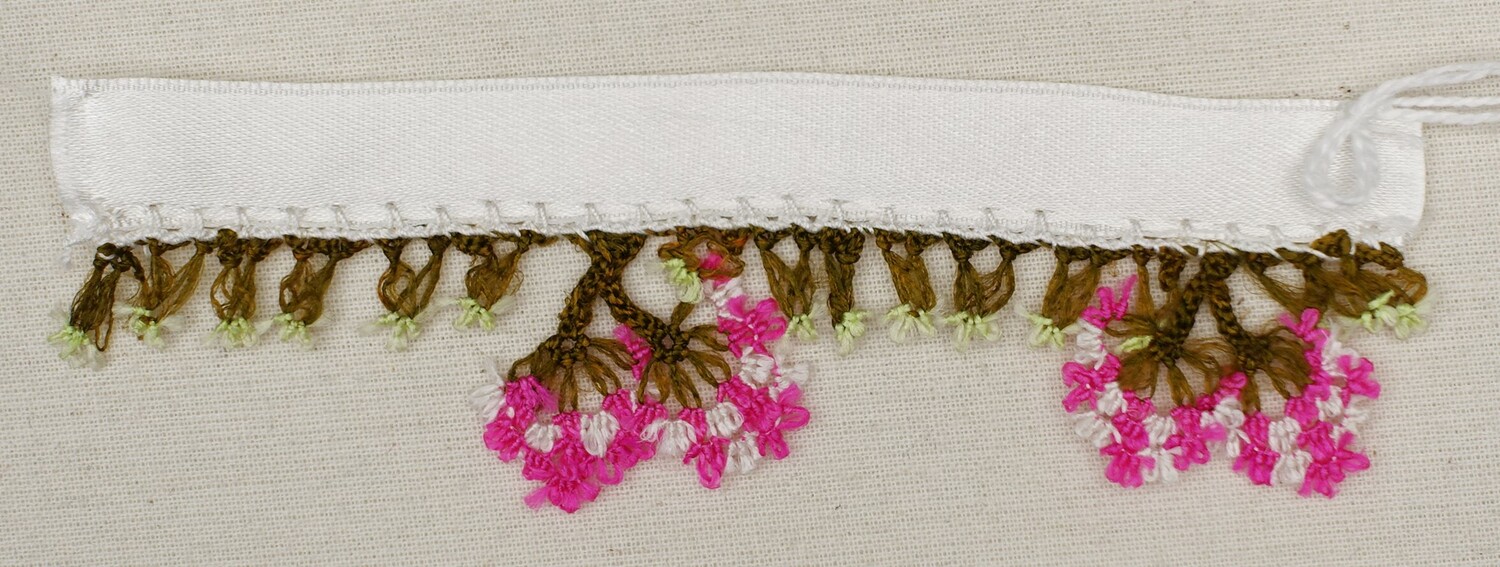 Sample of oya edging, needlelace, Turkey, early 21st century (TRC 2022.0066).An important part of the TRC collection are the more than seventy small samples of different oya edgings (which form part of the much larger TRC oya collection). Some of these samples represent the repertoire of a particular oya maker at a specific moment, others were especially made for the TRC. They display the basic forms of oya that were popular in c. 2009, and include many techniques, shapes, colours and uses. But over the centuries a much wider diversity of designs and patterns has been made and used that reflect the cultural heritage, skills and creativity of the oya makers.
 Sample of oya edging, crochet work, Turkey, early 21st century (TRC 2022.0053).Not surprisingly, the Stichting Güney (a Turkish organisation here in Leiden) and the TRC Leiden would like to build up this collection of oya forms and motifs, with details about who made them, how they were made, why, and their symbolism. This will help form a comprehensive ‘library’ that reflects this important, but often undervalued aspect of the creative lives of Turkish women.
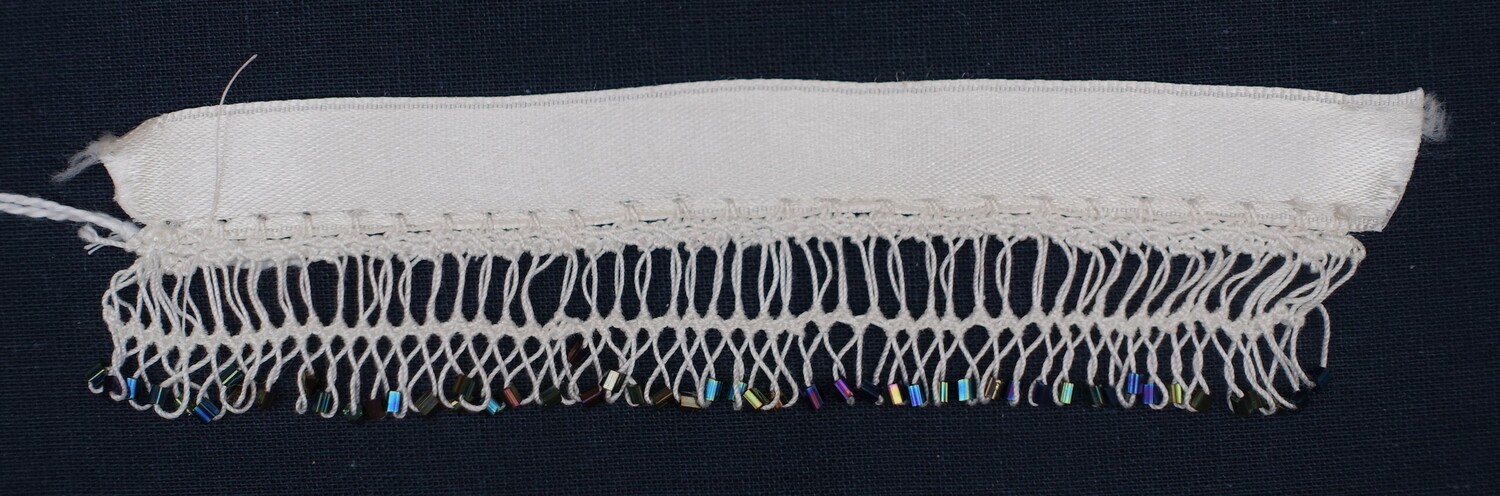 Sample of oya edging, hairpin lace, Turkey, early 21st century (TRC 2022.0062).In addition, the TRC Leiden and the Stichting Güney are currently preparing a digital exhibition about oya that will reflect the history, diversity and appeal of oya. This will come online later this year. If you have examples of oya you would like to donate to the TRC, please let us know at This email address is being protected from spambots. You need JavaScript enabled to view it. or via Emine Güney at This email address is being protected from spambots. You need JavaScript enabled to view it..
We are also working together to organise a series of oya workshops that will take place at the TRC as part of the TRC artisan centre. More details about these will be made available shortly.
Gillian Vogelsang, Director TRC, 22 January 2022